



New Relic has released its 2026 Observability Forecast for Financial Services, highlighting a gap between AI adoption and monitoring across the industry. The report draws on responses from 278 financial services IT and engineering leaders and practitioners, as part of a global study of 2,575 respondents.
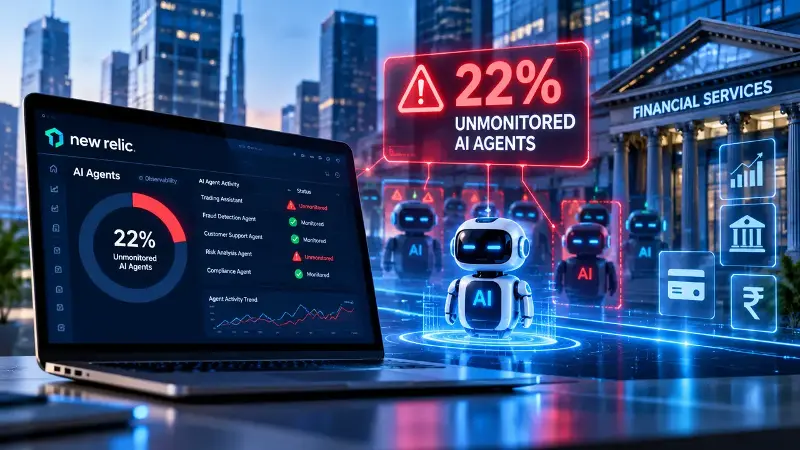
The report finds that 22% of financial services companies have deployed AI agents in production without monitoring them. This leaves nearly one in five companies with live agents without visibility into their actions, raising concerns around reliability, security and compliance.
New Relic calls the resulting problem “phantom velocity”: productivity gains from AI that are offset by downtime and emergency fixes caused by the same systems.
AI monitoring remains a governance gap
Security, governance, risk and compliance remain the leading drivers of observability adoption in financial services. AI applications rank second, followed closely by agentic AI systems.
Yet current monitoring adoption trails the global average. According to the report, 42% of financial services companies monitor AI applications, compared with 47% globally. For agentic systems, adoption stands at 38%, against 44% worldwide.
The outlook is improving. With planned deployments over the next 12 months included, AI application monitoring in financial services is projected to reach 83%, ahead of the global projection of 80%. Agentic AI monitoring is expected to reach 75%, close to the global forecast of 77%.
The report also finds that 78% of financial services leaders agree that AI-generated code makes reliable observability more critical.
For a sector managing sensitive financial information and regulated operations, the gap matters. An unmonitored agent that moves money or changes system configurations can create risks that remain unseen until an incident or compliance review exposes them.
Financial services detects and resolves outages faster
Despite its AI monitoring gaps, financial services performs better than the cross-industry average on several operational measures.
-
Incident detection: 35 minutes, compared with 41 minutes globally.
-
Incident resolution: 49 minutes, compared with 54 minutes globally.
-
Frequent high-impact outages: 30% of financial services organisations experience them weekly or more often, against 36% across industries.
-
Outage cost: An average of USD 1.69 million per hour, compared with USD 1.85 million globally.
The sector also reports higher adoption of key automation practices. Some 70% use continuous integration and continuous delivery (CI/CD), while 51% use automated incident response.
These figures point to established operational discipline, but they also highlight why AI monitoring needs attention as deployments expand.
Compliance leads, but AI is catching up
Financial institutions continue to prioritise observability to meet security, governance, risk and compliance requirements. This differs from the global findings, where AI applications are the leading driver of observability demand.
Nic Benders, Chief Technical Strategist at New Relic, said, “In a highly regulated industry like financial services, innovation cannot outpace governance.”
He added that institutions need to close visibility gaps and monitor AI agents before deployment to avoid unseen compliance failures.
Closing the visibility gap
The report presents a mixed picture. Financial services organisations detect and resolve outages faster than the broader market, yet some are deploying AI agents without monitoring their activity.
As AI applications and autonomous agents become more common, institutions will need to extend established observability practices to these systems. Monitoring must cover not only whether applications are running but also how AI agents behave and what actions they take.
For financial services firms, the challenge is to maintain operational discipline while scaling AI. The projected rise in monitoring adoption is encouraging, but closing the gap between deployment and visibility will be essential to reduce avoidable outages and governance risks.
Read More:
Beyond product sales: The next big growth opportunity for IT channel partners in India
From Migration to Managed Services: The Channel’s Next Growth Play
Cybersecurity partners: Why the shift from transaction to transformation is accelerating
AI is changing the rules for IT partners: Here’s what needs to change