



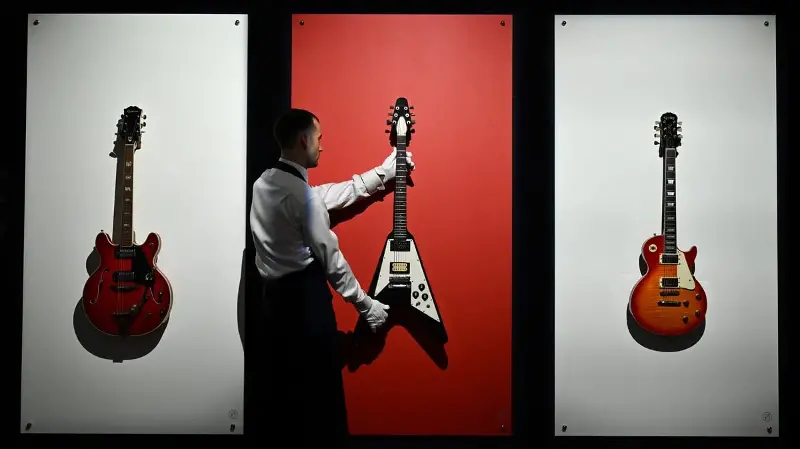
At a Christie’s sale in New York the other evening, there was wild applause. An electric guitar had just sold for $14.5m (£10.8m), a new world record. You read that right, an electric guitar. Not an antique, guitar-equivalent of a Stradivarius violin, but an ordinary, modern Fender Stratocaster.
It was not simply any run-of-the-mill instrument but one that was played by David Gilmour of Pink Floyd on the band’s classics, Shine on You Crazy Diamond, Comfortably Numb and Money. Nor was it a sale of one guitar. Two, in addition to Gilmour’s “Black Strat”, achieved record prices. In all, the entire sale of instruments and memorabilia with iconic associations in music and literature raised a whopping $94.5m.
As traditional sources of profit and security are proving increasingly volatile and uncertain, it’s clear speculators are turning increasingly to other types of investment. While shares are exposed to the ebb and flow of domestic and international politics, vulnerable to the moves and whims of Donald Trump, Sir Keir Starmer and Rachel Reeves, collectibles are relatively immune and equally, if not more, profitable.
It’s clear speculators are turning increasingly to other types of investment
Not so long ago, I was at an arts fund-raising dinner where the top auction lots were a guitar played by Pete Townshend on a US tour of The Who and a drummer boy jacket worn on stage by Mick Jagger. They both went for £25,000 to the same purchaser who said she was buying them for her sons. Whichever boy acquired the guitar did very well. Because today that instrument must be worth multiples of what she paid.
Look at the Gilmour guitar. It was part of the sprawling collection amassed by the late Jim Irsay. The former owner of the Indianapolis Colts American football team, Irsay was a renowned, inveterate collector of paraphernalia. The four-day sale of music and pop culture at the Rockefeller Center smashed numerous records.
The preceding exhibition drew thousands of fans and, said Christie’s, a portion of the proceeds will go to philanthropic causes supported by Irsay.
Accompanying Gilmour’s guitar was Jerry Garcia’s custom-built “Tiger” which fetched $11.6m and Kurt Cobain’s Fender Mustang, as used in the Smells Like Teen Spirit video, at $6.9m.
They became the three most valuable guitars ever. In total, the sale set 28 world records, with individual sales fetching four times the lowest estimates. There were frequent outbreaks of clapping, amid often frantic competition, with Christie’s staff taking online and phone bids. The atmosphere was more reminiscent of a sale of great works of art than electric guitars.
“Each instrument represents a defining voice in modern music, and together they transformed the auction into a landmark moment for the market,” said Christie’s.
Gilmour’s guitar went under the hammer in 20 crazy minutes. “This was a week the market will long remember,” said Julien Pradels, president of Christie’s America. “The palpable excitement and sustained applause in the saleroom, combined with the record-setting results, are a tribute to a great collector and a testament to the enduring resonance of our shared cultural icons.”
Gilmour’s guitar went under the hammer in 20 crazy minutes
But it wasn’t only guitars. Irsay devoted a large slice of his fortune to purchasing objects that touched him, that he felt helped characterise the soul of America. For 28 years, he scoured the US and elsewhere for souvenirs and “memories”.
So, Jack Kerouac’s original scroll manuscript for On the Road set a world record at $12.1m; Bob Dylan’s handwritten lyrics for The Times They Are a-Changin’ sold for $2.5m; while Hunter S Thompson’s 1973 Chevrolet Caprice classic convertible, known as the “Red Shark” by the Fear and Loathing in Las Vegas writer, sold for $254,000. Not only Americana: John Lennon’s Broadwood upright piano broke another record, for a Beatles souvenir, of $3.2m.
Pradels was not wrong when he said the Irsay sale would last in the memory. It went down as not simply another high-end auction of used stuff that once belonged to interesting folks, but as a defining event. One that showed guitars and other items with provable connections to lasting celebrity and genius have joined the likes of wine, watches and antiques as recognised alternative asset classes, coveted by investors worldwide, not only for their sentimentality and emotional pull but for their money-making potential.
The rewards can be dramatic. Gilmour’s Fender was bought by Irsay from the musician in 2019 for nearly $4m. Barely seven years later, its worth has increased more than threefold.
Barely seven years later, its worth has increased more than threefold
Watching the auction with interest in the UK was Patrick Racz. He is co-owner of Regent Sounds, the world-famous guitar shop, in London’s Denmark Street. Racz is looking to net upwards of £1.5m from the forthcoming sale on the Reverb online auction platform of the favourite guitar of another rock legend.
It’s the Gibson ES-5 regularly deployed by Aaron “T-Bone” Walker during his long, stellar career. “He is widely acclaimed to be the inventor of the electric blues and if you look at his disciples, they are the greatest guitarists of all time,” Racz says. “Jimi Hendrix playing the guitar behind his head, Chuck Berry’s famous duck walk; that all came from T-Bone.”
Guitars fetching what many people may consider mad prices is not new — Gilmour’s sale for charity of his collection in 2019, which included the Black Strat, has been described as a “real watershed moment” by Christie’s specialist head of private and iconic collections, Amelia Walker. But the Irsay sale has pushed it to another level.
What no one foresaw was the steep rise in prices since the Gilmour auction
What no one foresaw was the steep rise in prices since the Gilmour auction — probably due to the shock of Covid-19 and a roller-coaster planet constantly buffeted by tariffs, energy, taxes shocks and climate change. In a scary world, people see them as offering security.
“I don’t think anyone anticipated that that [auction] record would be broken quite so swiftly when Kurt Cobain’s MTV Unplugged electric acoustic sold for $6 million. “These records are tumbling. In terms of trajectory from 1999 it has been steadily upwards and while I don’t have a crystal ball, I don’t see it abating any time soon.”
What is whetting the appetites of collectors and profit-seekers are the collections gathered over the years by the artists themselves. Gilmour’s has been and gone, but aficionados are eagerly anticipating the day when those of veteran superstars such as Jimmy Page, Keith Richards and Bruce Springsteen become available.
Page, in particular, is known to be sitting on a vast portfolio. The 82-year-old Led Zeppelin guitarist was gifted a Fender Telecaster from fellow master, Jeff Beck, and also has a Gibson Sunburst Les Paul, which he attributes to creating the instantly-recognisable riff from Whole Lotta Love.
Richards, also 82, is known to possess the butterscotch blonde Fender “Micawber” Telecaster given to him by Eric Clapton, which produced those timeless tunes, Brown Sugar and Honky Tonk Woman. Again, when it comes up for sale there will be colossal interest in the 1950s Fender Esquire with a Telecaster body, which Springsteen, now 76, is holding on the cover of his 1975 Born to Run and 2012’s Wrecking Ball albums.
Racz says that if anything, guitars with illustrious histories represent even greater surefire bets than some other investible objects. “Is there a guitar being built now that is going to be as famous as any of these storied guitars? Probably not, and as time goes by, the rarer and more scarce they become. Ownership of these iconic guitars is like holding a tangible artefact from the history of music. You don’t get that from a Ferrari or a watch.”
The irony is that Irsay, who died last year, wasn’t set on earning a tidy buck when he bought his guitars — he already had funds aplenty. Larry Hall, former chairman and chief curator of the Jim Irsay Collection and a friend of Irsay, said he bought out of love. “Jim Irsay never did it because he thought of it as an investment so much as just sharing the joy. But I think anyone could see that, if looked at purely from an investment standpoint, [there was a] really strong return on that.”
Today, the words on Pink Floyd’s Money have never seemed more apposite: “Money, it’s a gas; Grab that cash with both hands and make a stash.”
© The Standard Ltd