



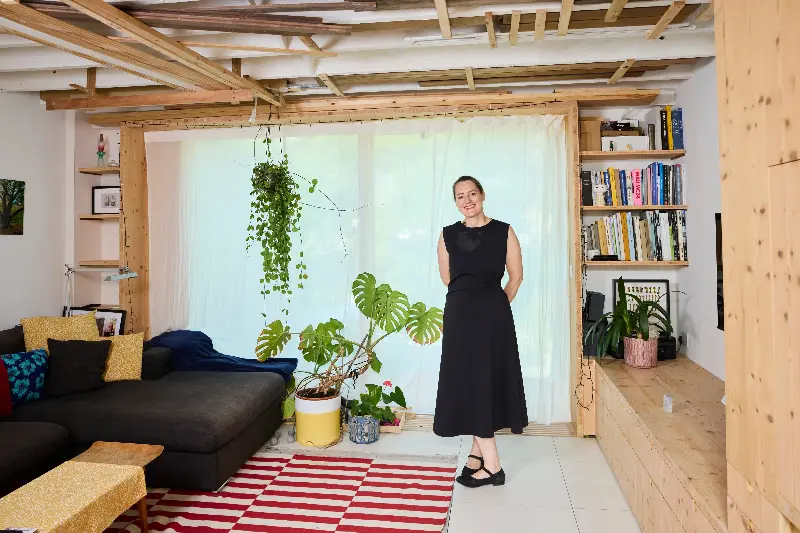
Thanks to our ageing housing stock, this summer Londoners have been sweating it out in rooms built for Georgian clerks, Victorian railway workers, Edwardian business tycoons, 1960s suburbanites and 1990s executives rather than hybrid workers facing down a climate apocalypse. With few cooling mechanisms adequate to beat the record-breaking temperatures, many of us experienced indoor temperatures of 34C or more, even in babies’ bedrooms.
Not Marion Baeli and Robert Prewett, however. Their 1960s-built home in south London, which they share with their two daughters, did not get above 26C even during the peak of the heatwave. “When friends walk into the house from the street they think we have air conditioning, the temperature differential is so high,” says Baeli.
This is thanks to an array of minor — and instantly replicable — measures, as well as major structural interventions. The couple, both architects who specialise in retrofits (updating older buildings, rather than demolishing and rebuilding them), have gradually transformed their home to cope with rising temperatures. As we enter the third heatwave of the year, it is time to follow their lead, investing in some long-term solutions to help our homes withstand the weather.
Baeli, who works for 10 Design, and Prewett, who runs Prewett Bizley Architects, bought the rundown property in Sydenham in July 2014. “In a way, for us, it was absolutely perfect because the condition justified the magnitude of work that we wanted to do,” says Baeli. “I think we would have felt less happy to have a heavy intervention in a house that was in a good state.” There was a sitting tenant, ideal to give the couple time to get planning approved, a contractor lined up and decide what they wanted to do first in a staged renovation, which they planned to continue as budget allowed.
Thermos tech
The week the tenant moved out the contractor moved in, starting work on the most disruptive jobs first while the family were still living elsewhere. The ground floor was insulated and tiled, a roof extension and triple glazing were added, and they replaced the leaky façade.
“Bob stayed in the house when the façade was off and said it was like camping in our bed behind nothing more than a polythene sheet, he could hear birdsong,” says Baeli.
They created a fully insulated and airtight “envelope” which gained them 15cm of floor space. That’s unusual in retrofit, where owners more often expect to lose space.
If all that insulation sounds hot, in fact it functions like a Thermos, retaining warmth in winter, but maintaining a cooler temperature in summer, provided rooms are not allowed to heat up in the first place.
“The secret is shading,” says Baeli. “I encourage everyone to look at the great work Shade the UK is doing on this. There are lots of tricks you can do. Internal curtains or blinds work, to an extent, but they are not sufficient in a heatwave, you need to stop the sun’s rays altogether.”
External shading for the windows is essential during heatwaves to prevent sunlight hitting, and heating, the glazing. Shutters or awnings are the southern European option here and would be attractive, but also expensive to install and permanent. In London we may only really need them a few weeks of the year. Instead Baeli has used low budget, semi-temporary external fabric “curtains”, which anyone can knock up for overnight relief during an unexpected hot spell.
“This is a step in the evolution of the house, a retrofit of our retrofit,” she says. “When we first designed the house 10 years ago we didn’t give as much thought as we should have to external shading.”
Comfort and aesthetics
You’ll need a breathable fabric that will let some air and light through — Baeli used a dust sheet — some eyelets and some bungees. These are then hooked to the corners of each window on sunny mornings. The eventual plan for the large glazed garden door is to put up a curtain track outside. This can be used in the summer, with the covering folded up and stored away for the rest of the year.
In the couple’s bedroom where there are two fixed windows they have to make do with internal shading but, says Baeli, “if you shade 50 per cent of your glazing it already makes a big difference. Do what you can.” You need a temperature difference of about 10 degrees to cool a home, advises Baeli, so as long as the heat decreases overnight, that is when you open the windows and purge the hot air.
Seeking moments of aesthetic interest as well as energy efficiency, the couple cut through the floors to create light wells, bringing daylight into the centre of the deep floor plan. There is one above the kitchen and one on the opposite side of the house above the stairs. These light wells need to be shaded, so currently Baeli climbs out on to a neighbour’s roof and slings white (to reflect the heat) sheets across them, but the investment option would be remote-controlled blinds.
Next on their heatwave-defying wish list are ceiling fans. “We all have pendant lights in the middle of our ceilings and you can now buy them with lights integrated so you don’t have to add an additional electric point. They are getting more widely available now from high-street retailers.”
The entire project is a process of combining aesthetics with function, efficiency and purpose in pursuit of comfort. “There’s thermal comfort but there is also the comfort of looking out over a nice view, so we have big sliding doors to connect the inside space with the garden,” she says.
“Obviously it was expensive to add the roof lights so we did a daylight analysis to justify it, and there is comfort in having well-lit spaces. It’s not about luxury. Most of our decisions are based on physics. We don’t put a price on comfort. When you sell your house the estate agent is not going to price in the fact your loft conversion overheats, but I think the price of comfort should be a key factor of the value of a property.”
© The Standard Ltd