



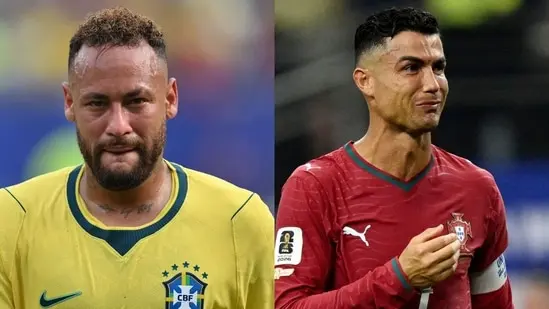
Yesterday, Neymar left crying. Today, Cristiano Ronaldo followed him into the same darkness.
Two nights, two icons, two exits that felt bigger than the scoreboard. One was the fallen prince of Brazil, the boy once asked to carry the soul of a football nation and return it to the throne. The other was the uncrowned World Cup king, the conqueror of clubs, records and generations, but not of the one tournament he wanted more than anything else. In the space of barely 24 hours, the World Cup did not just eliminate Brazil and Portugal. It seemed to close the emotional book on two of football’s most complicated modern legacies.
Neymar’s goodbye was the more final of the two. His tears after Brazil’s defeat to Norway were not merely the tears of a beaten footballer. They were the tears of a man who knew the argument had ended. For years, his Brazilian career had lived between beauty and burden. He was never allowed to be only Neymar. He had to be Pele’s heir, Ronaldinho’s successor, Ronaldo Nazario’s echo, the face of the sixth star, the man who would restore Brazil’s lost World Cup command.
That is an impossible inheritance, and yet Neymar came close enough to make the failure hurt. He gave Brazil moments of electricity, goals that lifted stadiums, touches that reminded the world why Brazilian football once felt like a language of its own. But he also gave them interruptions: injuries, suspensions, controversies, disappearances from decisive stages, and tournaments that seemed to break just when they were supposed to become his.
In 2014, injury removed him before Brazil’s humiliation against Germany. In 2018, his football was buried under scrutiny and ridicule. In 2022, Croatia turned another dream into penalty-shootout grief. In 2026, Norway became the final opponent in a story that had always promised coronation but ended in collapse. Neymar scored, Neymar cried, Neymar said it was over. The prince had not become king.
Ronaldo’s last missing crown stayed out of reach
Ronaldo’s exit hurt differently because his career has never been built on fragility. It has been built on resistance. He has spent nearly two decades fighting time, taste, tactics and doubt. Every time football tried to move away from him, he dragged himself back into the centre of the conversation. The body changed, the role changed, the leagues changed, the critics changed, but Ronaldo kept finding ways to remain relevant.
Yet the World Cup never gave itself to him.
That is the one strange emptiness in a career otherwise stuffed with proof. He won European titles, Champions Leagues, Ballon d’Ors, domestic leagues, golden boots and international glory with Portugal. He became the highest-profile symbol of a country’s football rise. Before him, Portugal were respected. With him, they became feared. He did not merely play for Portugal; he enlarged their ambition.
But the World Cup remained the missing jewel. And against Spain, in what carried all the emotional weight of a last chance, the old miracle did not arrive. Ronaldo played, Ronaldo waited, Ronaldo searched for the one moment that could bend another match to his will. Instead, Portugal faded, Spain struck late, and football produced one of its coldest images: the man who had spent his life outrunning limits finally being stopped by one.
That is why calling him the uncrowned king is not an insult. It is the most painful compliment. Ronaldo ruled almost everywhere else. He owned nights in Manchester, Madrid, Turin, Lisbon and beyond. He turned the Champions League into his personal kingdom. He made the Portugal shirt feel heavier and greater at the same time. But football’s biggest crown stayed elsewhere, and the absence will always sit beside the abundance.
Neymar and Ronaldo were never the same kind of genius. Neymar was born with looseness. His football was rhythm, mischief, instinct and sudden imagination. At his best, he played as if the pitch had more angles available to him than to everyone else. Ronaldo was something harder, sharper, more manufactured. His greatness came from repetition, hunger, punishment, and reinvention. Neymar looked like football’s joy before football wounded him. Ronaldo looked like ambition given human form.
Also Read: Cristiano Ronaldo breaks down in tears as final FIFA World Cup ends in heartbreak after Spain's late winner
Yet their exits now belong in the same frame because both stories speak to the same cruel truth: talent and greatness do not guarantee the ending they deserve.
Neymar’s tragedy is that he had the gift of a Brazilian immortal but not the World Cup chapter that would have protected him from debate. Ronaldo’s tragedy is that he had the career of a global giant but not the final trophy that would have completed his empire. One leaves with the ache of promise unfulfilled; the other with the ache of conquest unfinished.
The comparison also says something about Messi, even without making him the centre of the story. In 2022, Messi found the fairytale that football had denied him for years. The World Cup turned his wounds into gold. Neymar and Ronaldo did not get that healing. Their endings are jagged, unresolved, human. There is no perfect final image, no raised trophy, no argument-ending night. There are only tears, silence, and the brutal memory of what might have been.
That is what made these two days feel like the fall of an era. Neymar’s Brazil goodbye was the end of a romance that never fully became history. Ronaldo’s Portugal exit was the last turn of an obsession that never found its final reward. Between them, football lost two of its great emotional extremes: the artist who made the game feel playful even when his career was in pain, and the warrior who made greatness look like a daily act of defiance.
Yesterday, the fallen prince cried because Brazil’s dream had died with him.
Today, the uncrowned king walked away because time had finally answered back.
And in that cruel symmetry, the World Cup reminded everyone why it remains football’s greatest theatre. It does not care for reputation. It does not soften for legends. It gives some men their fairytale, denies others their crown, and leaves even the greatest to discover that immortality is never entirely in their hands.