




More than 2.36 million end-of-life vehicles (ELVs) remain active across Delhi-NCR, exposing the scale of the challenge in tackling vehicular pollution, even as nearly 94% of the 17.1 million vehicles registered in the region are two-wheelers and cars, the Commission for Air Quality Management (CAQM) has told the Supreme Court.
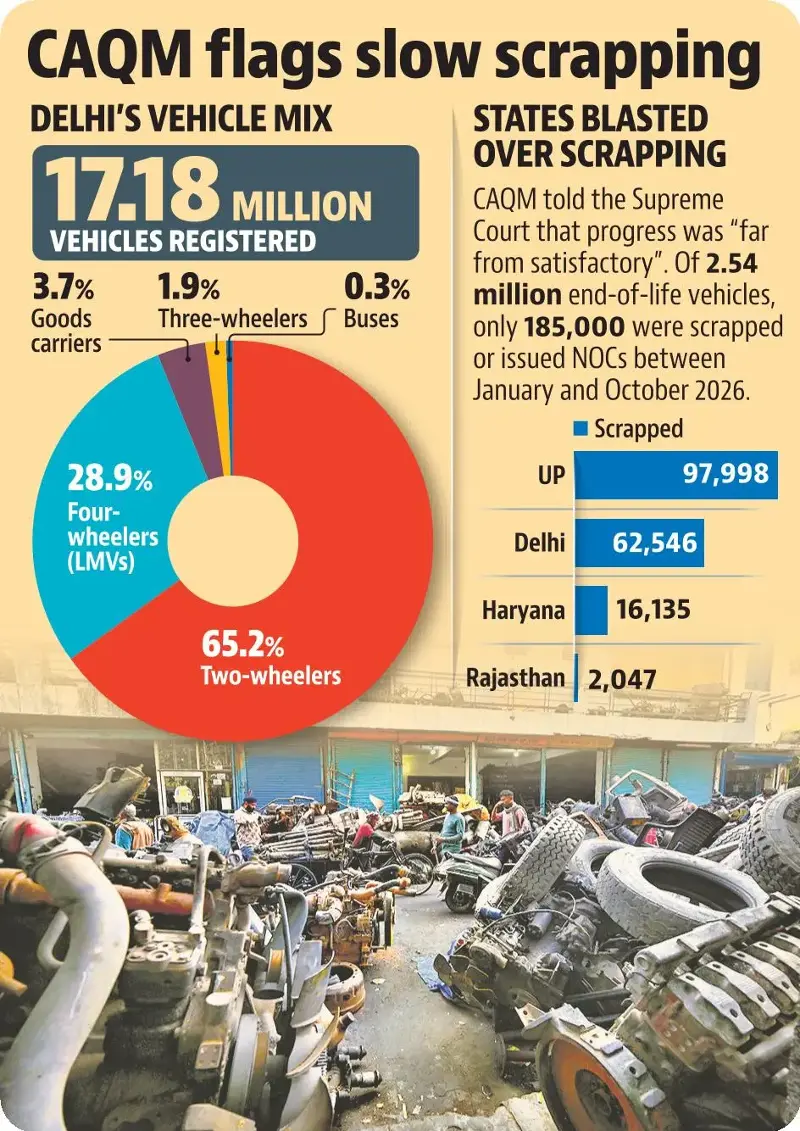
In its affidavit, the commission said that of the 2.54 million overaged vehicles reported across Delhi, Haryana, Uttar Pradesh, and Rajasthan, only 185,000 had been scrapped or issued no-objection certificates to move out of the region between January and October 2026, describing the progress made by the states as “far from satisfactory.”
In a status report filed in the court’s ongoing suo motu proceedings on vehicular emissions, the commission said two-wheelers account for 65.2% of the total vehicle population in Delhi-NCR, while four-wheeler light motor vehicles make up another 28.9%.
ALSO READ | Delhi falls short on key pollution control steps, fares better than other NCR states
The figures, based on data available on the VAHAN portal as on October 31, 2026, show the region has 11,205,160 two-wheelers and 4,959,087 light motor vehicles (LMVs) out of a total 17,176,234 registered vehicles. Three-wheelers account for 1.9%, buses 0.3%, and goods carriers 3.7%.
The commission, however, cautioned that the pollution potential of vehicles varies substantially according to their emission standards, with older vehicles emitting considerably higher quantities of pollutants than those conforming to Bharat Stage-VI, or BS-VI, norms.
Highlighting the problem posed by older vehicles, CAQM said BS-II emission standards came into force in April 2001, BS-III in April 2005 and BS-IV in April 2010.
The commission pointed out that BS-II standards came into force in April 2001, BS-III in April 2005, and BS-IV in April 2010. BS-VI standards were introduced in Delhi from April 2018 and the rest of NCR from April 2019. This means BS-III vehicles have been on the road for over 15 years, BS-II for over 20 years, and BS-I for over 24 years.
ALSO READ | Will allow only BS-VI vehicles in Delhi, says Supreme Court amid winter pollution crisis
The report provided a comparison showing older vehicles can emit several times more pollutants. Diesel LMVs and light commercial vehicles complying with BS-IV emit nitrogen oxides at 3.13 times the BS-VI level and particulate matter at 5.55 times. For BS-III vehicles, the corresponding emissions are 6.25 times and 11.11 times higher. Diesel vehicles conforming to BS-II emit NOx at 8.75 times and particulate matter at 17.77 times BS-VI levels, while BS-I vehicles emit 12.13 times more NOx and 31.11 times more particulate matter.
CAQM said the fitness of a vehicle should not be viewed independently of its emission potential, as even a vehicle that is otherwise fit would continue to emit pollutants in accordance with the standards under which it was manufactured. “Since Delhi-NCR faces an extraordinary situation, especially during winter due to poor dispersal of pollutants, there is a need to restrict plying of polluting vehicles based on emission standards,” the commission submitted.
Slow progress in scrapping
Delhi has 852,396 active end-of-life vehicles, of which only 62,546 were scrapped and another 7,230 issued NOCs to move out during 2026 till October. Haryana has 988,368 active ELVs, with 16,135 scrapped or issued NOCs. Uttar Pradesh reported 589,979, of which 97,998 were scrapped or moved out, while Rajasthan had 112,936, with only 2,047 accounted for.
The commission said the progress made by all four jurisdictions in dealing with end-of-life vehicles had been “far from satisfactory”.
Among the measures already undertaken, CAQM said it had directed that only CNG or electric auto-rickshaws be registered across the NCR from January 1, 2023, with a phased elimination of diesel auto-rickshaws. It has also mandated a phased transition towards electric three-wheelers, with new registrations of only electric L5-category three-wheelers to be permitted in Delhi from January 1, 2027.
ALSO READ | CPCB’s AQI method understates severity of Delhi’s worst pollution days
The commission has further directed that only CNG, electric or BS-VI diesel inter-city buses be allowed to enter Delhi from November 1, 2026, including buses operating under All India Tourist Permits and other service categories. Similarly, commercial goods vehicles other than BS-VI, CNG, LNG and electric vehicles have been barred from entering Delhi from November 1, 2026, subject to the applicable exemptions.
The report also highlighted the Delhi government’s Electric Vehicle Policy 2026, which provides for new registrations of only electric L5 three-wheelers from January 2027 and electric two-wheelers from April 1, 2028. It also envisages phased electrification targets for commercial fleet operators, logistics aggregators and private schools.
CAQM said the transition to electric mobility must be accompanied by adequate charging and battery-swapping infrastructure. As on October 31, Delhi had 683,251 electric vehicles and 14,913 charging stations or points. Uttar Pradesh had 347,587 electric vehicles and 565 charging points, Haryana 218,530 electric vehicles and 1,285 charging points, while Rajasthan had 44,987 electric vehicles and 22 charging points.
The commission has also recommended a series of long-term interventions, including a time-bound phase-out of polluting vehicles based on their emission potential, stronger pollution-under-control certification mechanisms and monitoring of on-road emissions through remote-sensing devices.
ALSO READ | The AQI paradox: Why the official count may be downplaying the pollution problem
Other recommendations include expanding metro and regional rail networks, developing multi-modal transport hubs connecting metro and the Regional Rapid Transit System, improving last-mile connectivity and expanding electric bus services.
It has also called for a wider network of EV charging and battery-swapping facilities, incentives for scrapping older vehicles, and permission for retrofitting existing vehicles to electric mode subject to certification by the Automotive Research Association of India or the International Centre for Automotive Technology.
On the enforcement front, CAQM has proposed technology-driven surveillance through automatic number plate recognition cameras, radio frequency identification systems, remote-sensing techniques and artificial intelligence-based monitoring.
A significant part of the commission’s recommendations concerns decongesting Delhi’s border entry points, where prolonged stoppages of vehicles contribute to pollution. It has recommended installation of barrier-free Multi-Lane Free Flow systems integrated with RFID and ANPR technology at all toll collection points.
The commission has suggested that if the system is not fully operationalised within the prescribed timeline, toll collection at nine identified toll plazas during the peak winter months of November to January should be restricted to vehicles liable to pay the Environment Compensation Charge (ECC), with other vehicles exempted until the system becomes operational.
It has also suggested rationalisation of toll and ECC rates, which it said have remained unchanged for a considerable period, to discourage commercial vehicles from using Delhi as a shortcut instead of the Eastern and Western Peripheral Expressways.
The CAQM report comes amid the Supreme Court’s continuing examination of measures to tackle vehicular pollution, with the bench of Chief Justice Surya Kant and justices Joymalya Bagchi and V Mohana recently signalling that it would consider allowing only BS-VI vehicles to ply in Delhi during the winter months.
The bench has also mooted a five-year plan to prevent commercial vehicles from entering the Capital, suggesting that warehouses be established at Delhi’s borders and essential commodities be brought into the city through battery-operated or other non-polluting vehicles.