



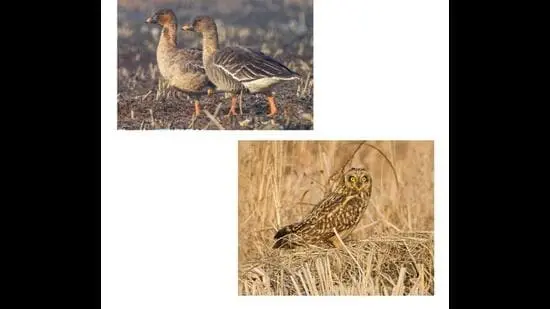
Kashmir’s winters have a new storyteller this season. After the snowfall, wings from distant places landed in the Valley. Among all the migratory birds, a first-time visitor--Tundra-bean-goose--has etched its name in the avian records of the Valley, meanwhile, some less sighted species have also registered their visit in greater numbers.
Bird enthusiasts have sighted Tundra-bean-goose documenting its presence for the first time in North Kashmir’s Wular Lake, while there are also sightings of short-eared owls, usually rarely sighted here, in good numbers in Hokersar, capital Srinagar’s biggest wetland. While Tundra-bean-goose is native to Siberia, short-eared owls are believed to have arrived from Belgium.
Officials and bird enthusiasts said that lakhs of birds have come to spend their time in the wetlands and lakes of Kashmir after travelling thousands of kilometers in tune with their annual migration from colder regions of the world.
Wular Lake, Asia’s second largest freshwater lake spread over two districts in north Kashmir, is hosting lakhs of water bird species this year.
Showkat Ahmed, zonal officer Baniyari of the Wular Conservation and Management Authority (WUCMA) and a bird-watching enthusiast, said that he saw a new species which was never reported to be sighted in Kashmir before this. “This year a new bird species Tundra-bean-goose was spotted in Wular lake. I sighted five such birds. They come all the way from Tundra, almost from the arctic region. They are totally new to Kashmir,” he said.
Showkat Ahmad said that he has also sighted White tailed eagle this year again. “A single White tailed eagle keeps coming to Kashmir. I believe it is a single bird and is hovering over other water bodies of the valley. The bird is a hunter and likes to sit around other birds to prey on them,” he said.
In 2024, Wular had witnessed the Great bittern (Botaurus stellaris) registering its first sighting in the Kashmir Valley. Owing to conservation efforts in the lake, the clean waters of the lake has been attracting some rare species, such as Falcated duck, Horned grebe, Western reef heron, Smew duck, Long-tailed Duck, Pacific Golden polover and the Broad-billed sandpiper.
Hokersar wetland,which attracts the highest number of migratory birds in Srinagar, is also teeming with birds of all kinds. “We have ample numbers of birds running in lakhs in Hokersar. They are flocking and will settle for food and perching before starting for the onward migration,” said Hokersar ranger officer Sajid Ahmad.
With its vast waterways, marshes and vegetation, the 13.54 sq km wetland, which is the second largest in the Kashmir Valley after the 16 km Shalbug wetland (with lesser water expanse) in Ganderbal, resembles a winter wonderland as flocks of migratory birds home in on it between October and April. Last winter, 13 lakh migratory birds had visited Hokersar.
Though the birds kept their promise to start arriving in early winter, the widespread snowfall intermittently since January 22 has prompted an exponential increase in the new arrivals owing to the increase in water levels in the wetlands and lakes.
The migratory birds visiting Kashmir travel from the colder areas of the world flying over continents in flocks from Europe, Siberia, Japan, China and Central Asia. The birds that arrive here every year are mallards, greylag geese, pochards, common tails, shovelers, pintails and gharwals.
Reyan Sofi, a Hokersar resident and avid bird watcher, said that he sighted a pretty large number of birds in Hokersar owing to a very good water level at the Ramsar site. “Since snowfall and after the other side of the Hokersar was restored, the bird presence was very good,” he said.
He said that some species which would be sparsely seen earlier were in good numbers this year.
“Short-eared owls have come in large numbers. They would very rarely be sighted here, usually in flight. But this year they have landed in a corner of Hokersar in good numbers. They usually come from Belgium,” Sofi said.
Every year, the birds arrive in eight protected wetlands managed by the wildlife department. Apart from Hokersar in Srinagar (13.5 sq km) and Shalbough in Ganderbal (16 sq km), the birds also visit Haigam in Sopore, Baramulla (9 sq km), Mirgund in Budgam, Chatlam in Pampore, Kranchoo, Manibugh, Freshkhoori and also in other 25 water bodies of the valley which harbor sizeable number of migratory birds during winter migration. Kashmir has around 400 water bodies including Dal Lake and Nigeen Lake in Srinagar.
Sajid Ahmad, the range officer, said that the birds travel along definite paths- Central Asian flyway zones to arrive here for feeding. “India is a feeding ground for these birds in winter and they will migrate back in March to Central Asia or other countries for breeding,” said Sajid Ahmad, the range officer.
The number of arrival of birds every year depends upon the weather conditions and water level in wetlands like 12- 13 lakh birds had visited last two winters, a figure higher than 11 lakhs in 2021-22. Before that the numbers had ranged around 8 to 10 lakhs.
A bird census is expected to be conducted by the end of this month.