



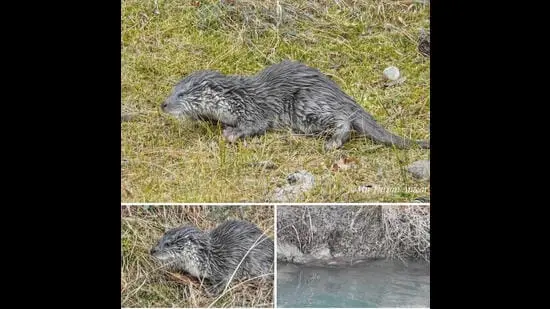
While the Line of Control (LoC) remains one of the most guarded boundaries in the world, a shy, sleek resident of the Himalayas is crossing it with ease. The Eurasian Otter, once thought to have vanished from the region, is staging a quiet comeback, with evidence suggesting it is using trans-boundary waterways to return to ancestral habitats in the Kashmir Valley.
Evidence from the Gurez Valley suggests that the Kishenganga river serves as a natural corridor for the species. Frequent sightings near Tarabal indicate that otters are swimming freely between villages in Pakistan-occupied Kashmir (PoK) and North Kashmir, crossing the frontier at Keran and Teetwal.
“The sightings in Gurez indicate that otters easily swim to PoK villages using the Kishenganga and return,” an official said. This movement suggests that the high-altitude, cold-water streams along the LoC, largely undisturbed by heavy civilian industrialisation, have become a vital sanctuary. Researchers are now looking for migration pathways to confirm if the current population is expanding from the PoK or Ladakh regions into the heart of the Valley.
Breakthrough in Sindh Nalla
The most significant confirmation of this revival came from the Sindh Nalla in Ganderbal. For the first time in nearly 50 years, the forest department has secured direct photographic evidence of the animal. Range officer Faizan Anwar Mir captured a clear image of a sub-adult otter at 10am in Gutlibagh, a rare face-to-face encounter with a species known for its nocturnal nature.
“Earlier camera-trap records in Kishenganga and Rambiara Nalla confirmed their presence, but this direct sighting in Sindh further extends their known range,” said chief conservator of forests, Irfan Rasool. He emphasised that the presence of a sub-adult is a strong indication of a breeding group nearby, suggesting the species is not just passing through, but potentially thriving.
Road to ecological recovery
Despite the excitement, environmentalists like filmmaker Jalal Jeelani argue that the LoC sightings are only one piece of the puzzle. While the otters are finding refuge in the remote, cleaner waters near the border, their former strongholds, such as Wular Lake, remain heavily impacted by pollution and encroachment.
“Over the years, steady water quality decline and chemical runoff from agriculture severely altered the lake’s ecology,” Jeelani said. He noted that a convincing sign of recovery will only be established when stable populations return to the Jhelum waters and wetlands like Hokersar.
For now, the cross-border otters of the Kishenganga and the rare sightings in Sindh Nalla serve as a biological litmus test: The species is resilient, but it requires clean water and healthy fish stocks to stay for good.
Perhaps, it will lead back to the time in Kashmir when the waters were so populated with otters that parents warned children against swimming in the rivers.