



MUMBAI: For a city like Mumbai whose contours twist and change with routine frequency, documenting its evolution can be daunting.
Researcher Divya Ravindranath, who works at the intersection of informal labour, gender and urban health, recognized that literature has already laid this groundwork—through the pre-Partition world of sex workers and migrants in the short stories of Saadat Hasan Manto, the chaotic, intrusive chawl life in Kiran Nagarkar’s Ravan and Eddie (1995), the murky opium-dazed Bombay of Jeet Thayil’s Narcopolis (2012), or the stimulating poetry addas in Jerry Pinto’s coming-of-age novel, The Education of Yuri (2022)—all sights and sounds once commonplace, but now waning from the city’s consciousness. Reading fiction set in Indian cities she was able to comprehend major demographic shifts, socio-cultural changes, and even the altering ecology of these places. To her, these books, through imagined realities, served as important record-keepers.
It prompted her to bring “fiction as a pedagogical tool into the classroom”. “We generally think of fiction only in literature classrooms, but it can be used in many different disciplines,” says Bengaluru-based Ravindranath. “For instance, if I want to talk about housing in Mumbai, I could discuss it through Amrita Mahale’s novel Milk Teeth, which explores the problems faced by residents of a rent-controlled apartment in Matunga in the late 1990s.”
Ravindranath’s classroom project got a new lease of life in September 2023, when Apoorva Saini, one of her students at the Indian Institute for Human Settlements, helped her set up Cities in Fiction, a public digital archive which serves as a database locating the literary landscape of India and South Asia. The ongoing project has since mapped out hundreds of fictional texts from the region, a majority of which—84 books—have emerged from Mumbai, serving as a resource pool for educators and learners. “It’s also for anyone keen to discover a new place or see a familiar city from a different lens,” says Saini, adding, “I haven’t grown up in Mumbai, but I know that even if I read any five random books about it, I will learn so much about its history.”
Saini and Ravindranath are not alone in redrawing how the city is explored and understood. There is a growing breed of researchers, historians and artists leading dynamic archival projects that are unravelling newer ways of interpreting Mumbai’s past and present.
A city of myths and stories
Over the last one year, researchers Arundhuti Dasgupta Singhal and Utkarsh Patel have been poring over old texts and gazettes, while scouring the city and its suburbs for any oral accounts about the origin story of Bombay.
Their work is an extension of The Mythology Project, a centre for the study of ancient stories and storytelling traditions, which they co-founded in 2021. Supported by Indian National Trust for Art and Cultural Heritage (Intach), the duo is now working on a book that will tell the history of the city through its myths and legends.
“When we think about the history of Bombay, we often get stuck at a point in the timeline when it was given off as dowry by the Portuguese to Britain [during the 1661 marriage alliance between King Charles II of England and Catherine of Braganza, the sister of the King of Portugal]. And everything then flows forward from there. But there was a place and a people before that,” says Singhal. Mythology, which Patel, says looks at a “time before time” isn’t bound by the rigid academic pursuits of objectivity and chronology.
For instance, local legend traces the region’s history to Ravana. He gave land on the Konkan coast to a band of musicians, who settled here, and played the fiddle he had created. The Dhola Agris, a subgroup of the Agri community, still believe they are descendants of Ravana’s musicians.
“These are living traditions which draw from memory and personal histories. As researchers, we know we are walking a tight rope, between what is myth and real, or even religious,” says Patel. But, for an exercise of this nature, one needs to work with an open mind.
Katyayani Agarwal, convenor, Intach Mumbai, says the research is a pilot, and “breaks away from their traditional approach of looking at the built heritage of cities, focusing instead on the intangible”. “If successful, we plan to replicate it in other cities as well.”
An act of protest, preservation
In 2019, when the indigenous Koli tribes, which prides itself on being the original inhabitants of Mumbai, were being displaced by the rush of infrastructural projects, artist couple Parag and Kadambari Koli-Tandel were thinking of ways in which the community could assert itself. “Due to this displacement, our identity was getting lost,” recalls Kadambari. “We were being taken further and further away from the shore.” The duo launched the Tandel Fund of Archives (TFA) that year, naming it after the 14th century Tandel Fund, created to protect the families of men at sea. “It was our silent pushback against what was happening around us.”
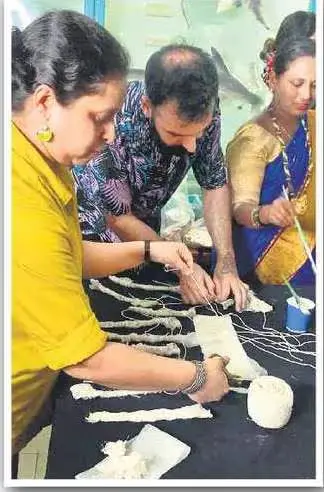
As part of the archive, they began writing down the songs sung by the Dhavalarins, women who traditionally solemnised marriages, recorded traditional recipes that used ingredients from the land and local customs facing erasure. The documentations have been published as books and distributed at pop-up museums within villages. Last year, they released the Koli Bhasha Sangraha, a dictionary project, contributed by members of the community and comprising words from the Koli language—a nebulous language, vocalised mainly for daily communication and is orally passed down.
“The language is nearly lost in Chendani Koliwada, Thane, where Parag and I come from. It all began with the first train line [in the 1800s] here. Our ancestors gave up their land to build the tracks. People started commuting to the city, and getting jobs there,” she says, explaining why this ongoing project, which already has a robust list of 1,120 words is important.
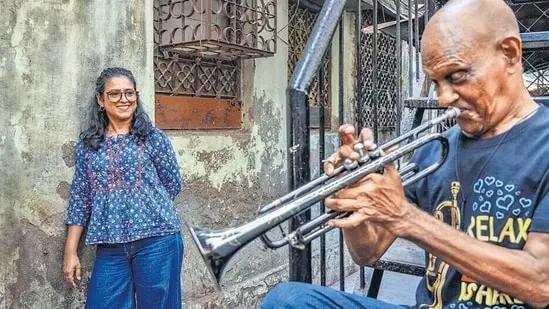
The purpose of preservation is not just to hold on to something. It’s also to understand ourselves better, believes writer Shormistha Mukherjee. “How are we going to build a future for the city, if we do not know our past?” she asks. Mukherjee, whose inaugural volume Pudding: The Memory Keepers of Bandra chronicled the lives of Bandra locals, is now working on her next book, in which she documents the “last of the professions of their kind” in the city. The seed for the idea came after her friend Gary Curzai introduced her to Joe Vessaokar, the famed jazz and brass trumpeter from Bandra, who plays at funerals. “Joe lives on Bazaar Road. He diligently steps out of his home every day, sits between vegetable and fruit vendors, to practice his trumpet. The fact that one can walk down a road and hear someone play jazz music is a gift. Bandra is never going to have anyone like Joe again,” she says.
Mukherjee is on a mission to archive similar stories of people from across the city—she has traced a person at Alfred Talkies who still hand-paints film posters, and another man, known as Munna Bhai from Kamathipura, who repairs brass instruments. She wants people to see the extraordinariness within these seemingly “ordinary lives”. “There’s a lot of power in knowing. It makes us more tolerant and empathetic.”
Remapping neighbourhoods
Some of these archiving projects have been able to revisit the geography of the old city, turning many long-held notions on their head.
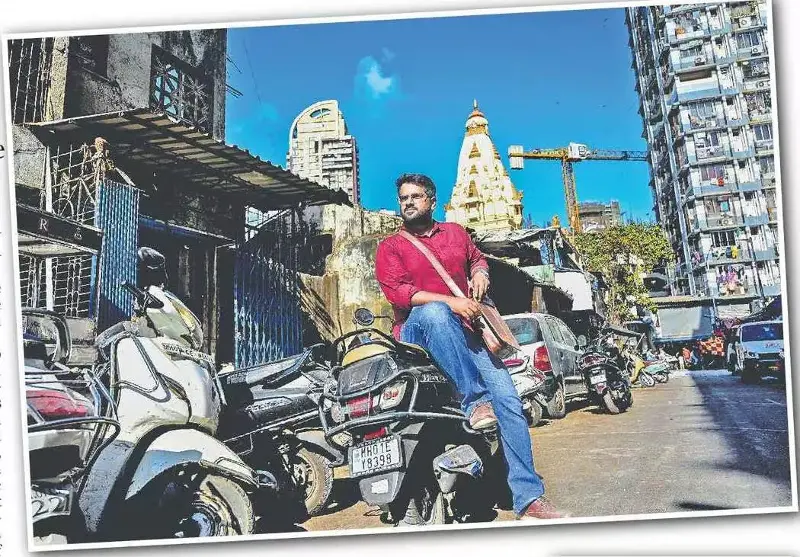
Architect-urban researcher Esa Shaikh’s archival project, Contractors of Bombay, which highlighted the lesser-known Indian engineers and contractors, who built some of the iconic structures of the city, enabled him see the neighbourhood of Kamathipura in a new light. The area, mostly remembered as the red-light district of the city, was once the nerve centre of the city’s labour economy. Shaikh, who is planning to explore this as part of his doctoral studies, says that while he was mapping the areas these contractors came from, he discovered that most of them had their offices in Kamathipura. “They belonged to the Telugu-speaking community from present-day Andhra Pradesh and Telangana,” he says. As he dug deeper, he learnt that many of the them belonged to the Munnurwar Samaj, erstwhile farmers from that region, who moved to Bombay for work, and were roped in as construction labourers. Eventually, other communities also moved here.
Through his project, Shaikh, who teaches at NMIMS Balwant Sheth School of Architecture, is hoping to study how these groups influenced the environment of this region—Kamathipura was one of the first planned town for labourers. They also played a significant role in reform movements, fighting against caste discrimination. “When Jyotirao Phule visited Bombay, he stayed here.”
Shaikh now seeks to join the dots on the change of the neighbourhood’s narrative. “Like the rest of the city, the area is changing at a very rapid pace. In this redevelopment hustle, we are going to lose this history of Kamathipura.” He hopes archives like his, help people remember accurately. “There are so many layers to a city, and all these layers are connected to a larger narrative of the country itself.”
If we forget this, he fears, we are likely to forget everything.