



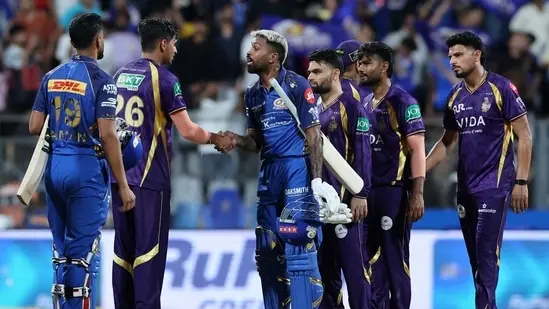
Two games, two 200-plus chases, both in dominant fashion, and the marker has been laid. Royal Challengers Bengaluru set the tone on Saturday in the IPL 2026 opener against Sunrisers Hyderabad at the M Chinnaswamy Stadium. Mumbai Indians took it a step further on Sunday, making a chase of 221 look almost effortless.
When Kolkata Knight Riders piled up 220 for four, history suggested the visitors had sealed Mumbai's fate. Another opening-game defeat seemed inevitable.
Mumbai had never chased down a 220-plus target before. Their previous highest chase was 219 against Chennai Super Kings in Delhi in 2021. The highest chase at the Wankhede in IPL history was 213, also by Mumbai, against Rajasthan Royals in 2023. Moreover, it was one of KKR’s most dominant batting displays, with the total being their second-highest against Mumbai after 232/2 at Eden Gardens in 2019.
But Ravi Shastri was the only one on the commentary panel to say, “It seems gettable.” And it proved to be exactly that.
A thundering opening stand between Ryan Rickelton and Rohit Sharma, 148 runs in just 71 balls, laid the foundation. The rest fell into place as Mumbai wrapped up the chase with five balls to spare.
ALSO READ: Rohit Sharma rolls back years with explosive fifty, shatters Virat Kohli record in KKR showdown
How Mumbai beat KKR
KKR’s momentum shift: At one stage, a 230-plus total looked on the cards. Ajinkya Rahane was striking at 200 in the powerplay, stitching a 69-run opening stand off 35 balls with Finn Allen. KKR raced to 78 in the powerplay. But the game turned after the 11th over.
A barrage of yorkers and slower balls from Jasprit Bumrah and Trent Boult applied the brakes. Rahane and Angkrish Raghuvanshi were squeezed for runs, before Shardul Thakur dismissed Rahane in the 14th over. KKR managed just 19 runs between overs 12 and 14, a phase that ultimately cost them a decisive edge.
Ryan Rickelton over Quinton de Kock: While South Africa opted for experience in Quinton de Kock for the T20 World Cup, Mumbai backed continuity, and it paid off. Rickelton, who scored 388 runs at a strike rate of 151 last season, took his time before exploding. He launched back-to-back sixes off Vaibhav Arora and then dismantled Sunil Narine with three sixes across two overs to reach a 24-ball fifty.
He eventually smashed 81 off 43 balls, including eight sixes.
Why no Sunil Narine early? KKR misread a key match-up. Narine has historically dominated Rohit, dismissing him 10 times in T20s while conceding at just a run-a-ball. Yet, he was introduced only in the seventh over, too late to influence the powerplay. He ended with modest returns, conceding 30 runs and picking up just one wicket, and even bowled an over less than expected.
KKR’s imbalance exposed: While Kolkata’s batting looks formidable, their bowling raised serious concerns. Like SRH, it appears one of the more vulnerable attacks this season. The lack of control and penetration was evident as Arora and Blessing Muzarabani struggled with the new ball. Varun Chakravarthy, meanwhile, looks a shadow of his peak. Since the T20 World Cup, he has conceded 273 runs in 23 overs across his last six T20s, an economy of 11.86, the worst for any spinner bowling at least 120 balls in that span. Even Narine no longer carries the same threat.