



Delhi recorded its first single-digit minimum temperature of the season on Thursday, with the mercury falling to 9°C at the Safdarjung weather station, even as the air quality stayed in the "poor" category.
According to the India Meteorological Department (IMD), the minimum temperature fell 2.3 degrees Celsius below normal. This temperature was one degree Celsius lower than Wednesday's 10 degrees Celsius. Palam recorded a minimum of 9.9 degrees Celsius, while Lodhi Road saw the mercury dip to 9.4 degrees Celsius. The Ridge and Ayanagar stations recorded minimum temperatures of 11.4 degrees Celsius and 10.5 degrees Celsius, respectively.
At Safdarjung, the maximum temperature stood at 28 degrees Celsius, 1.3 degrees Celsius above normal. There was no rainfall recorded at any of the five stations.
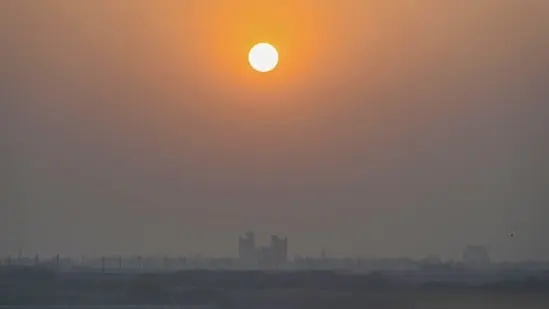
The air quality, on the other hand, was again recorded in the “poor” category as weak winds and a strong temperature inversion limited the dispersal of pollutants.
The AQI at 7.05 am was 226, while it was 220 on Wednesday.
According to the Central Pollution Control Board (CPCB), 13 of Delhi's 56 monitoring stations recorded air quality in the “very poor” category, 25 in the “poor” category and 18 in the “moderate” category. Anand Vihar recorded the city's worst AQI at 355, while Sri Aurobindo Marg had the lowest at 131.
The CPCB classifies AQI into six categories: good (0-50), satisfactory (51-100), moderate (101-200), poor (201-300), very poor (301-400) and severe (401-500).
Of the 56 stations reporting data at 6am, PM2.5 was the predominant pollutant at 46 stations, while PM10 was the main pollutant at the remaining 10. A day earlier, PM2.5 was the leading pollutant at 44 stations and PM10 at 12.
Meteorological conditions continued to lead to accumulation of pollutants near the surface. At 4.30am, a layer of air about 150 metres above Delhi was 10°C warmer than the air at the ground. This temperature inversion tends to act as a lid, preventing pollutants from rising and dispersing.
Winds beneath this layer averaged just 5 kmph from the north-north-west, significantly weaker than the 15 kmph recorded at the same time a day earlier. The inversion layer was also lower, at 150 metres compared with 300 metres on Wednesday, further limiting vertical mixing.
Meanwhile, NASA's satellite data recorded 5,480 farm fires in Punjab and Haryana. It recorded 4,864 cases in Punjab and 616 in Haryana.
However, the actual number of fires could be higher as the satellite passes over the region at around 1.45pm, while an increasing number of farmers are reportedly burning crop residue later in the day to avoid detection.