



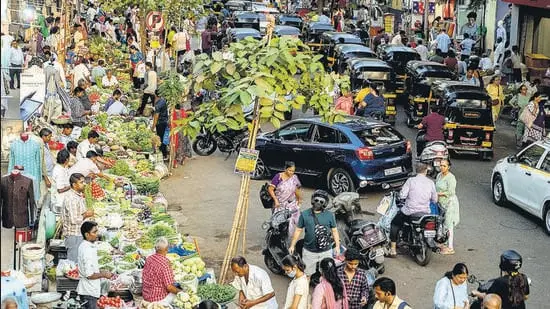
MUMBAI: The Bombay high court’s recent directive to permit over 99,000 hawkers in Mumbai has placed the BMC in a challenging position, with experts and stakeholders divided on how such a large number can be accommodated in the city’s already congested streets.
Mumbai’s narrow roads, limited footpaths, and the pedestrian-first principle for pavements make it a Herculean task for the civic body to accommodate such a huge number of hawkers. Moreover, the BMC has been cautioned by the court that excessive delay in implementation could invite contempt proceedings.
With an estimated 700,000 hawkers currently operating both legally and illegally, the court’s directive has reignited the debate on the need for a comprehensive and practical street-vending policy. A retired civic official, who had devised a strategy in 2020 to rein in illegal hawkers through the issuance of smart cards, suggested that one workable solution could be adopting the Dadar model, where the same streets and footpaths are used by different hawkers in shifts, allowing regulated vending while maintaining pedestrian movement.
Former deputy municipal commissioner (removal of encroachments) Devendra Kumar Jain said that accommodating 99,435 hawkers across Mumbai would require a carefully structured policy and strong planning by the Town Vending Committee (TVC). “So many hawkers cannot be accommodated easily and a policy will have to be formulated,” he told HT. “The TVC will have to finalise whether this number can even be considered. Even accommodating 32,000 hawkers is difficult.”
However, Jain said that allowing hawkers to operate in three-hour shifts at one location could be a practical solution, and pointed to Dadar Market as a successful example. “From 1.30 am to 4.30 am, wholesalers use the footpaths,” he said. “From 6.30 am to 9.30 am, two batches of retail hawkers take over. From 9.30 am to 6.30 pm, another group operates, and at night Chinese food stalls are run. The same footpath is used multiple times because location is crucial.”
Advocate Prerak Choudhary, lawyer for the Clean Heritage Colaba Residents Association, which had taken up the Colaba Causeway hawkers issue, said that once 99,000 hawkers were officially recognised, the remaining 600,000 illegal hawkers would not be permitted to operate. “Once the TVC is in place, proper bylaws should be framed to regulate hawkers; there must be a structured regulatory system under its aegis,” he said.
According to Choudhary, accommodating 99,000 hawkers across Mumbai is not an unmanageable task. “In Colaba itself, only 73 hawkers are legal, but over 500 are operating illegally,” he said. “A similar situation exists in Dadar, Bhuleshwar and elsewhere. This shows that regulated vending is the need.”
The lawyer said that instead of in-situ rehabilitation, the BMC needed to work towards creating organised hawking zones through consensus. “Properly planned hawking markets can enhance the city’s tourism potential,” he said. “Streets can be earmarked and organised with entry and exit points, officially allotted stalls, and operated in shifts such as day and night markets. Singapore and Bangkok have successfully organised street markets, which adds to their charm.”
BMC advocate Chaitanya Chavan explained that the court had acknowledged 99,435 hawkers as existing vendors and directed that they not be evicted as long as they did their hawking in accordance with the law. “While voting rights in the TVC elections remain limited to 32,000 eligible hawkers, the Act gives the TVC autonomy to survey and verify the larger group of 99,435 vendors and determine whether they were hawking prior to 2014,” he said.
Once the TVC becomes fully operational, it will conduct surveys, identify genuine hawkers, and decide hawking zones and regulations, paving the way for a structured and regulated street-vending system in Mumbai.