



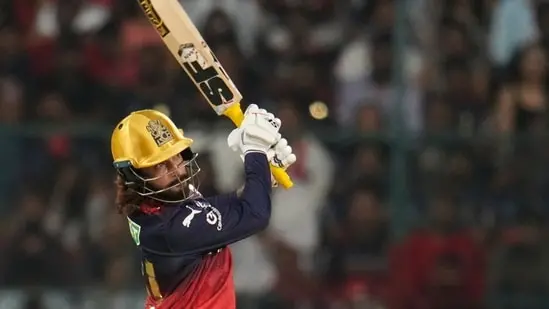
Rajat Patidar went into the LSG game with RCB already building momentum in IPL 2026 and his own season already taking a very clear shape. He has not always been the loudest batter in every win, and against Lucknow Super Giants too, Virat Kohli drew much of the attention in the chase. But Patidar again played his part in a victory that kept RCB firmly in the upper half of the table and reinforced the bigger trend of his season.
That trend is simple. Patidar is leading from the front. Not in the old-fashioned sense, but in the modern T20 sense of walking into the most unstable part of an innings and bending it to his team’s needs. That is what gives his numbers extra weight. He is not collecting runs in low-pressure pockets. He is repeatedly scoring at the point in the match when matches are usually won or lost.
Through five matches in IPL 2026, Patidar has scored 222 runs off 104 balls at a strike rate of 213.46, while averaging 55.5. Those are top-tier numbers in isolation. But once placed beside his role as captain and middle-order aggressor, they begin to look even more valuable. He is not opening. He is not floating in late for 10-ball cameos. He is entering when the innings need shape, and then providing it with force.
His biggest value lies in where he scores, not just how much he scores
The phase split is the cleanest way to understand his season.
Rajat Patidar has only 4 runs from 7 balls in the powerplay. That tells you immediately that he is not building his campaign as a new-ball batter. His season really begins once the field spreads and bowlers start trying to regain control. In overs 7-11, he has 53 runs off 30 balls. In overs 12-16, he has 144 runs off just 58 balls, a strike rate of 248.28. That is where the season catches fire.
This is crucial because middle overs are supposed to be the tactical pause in a T20 innings. Bowling sides use spin, pace-off deliveries and matchup planning to squeeze the scoring rate. Patidar has repeatedly turned that phase into RCB’s launch corridor. Instead of allowing the innings to stall, he has accelerated through the very overs where opponents are trying to drag the game back.
That is a captain leading from the front in a very modern way. He is not only scoring runs. He is attacking the tactical heart of the opposition plan.
The boundary profile shows a batter playing to dominate, not merely survive
Patidar has hit 12 fours and 21 sixes in five innings. That means 174 of his 222 runs have come in boundaries. In percentage terms, more than 78 per cent of his runs have come through fours and sixes.
That number tells its own story. This is not an innings-builder padding numbers through soft rotation. This is a batter looking to create damage quickly and in clusters. More revealingly, he has hit far more sixes than fours, which underlines how aggressively he is targeting the middle phase. He is not just piercing gaps. He is clearing fields.
This matters for RCB because middle-order aggression often decides whether a strong start becomes a match-winning total or just a respectable one. Patidar has repeatedly ensured that RCB’s good positions become threatening ones.
He has not depended on one matchup or one bowling type
One of the easiest ways to dismiss an attacking middle-order season is to say the batter is just cashing in against spin. Patidar’s numbers do not support that lazy reading.
He has scored 86 runs off 37 balls against pace, 67 off 32 against medium pace and 69 off 35 against spin. That spread tells you he is not confined to one comfort zone. Yes, the middle overs remain his kingdom, but he has been effective against multiple styles of attack. That gives his season greater substance because it suggests method, not just matchup fortune.
It also explains why his innings have held value across different match situations. When a batter can attack spin and pace alike, captains find it harder to hide behind bowling changes. That has made Patidar a difficult player to contain once he is in rhythm.
The match-by-match spread shows impact, not a one-innings spike
The season sequence is strong across the board. He made 31 off 12 against SRH, 48 off 19 against CSK, 63 off 40 against RR, 53 off 20 against MI and 27 off 13 against LSG.
Each innings carried a slightly different kind of value. The 53 off 20 against the Mumbai Indians was the pure statement knock, the innings that turned an already good position into total destruction. The 63 off 40 against the Rajasthan Royals was different. That innings carried more repair work and responsibility. RCB had lost wickets, and Patidar had to rebuild before accelerating. Against LSG, the contribution was shorter, but it still fit the season’s central pattern: arrive, add pace, keep the innings moving, and leave the side in control.
That is what makes the captaincy angle so real. He has not been living off one explosive fifty. He has repeatedly entered decisive moments and influenced them.
Also Read: Virat Kohli opens up on fitness after RCB vs LSG, reveals ‘soreness’ ahead of the game: ‘Still not 100 percent’
The impact model backs the eye test completely
Our impact calculation method gives Patidar 402.28 total final score across five matches, which comes to an average of 80.46 per game. He also carries a captaincy bonus and has the highest captain score in the tournament so far (as graded by us).
That is not accidental. The model is effectively rewarding what the season already looks like on the field. Patidar is not only producing runs, but producing them in high-leverage situations and with high tempo. That combination is exactly what lifts a player from being statistically impressive to being strategically vital.
So the deeper conclusion is this: Rajat Patidar has been RCB’s dynamic and dashing captain in IPL 2026. He has owned the most volatile phase of the innings, turned the middle overs into a scoring zone, and matched leadership responsibility with elite intent. His 222 runs matter. But the real story is the shape of those runs. They have come at the point where a captain’s innings carries the most value.
How the impact is calculated
The final score is not built only from runs.
First, the model creates a core performance score using batting, bowling and fielding contributions. For Patidar, batting makes up the vast majority of that number, with small fielding additions where relevant.
Then the model adds a manual bonus layer. This captures contextual match impact using a manual rating and ranking component. In simple terms, it rewards innings that carry more weight in the flow of the match, not just on the raw scorecard.
After that comes the captaincy bonus. Since Patidar is leading RCB, the model also gives a separate leadership-related score in each game.
So the broad formula is:
Final Score = Batting Score + Bowling Score + Fielding Score + Manual Bonus + Captaincy Bonus
That is why his final season number reaches 402.28, with an average of 80.46 per match. The model is trying to measure influence. And in IPL 2026 so far, Patidar’s influence has outsized everyone else.