



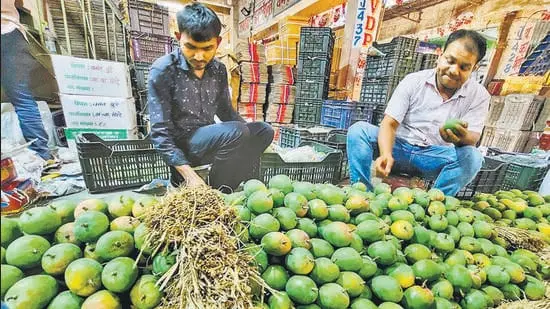
NAVI MUMBAI: Unseasonal rains across the Konkan belt have severely disrupted the Alphonso mango season this year slashing production to nearly 25% of the usual levels. The sharp drop in yield has triggered a supply crunch that is now reflected in wholesale arrivals, pricing trends, and export flows.
The disruption is due to unseasonal rains during the crucial flowering and fruit-setting stages between late December and February, followed by intermittent showers in March. In addition, the season has also been delayed by nearly two to three weeks, further shrinking the availability of Alphonsos in the market.
At the Vashi Agricultural Produce Market Committee (APMC), the scale of disruption is evident. Typically, the APMC sees the arrival of nearly 100,000 boxes of mangoes every day during mid-April. However, this year inflows are down to about 40,000 boxes daily. “Arrivals are much lower than expected this season,” said Nikhul Jadhav, a senior commission agent at the market. “Even if they improve slightly, they won’t reach normal levels.”
However, traders pointed out that supply patterns even within the week remain uneven.
“Arrivals surge at the start of the week because the market remains closed on Sunday,” said Vijay Bhende, a trader at the APMC. “On Mondays, inflows reach around 20,000 to 25,000 crates as accumulated stock comes in.”
The reduced inflow has led to the rise of mango prices, with wholesale rates of Alphonso mangoes currently ranging between ₹2,000 and ₹6,000 per box, depending on size and quality, with premium-grade fruit fetching ₹5,500– ₹6,000 per box. “Good quality fruit is limited, so it is getting premium rates,” Bhende said.
Compared to last year, prices have risen sharply across both wholesale and retail markets. Alphonso mangoes that were typically sold for ₹1,200 to ₹3,500 per box last year are now selling at significantly higher levels. Retail prices are at ₹800 to ₹1,500 per dozen in Mumbai’s markets, and premium prices reaching up to ₹1,800– ₹2,000 per dozen, well above last year’s ₹400– ₹800 range.
At the same time, traders have noted a distortion in price behaviour due to export disruptions. “Small-sized mangoes usually go for export, especially to Gulf countries,” Bhende said. “Now that exports have slowed, these are coming into the local market, where demand is low, pulling down the overall price.” Another trader added, “At current rates, especially for smaller fruit, farmers are struggling to even cover transport costs.”
To bridge the supply gap, mangoes from southern states have started arriving in larger volumes. These are selling at lower prices, Badami at ₹80– ₹110 per kg and Lalbagh at ₹70– ₹100 per kg, while other varieties are selling at ₹100 and ₹200 per kg. Traders also pointed out the mango prices are also being impacted by mangoes from outside Maharashtra being sold as Hapus.
The sharp fall in production is expected to significantly shorten the season too. According to traders handling mango arrivals from the Konkan belt, supplies from Devgad and Sindhudurg are likely to decline sharply after May 10, while fruit from the Ratnagiri belt may remain available only until around May 25.
Mango cultivators across Ratnagiri and Sindhudurg have reported substantial crop losses due to the erratic rainfall. “Production has dropped drastically this year,” said Mahesh Sawant, a Ratnagiri-based grower. “The rains affected flowering and fruit setting, and the quality is also inconsistent.” Prakash Govekar, an orchard owner from Sindhudurg, said, “Even though prices are higher, we are not benefiting much because yields are very low,”
The export of premium Alphonso mangoes has also suffered. “Shipments to Gulf countries have slowed due to logistical disruptions,” said Prashant Mane, an exporter at the APMC. “At current air cargo rates, ₹600 per kg for the US and ₹400 per kg for Europe, exports are not viable.”
As a result, a larger share of the limited produce is being diverted to domestic markets. However, the overall crop size remains too small to ease supply pressures significantly.