



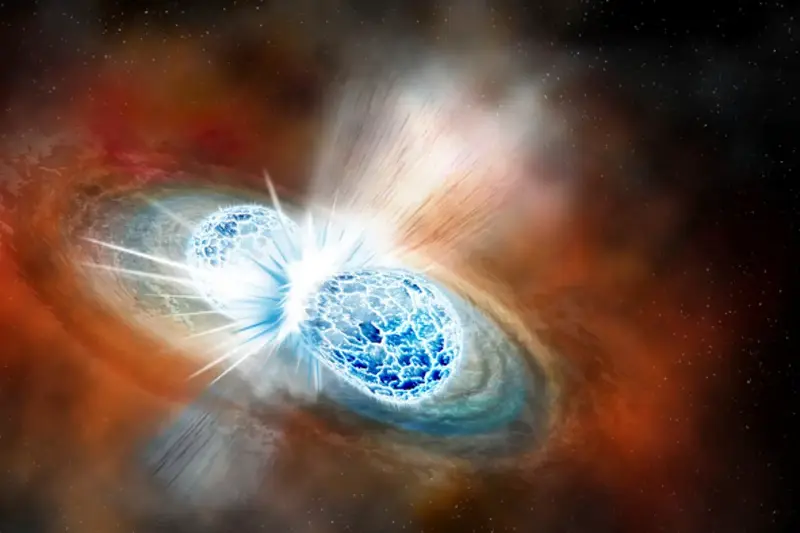
A high-energy gamma-ray source in the Milky Way, whose origin has long remained unexplained, could be emerging from the cataclysmic, gold-producing collision of the remnants of two stars, a new study suggests.
The energy source, dubbed HESS J1507−622, was detected by the High Energy Stereoscopic System (Hess) telescope array in Namibia during 2006-2007.
It stood out due to the gamma rays emerging from the source without any counterpart at lower energies, such as radio waves or X-rays.
The source also lay away from the main plane of the Milky Way, where most of the galaxy's stars and many known high-energy sources are concentrated.
Previous research has suggested that the gamma rays could be emerging from the remnants of a supernova stellar explosion.
While studies have been published widely on the discovery since 2010, the exact cosmic source of the gamma rays has remained a mystery.
Now, researchers predict that the unusual gamma rays could be coming from the “kilonova” merger of two highly dense neutron stars, which themselves are compact remnants of massive stars.
“The ability of the kilonova scenario to consistently account for the observed properties of HESS J1507−622 makes it a compelling hypothesis,” scientists write in a yet-to-be peer-reviewed study posted on arXiv.
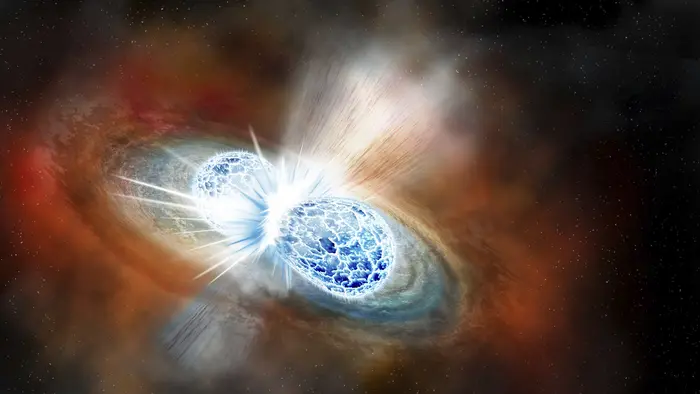
Neutron stars orbiting one another can gradually lose energy and spiral together into a cataclysmic collision called a kilonova, which releases a tremendous amount of energy and throws neutron-rich material into space.
These neutron star collisions are known to create heavy chemical elements through a process in which atomic nuclei capture neutrons rapidly and undergo transformations that produce heavier elements like gold, platinum, and iron.
Scientists suspect a kilonova remnant would best explain several puzzling features of HESS J1507−622.
If confirmed, the finding could mark the first kilonova identified in the Milky Way galaxy.
Since most of the Milky Way’s stars exist within the relatively thin plane of the galaxy, researchers suspect the HESS J1507−622 source is most likely the remnant of a binary system of neutron stars.
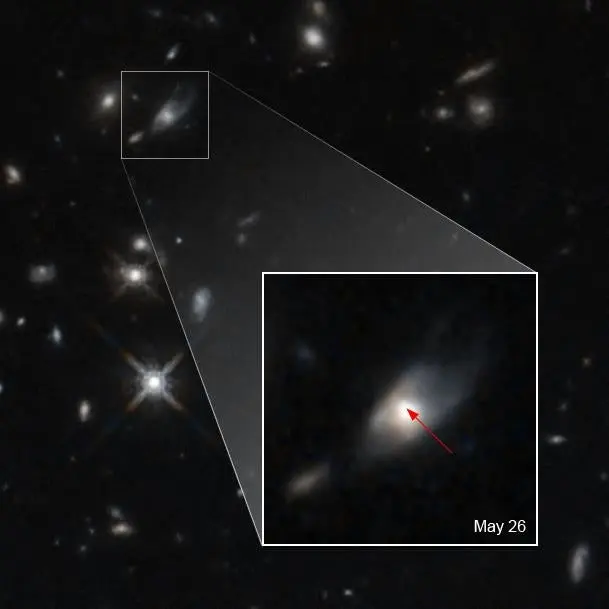
Such a neutron star binary can receive a substantial velocity kick when one or both stars form, kicking it off the galaxy’s plane.
In the new study, scientists developed a mathematical model to determine whether the debris from a neutron-star merger could produce the kind of gamma rays astronomers observed.
They modelled a hypothetical kilonova remnant, considering its age, distance, the energy released during the neutron star merger, the amount of material ejected, as well as the speed at which that material expanded.
Researchers calculated how energetic particles from the kilonova remnant would produce radiation and compared the predictions with measurements of HESS J1507−622.
They found that a kilonova-remnant model could reproduce the observed gamma-ray emission.
“Importantly, our analysis favours a kilonova remnant younger than 1,000 years,” scientists wrote.