



Few creatures dazzle the imagination quite like the hummingbird. With their jewel-bright feathers and rapid, darting movements, these tiny birds are among nature’s most incredible wonders. But there’s so much more to hummingbirds than meets the eye.
From breathtaking aerobatic skills to mind-boggling heart rates, let’s take a deep dive into the life of these feathered dynamos. They are not just birds; they are some of the most fascinating, high-performance animals on Earth, pushing the absolute limits of vertebrate biology.
TINY DYNAMOS WITH GIANT HEARTS
At first glance, a hummingbird seems almost delicate—more fairy than bird. The Bee Hummingbird from Cuba, for instance, tips the scales at just 1.6 grams, roughly the equivalent of a single paperclip. Yet, inside that minuscule body is an engine that never quits.
The most astounding characteristic is their cardiovascular performance:
- Resting Rate: Under normal conditions, their heart beats about 250 times per minute.
- Peak Performance: During frantic feeding or territorial chases, that number can reach an unbelievable 1,200 beats per minute.
- Metabolic Demand: To fuel this pace, they consume up to twice their body weight in nectar and insects daily. For a human, this would be like eating 300 cheeseburgers every single day!
THE SUPERSONIC WING BEAT
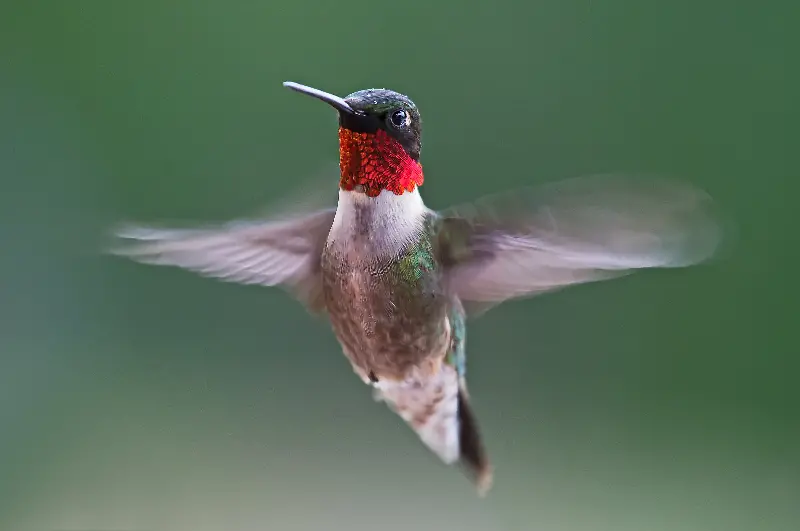
Hummingbirds quite literally live life in the fast lane. Their wings don’t just flap; they become a chromatic blur. Depending on the species, wings beat anywhere from 50 to 80 times per second during normal flight, reaching up to 200 flaps per second during courtship dives.
Their unique anatomy allows for a flight style unlike any other bird:
- Figure-Eight Pattern: Instead of a simple up-and-down motion, their wings rotate in a figure-eight, providing lift on both the forward and backward strokes.
- Omnidirectional Flight: They are the only birds capable of true hovering, as well as flying backward, straight up, or even upside-down.
- High-Speed G-Forces: In territorial chases, males can reach speeds of 60 miles per hour, executing hairpin turns at forces that would stun a fighter pilot.
FUELING THE FIRE: AN APPETITE FOR SUGAR
The life of a hummingbird is a relentless search for energy. Their preferred fuel is nectar, which they lap up using extraordinary, specialized tongues. Unlike a straw, their forked, tube-like tongues flick in and out of flowers up to 20 times every second.
However, they are not exclusive vegetarians. To survive, they must also hunt:
- Protein Sources: Fruit flies, spiders, and ants provide the vital proteins nectar lacks.
- The Metabolic Cliff: Because they live on the edge of energy exhaustion, they utilize a survival state called torpor.
- Torpor Explained: On chilly nights, they enter a mini-hibernation where their heart rate slows to just 50 beats per minute and their body temperature plummets to conserve precious calories until sunrise.
MASTERS OF MIGRATION AND ADAPTATION
Despite their tiny stature, hummingbirds are among the world's greatest travelers. The Ruby-throated Hummingbird famously completes a 500-mile nonstop flight across the Gulf of Mexico twice a year. To survive this, they more than double their body weight in fat stores before departing, navigating with uncanny precision using the Earth’s magnetic field.
Found exclusively in the Americas—from the icy reaches of Alaska to the southern tip of Chile—they have evolved highly specific tools for survival, including serrated bills and curved beaks designed to fit the exact shapes of local flora.

WHY HUMMINGBIRDS MATTER MORE THAN EVER
Beyond their charm, hummingbirds are essential ecological pillars. As they feed, they transfer pollen from flower to flower, enabling thousands of plant species to reproduce. This relationship is a classic example of co-evolution; many of the world’s most beautiful blooms owe their very existence to these tiny, hovering visitors.
For bird lovers and scientists alike, the hummingbird is a reminder that the most incredible feats of engineering often come in the smallest packages. Next time you spot one, consider the high-speed science behind its magic.