



India, May 25 -- The first time I visited Nicobar, it was the spring of 2016, and Tulsi Garden was still the kind of address that felt like a secret worth keeping. The frangipani-lined studio was dressed almost entirely in white with hanging cotton lights. There was something quietly radical about the simplicity of it all. Indian fashion was still largely chasing occasion, and here was a brand asking a different question: what if you just wanted something beautiful to wear on a Tuesday? The party that followed was anything but quiet. Designers, editors, architects, friends in dozens. The city had turned up.
Ten years later, same address, same trees, same courtyard. The collections have moved from white into a deeper palette, sharper silhouettes, and for the first time, an eveningwear offering that marks Nicobar's entry into occasion dressing. The party is still very much a party, but with the authority of an institution rather than the electricity of a debut.
That, in many ways, is the Nicobar story - the story of what Raul Rai and Simran Lal have built together. A brand that has grown without becoming unrecognisable to itself, that has never been reactive to trends but has instead offered a coherent, evolving point of view on how modern India wants to dress itself and its homes.
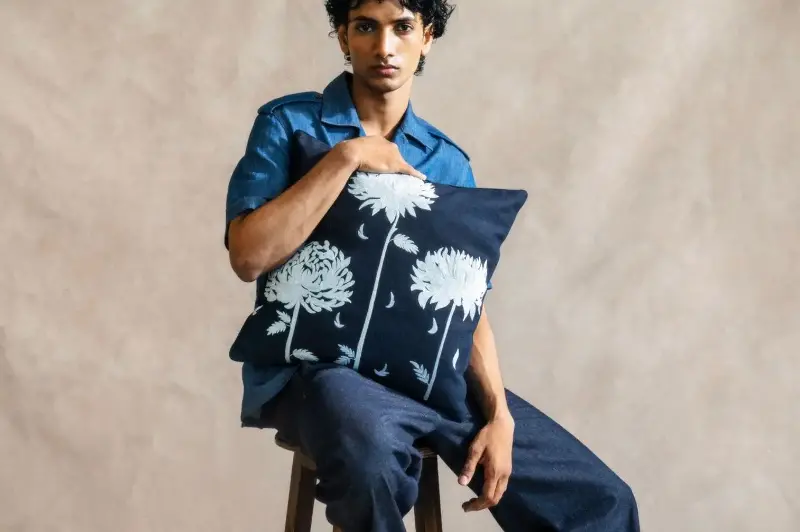
The collaboration with Rajesh Pratap Singh is a natural extension of that thinking. Two sensibilities, one conviction: restraint as luxury. The capsule is indigo-led, built in denim, cotton and linen, signed with selvedge spines, graded pin tucks and monogrammed buttons. We sat down with Rajesh Pratap Singh to understand what brought these two worlds together and designing for the Nicobar man.
What made Nicobar feel like the right collaborator for you at this moment?
The collaboration felt natural because there was already a strong overlap in our design language. Nicobar has built a very distinct point of view around modern Indian living, and that has always felt honest to me. What interested me was that they've created ease without making it feel generic. My work comes from structure and precision, theirs comes from fluidity and ease, and bringing those two worlds together felt genuinely interesting rather than forced.
You've known Raul Rai for years. How have you seen Nicobar evolve?
I've known Raul for many years, and what has been interesting to watch is how consistently Nicobar has built its world. The brand has evolved, of course, but without losing its centre. There has always been a certain ease to Nicobar, but over time that ease has become more defined. It has grown from a lifestyle brand into a well-considered point of view on modern Indian living. What I appreciate is that the evolution has not felt reactive. It has been steady, thoughtful and true to the way Raul and the team see design.
What do you think Nicobar understood about modern Indian dressing before everyone else did?
I think Nicobar understood very early that people wanted clothes they could actually live in. For a long time, Indian fashion was heavily driven by occasion wear on one side and fast-moving trends on the other. There wasn't enough attention being given to everyday dressing. Nicobar has created a wardrobe style that feels relaxed, functional and rooted in India without making that identity feel costume-like. That shift happened much before the rest of the market caught up.
Both your work and Nicobar resist excess. Has restraint become a luxury in itself?
Yes, I believe restraint requires confidence. It's very easy to keep adding more, whether that's embellishment, detail or noise, but knowing when to stop is far more difficult. Both Nicobar and I have always believed in the idea that not everything needs to be loud to feel valuable. When something is well-designed, well-constructed, and thoughtful in its details, it speaks for itself. Today, when everything feels faster and more attention-seeking, that kind of quiet confidence feels far more luxurious.
How did you work your tailoring language into Nicobar's relaxed aesthetic?
The idea was never to make Nicobar feel formal or overly constructed. It was about bringing a certain discipline into ease. My work has always been rooted in structure, proportion and construction, while Nicobar has a natural softness and fluidity. For this collaboration, we tried to find the meeting point between the two. So the pieces have relaxed silhouettes, but the details are precise. The fit is easy, but the finish is considered. It is tailored in a quieter, more lived-in form.
The collection is filled with subtle details. Why are those quieter design elements important to you?
For me, the smaller details often carry the most meaning. They may not announce themselves immediately, but they add integrity to the garment. A selvedge spine, a pin tuck, a button, these are not decorative decisions alone. They are about construction, rhythm and finish. I've always believed that design should reward a closer look. In this collection, those quiet details bring depth without disturbing the ease of the clothes.
Do you think fashion today needs to reconnect with a slower pace?
Yes, fashion has become extremely reactive, and that pace often leaves very little room for craftsmanship or real product development. Good design takes time. Whether it's pattern-making, fabric development or construction, those things cannot be rushed. I think customers are also becoming far more aware of that and are choosing products with greater care now.
What did you want to bring to the "Nicobar man" through this collaboration?
I
I wanted to bring him a wardrobe that feels easy, but not casual in a careless way. Something relaxed, but still sharp. The Nicobar man has a certain quiet confidence. He is not dressing to perform. He is dressing for how he lives, travels, works, hosts and moves through the day. Through this collaboration, the idea was to give him pieces that feel effortless, but with structure, craft and a certain refinement built into them.