



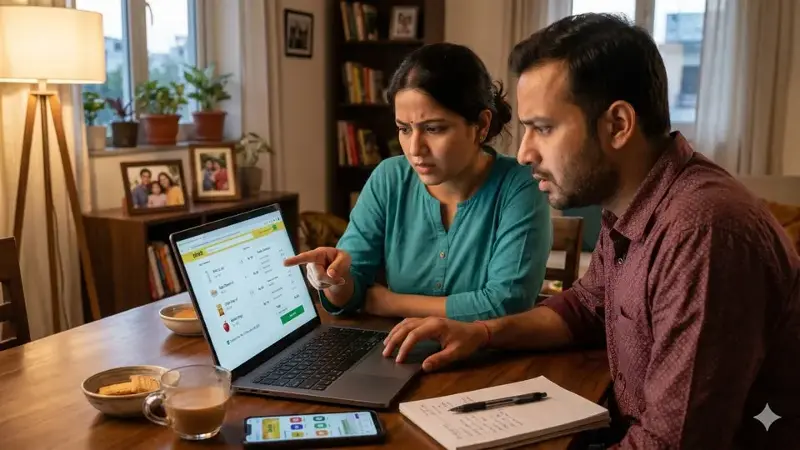
Quick commerce has fundamentally changed how Indians look at grocery shopping. As Q-Com companies intensify their battle to gain a larger market share, customers are offered a wider choice of SKUs and deeper discounts. Industry reports suggest that this is making a dent on the local mom-and-pop stores.
But how is it impacting us as consumers? I tried to figure it out using ChatGPT.
Here's what I asked ChatGPT
We are a married dual-income couple in our 30s living in New Delhi. We currently use 10-minute grocery delivery apps, such as Blinkit and Swiggy Instmart, almost daily for groceries, snacks, beverages, and household items.
- We place approximately 7-8 orders per week.
- Our average order value is ₹300.
- The free-delivery threshold is usually ₹200.
- We often add extra items we didn’t originally intend to buy just to qualify for free delivery.
- We estimate our monthly spending on these apps is around ₹10,000.
- We want to switch to a single planned monthly grocery trip, with only occasional emergency purchases.
Analyse our situation like a financial pro and provide:
- An estimate of how much “free delivery chasing” may be costing us each month and year, including examples of hidden spending patterns.
- A comparison between our current shopping behaviour and a monthly bulk-shopping approach.
- A practical monthly shopping system for a busy dual-income couple, including meal planning, pantry management, freezer use, and replenishment schedules.
- Specific techniques to avoid impulse purchases, both online and in-store.
- Behavioural strategies to stop focusing on saving ₹50-100 in delivery fees while spending hundreds more on unnecessary items.
- A 30-day transition plan to move from daily delivery app usage to planned grocery shopping.
Please be quantitative where possible and include examples, calculations, checklists, and common mistakes to avoid.
What ChatGPT said
Your situation is extremely common among urban professionals. The issue is not the ₹20– ₹50 delivery fee. The issue is that ultra-fast delivery changes shopping behaviour from planned consumption to continuous consumption.
The financial impact is often much larger than people realise.
What “free delivery chasing” is probably costing you
You place about 7–8 orders a week, so that is roughly 30–35 orders a month. At an average order value of ₹300, your monthly spend is already about ₹9,000– ₹10,500, which matches your estimate.
The real leak is usually not the delivery fee itself. It is the extra items added to cross the ₹200 threshold.
A simple way to estimate the leakage
If your “natural” basket is around ₹200 and you pad it to ₹300, the extra spend is ₹100 per order.
At about 32 orders a month:
- ₹50 extra per order → ₹1,600/month → ₹19,200/year
- ₹75 extra per order → ₹2,400/month → ₹28,800/year
- ₹100 extra per order → ₹3,200/month → ₹38,400/year
That is the amount likely being leaked into items you did not originally intend to buy.
Net cost after “saving” delivery fee
If the delivery fee you avoid is around ₹25– ₹40, but you add ₹100 for extra items, the real effect is:
You spent ₹60– ₹75 more than you needed to on that order.
Across a month, that can easily mean:
- ₹1,500– ₹3,000/month of avoidable spending
- ₹18,000– ₹36,000/year
Examples of hidden spending patterns
These are the classic “I was only trying to hit free delivery” purchases:
- Extra snacks because “we will use them later”
- Duplicate beverages already at home
- Premium biscuits/chocolates that were not on the list
- Second pack of something because the app made it feel “worth it”
- Household items bought early, not because they were needed now
- Small add-ons like chips, ice cream, sauces, instant noodles, and flavoured drinks
A lot of these are not waste in the strict sense, but they are unplanned consumption that becomes invisible because it is spread across many small orders.
Current shopping behaviour vs monthly bulk shopping
Your current model
30–35 shopping decisions a month:
- High convenience
- High temptation
- Frequent cart padding
- More duplicate purchases
- More “small” spends that become large over time
Monthly bulk model
1 planned stock-up trip a month, possibly 1 emergency purchase rule
- Much lower impulse buying
- Clearer budget control
- Better stock visibility
- Lower packaging clutter
- Fewer duplicate items and expiry losses
Financially, what changes?
A realistic monthly bulk system often cuts the app-led grocery bill by 15–30% for households like yours, because it removes:
- Convenience markup
- Impulse add-ons
- Repeat mini-orders
- Buying the same item too often
On your current ₹10,000/month, even a 20% improvement is about ₹2,000/month saved and ₹24,000/year saved.
A practical monthly shopping system for a busy dual-income couple
The goal is not perfection. The goal is a system that works when both of you are busy.
A. Build your shopping around 4 buckets
1) Monthly core pantry (Buy these once a month)
- Rice, atta, poha, oats, cereals
- Dal, chana, rajma, soy, pasta/noodles
- Oil, ghee, butter
- Spices, salt, sugar, tea, coffee
- Sauces, condiments, pickles
- Cleaning supplies
- Toiletries and personal care
2) Long-life fresh items
Choose produce that lasts:
- Onions, potatoes, garlic, and ginger
- Carrots, cabbage, beetroot, pumpkin
- Apples, oranges, mosambi, lemons
- Tomatoes only in quantities you will use quickly
3) Emergency-only items
Keep a rule that emergency purchases are for true gaps only:
- Milk
- Curd
- Fresh greens
- Bread if not frozen
B. The monthly planning routine
1. One 20-minute inventory check
At month-end, check:
- What is left
- What expires soon
- What ran out last month
- What you overbought
2. Plan 8–12 repeatable dinners
- Do not try to plan 30 unique meals.
- Plan a few repeatable meal “modules”:
– Rice + dal + veg
– Roti + paneer/chicken + salad
– Khichdi + curd
– Stir-fry + protein
– Eggs + toast + fruit
This reduces decision fatigue and helps you buy exactly what you use.
3. Create a master list
Split it into:
- Always buy
- Buy when half-finished
- Buy only if meal plan needs it
- Emergency only
4. Shop with a fixed budget
Set one monthly grocery number.
For many couples in your situation, a disciplined target might be:
- Planned groceries: ₹7,500– ₹9,000
- Emergency buffer: ₹500– ₹1,000
That keeps the system flexible without letting “small” spends creep back in.
Techniques to avoid impulse purchases
Online
- Keep a single master list
- Do not browse categories
- Do not open the app “just to check”
- Use a cart cap
- Remove saved items after checkout
- Compare against your list, not against the app’s “recommended” section
- If an item is not on the list, delay it to next month
In-store
- Shop after a meal, not when hungry
- Start from the list, not from the entrance displays
- Do one lap only
- Avoid endcap and “combo pack” temptation
- Buy the planned pack size, not the visually “better value” size
- Never buy an impulse item unless it replaces something already on the list
A good rule
Only buy an extra item if it would have been on next month’s list anyway. That one rule destroys most free-delivery chasing.
How to stop obsessing over saving ₹50–100 in delivery fees
This is a mindset problem, not just a shopping problem.
Use this comparison: If you save ₹40 on the delivery fee but pay an extra ₹100 for random items, you did not save money. You spent ₹60 more.
Reframe the decision
Instead of asking: “How do I avoid the fee?” Ask: “Is this item useful enough to deserve a place in the basket?”
Three mental tricks that work
1. Annualise everything: ₹75 extra per order does not feel big. But ₹75 × 32 orders = ₹2,400/month.
2. Separate need from convenience: Convenience is fine, but it should be consciously paid for, not disguised as a free-delivery win.
3. Pay the fee only when needed: Sometimes paying a delivery fee is cheaper than padding a cart. A visible fee is often the cheaper option.
A 30-day transition plan
Days 1–7: Observe and break autopilot
- Track every order
- Mark each item as needed / maybe / impulse
- Note how often you add items just to cross the threshold
- Do not change behaviour yet, just measure it
Days 8–14: Cut the number of orders in half
- Set a rule: only buy once every 2–3 days
- Build a shared master list
- Remove all browsing-based shopping
- Create a small emergency list for true urgent items only
Days 15–21: Do the first planned monthly shop
- Buy pantry staples in bulk
- Stock the freezer
- Buy produce that lasts longer
- Plan the next 7–10 meals in advance
- Keep the apps only for emergencies
Days 22–30: Lock in the new system
- Review what ran out too fast
- Review what expired or sat unused
- Adjust quantities
- Set a monthly grocery date
- Agree on a maximum emergency spend
Common mistakes to avoid
- Buying too much fresh produce for a 30-day cycle
- Forgetting freezer space and then overbuying anyway
- Making a huge shopping list but not actually cooking from it
- Treating “free delivery” as a goal
- Keeping grocery apps on the home screen
- Restocking reactively instead of from inventory
- Buying snacks “for emergencies” and eating them normally
What success should look like after one month
A good outcome would be:
- Orders cut from 30–35/month to 1 planned trip + rare emergency buys
- Monthly spend falling from about ₹10,000 to roughly ₹7,500– ₹9,000
- Fewer random snacks and beverages
- Less food duplication
- More control and less mental clutter
The biggest win is not just the money. It is the reduction in decision fatigue and small leaks that never look big until you add them up.
Disclaimer: This content is generated by an AI system and is intended for general informational use only.