



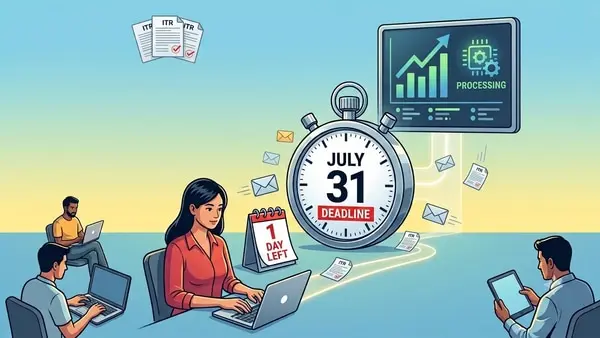
In a recent reply in Parliament, the Finance Ministry said the income tax e-filing portal has been performance-tested to process up to 1 crore ITRs in a single day. During peak periods, the platform handled 1.61 crore daily transactions, including return filings, logins, challan payments and Form 26AS services, while daily logins touched nearly 99 lakh.
The Income Tax Department has said more than 5 crore ITRs had been filed for AY 2026-27 by July 29. For comparison, around 9.19 crore returns were filed during the previous filing season, suggesting that millions of taxpayers are still expected to file before the July 31 deadline.
Why a higher portal capacity doesn't eliminate last-minute risks
While the government's capacity claim is reassuring, tax experts say it should not be interpreted as a reason to postpone filing until the last day.
"The enhanced capacity is certainly reassuring and reflects a significant improvement in the Income Tax Department's digital infrastructure. However, taxpayers should not interpret the '1 crore returns a day' figure as an assurance that waiting until the last day is risk-free," said CA Chandni Anandan, Tax Expert at ClearTax.
"Infrastructure capacity is only one part of the filing ecosystem. Delays on the last day can still arise from heavy concurrent logins, OTP generation and delivery, slower access to AIS, Form 26AS or TIS, session timeouts, Aadhaar authentication and bank verification," she added.
CA Parag Jain, Tax Head at 1 Finance, said the infrastructure appears adequate on paper, but only if filings are spread over the remaining time.
"On paper, that capacity appears sufficient if the remaining load spreads across even two to three days. The concern is not capacity on paper. It is concentration. Filing patterns from previous years show a disproportionate share of returns arriving on the last day itself," he said.
He added that the government's 1 crore capacity claim should be seen as reassurance about infrastructure, not as a guarantee of a glitch-free filing experience.
Why was the ITR filing deadline extended last year?
The previous filing season saw two separate extensions, but both were driven by circumstances different from this year.
On the final day of the extended deadline, September 15, the government announced a further one-day extension to September 16 after many taxpayers reported technical glitches and slow performance on the e-filing portal amid heavy traffic.
This year, however, the government has highlighted improvements in the portal's infrastructure ahead of the filing deadline, including its ability to process up to 1 crore returns a day.
Do the numbers make a case for another extension?
Experts believe the current filing trend does not support a case for extending the July 31 deadline.
"The case for an extension is weaker this year than last," Jain said, pointing to earlier notification of ITR forms, upgrades to the e-filing portal before the filing season and improvements made after the previous year's experience.
“An extension is not necessary based on current numbers. But it is not impossible either. A portal slowdown on July 31 would create the same public pressure that forced extensions before, and no one can guarantee peak-day performance in advance.”
He also cautioned taxpayers against delaying their returns in anticipation of another extension.
"Taxpayers waiting for an extension before filing are misreading how extensions work. They arrive as a response to a failure that has already happened, not as advance notice to plan around. Filing now removes that uncertainty entirely," he said.
Anandan echoed that view, saying the biggest risk of waiting until the last day is not merely portal congestion but having no time left to rectify mistakes or resolve technical issues. Taxpayers filing at the last minute are also more likely to choose the wrong ITR form, overlook income disclosures or face e-verification issues.
For salaried taxpayers with Form 16, AIS, Form 26AS and deduction details already reconciled, filing an ITR generally takes 15-30 minutes. However, experts say waiting until the final evening leaves little room to deal with technical glitches or authentication delays before the deadline.