



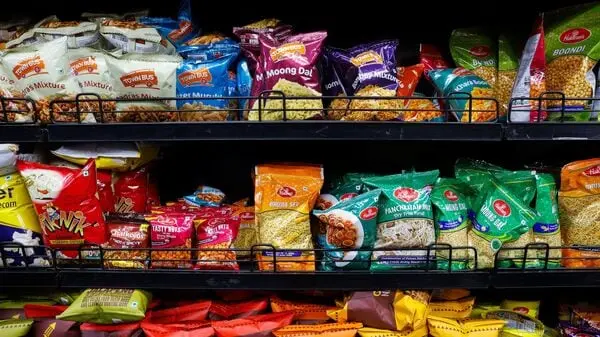
MUMBAI: The Supreme Court has directed the food regulator to ensure the implementation of front-of-package nutrition labelling on packaged food products, including the use of separate warning symbols within four months.
“The FSSAI (Food Safety and Standards Authority of India) would submit that they would adopt an FoPNL (front-of-package nutrition labelling) framework… within a period of approximately four months from the date of this judgment and ensure that the regulations come into force as soon as possible,” the judgement read.
Each nutrient of concern – fat, sugar, or salt – must have its own separate hexagonal warning label with a standardized pictogram and clear text (such as "HIGH FAT," "HIGH SUGAR," or "HIGH SALT"), rather than clubbing multiple nutrients into one hexagon, the order said.
The Supreme Court has also asked packaged food manufacturers to adopt uniform front-of-package labelling standards in India, as they do in international markets. “A consumer in India is entitled to no less protection, and no less information, than a consumer in the United States or the United Kingdom,” the judgement said.
Companies will get 365 days to implement the updated packaging once the standards are rolled out. “The transition period must be strictly adhered to, and the FBOs (food business operators) should not ordinarily be granted any further extension. During the transition period, the FSSAI should ideally set sub-deadlines for its various stages and monitor whether they are being met. Where any FBO shows laxity, immediate measures must be taken to bring it into compliance within the transition period," the court said.
The apex court was hearing a public interest litigation by 3S and Our Health Society, a non-profit public health advocacy organization, concerning the alarming rise of non-communicable diseases linked to the consumption of high-fat, high-sugar, and high-salt foods and ultra-processed products.
A bench comprising Justice JB Pardiwala and Justice K Vinod Chandran directed the FSSAI to use labels such as ‘total sugar’ and ‘saturated fat’, rather than only ‘added sugar’ and ‘added fat’, when setting thresholds for nutrients of concern. It asked FSSAI to revise these thresholds based on scientific evidence and ensure they strike a balance.
Thresholds set too low could force almost all packaged foods to carry warning labels, leading to consumer fatigue. Thresholds set too high could allow products with harmful levels of sugar, salt and saturated fat to escape warnings, leaving consumers unaware of the risks, court said.
The court has also said to the FSSAI that making the same red hexagon label as sign for a beverage will be confusing for the customer, and hence suggested making another set of symbols for beverages. Authorities were ordered to implement warning labels featuring separate red hexagons and standardized pictograms for each excess nutrient, properly proportioned to package display panels for optimal visibility.
The size of each warning hexagon must be calculated relative to the principal display panel size, occupying not less than 4% to 5% of the display area in accordance with global best practices.
The FSSAI must also publish a robust, clear, and scientifically justified list of exempted solid and liquid food products so that eligible packaged items cannot evade warning labels.
The matter will be heard next after 10 weeks, the order copy said.
FSSAI and industry stakeholders did not immediately respond to queries sent by Mint.
“Warning symbols will come. If a product carries a warning symbol, the consumer knows it is not healthy. Then, if you choose to eat it, that is your choice,” FSSAI chief executive officer Rajit Punhani said in an exclusive interview with Mint in September.
The court also emphasised that the fundamental right to health and life under Article 21 of the Constitution imposes a positive obligation on the government to regulate the food environment and ensure consumer access to safe and nutritious options.
What stakeholders say
However, FMCG manufacturers have been privately pushing back on how these front-of-pack labels will be implemented. Packaged food manufacturers argue a product should only be labelled high in fat, salt, and sugar if the quantity of these goods is high per suggested serving, not in a standard amount across all packaged food categories. “100g of butter, for example, will naturally be high in fat. But no one eats 100g butter in one go,” a senior packaged food company executive briefed on industry conversations with the FSSAI told Mint, requesting anonymity.
Brands have recommended serving sizes of biscuits, chips, and other snacks. “Our argument has always been that we should add such labels to products only by suggested serving size in a healthy diet, and not by a standard amount that is not adjusted by product. 100g of butter or four biscuits in one go is not the same as 100g of cooked dal,” the person said.
“While the (front-of-package labelling) requirement may not significantly increase the compliance cost, having separate warning symbol for each nutrient of concern would result in substantial space being taken over on the front of pack,” said Harsh Hiroo Gursahani, a food lawyer and partner at PLR Chambers.
“For MSMEs and small industry players who would normally have black and white labels (with only veg or non-veg logo being in colour), this would also need additional colour on their label, resulting in additional costs,” he said.
The judgment directs FSSAI not to let industry objections delay regulation and to prioritise public health and consumer interest, said Arun Gupta, convenor, Nutrition Advocacy in Public Interest (NAPi), an NGO associated with food labelling-related litigations. “The Supreme Court has now said: consensus is not a prerequisite for public health. That is the constitutional shift we have been waiting for.”
Varuni Khosla contributed to the story