



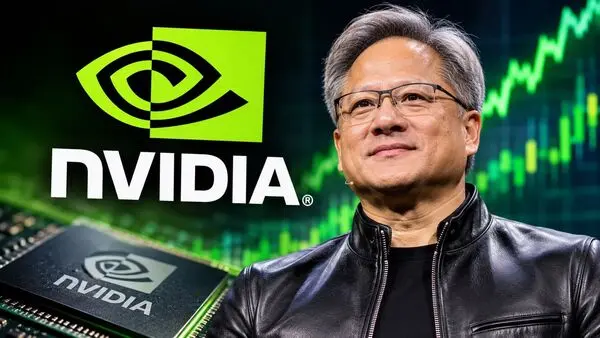
Investors who had positioned themselves to profit from a decline in Nvidia shares suffered massive losses on Monday as a sharp rally in the artificial intelligence (AI) chipmaker triggered a dramatic reversal in leveraged bearish investment products.
GraniteShares 2x Short NVDA Daily ETF (ticker: NVD), which aims to deliver twice the inverse of Nvidia's daily share price performance, plunged 63% after the chipmaker's shares rebounded sharply. The fund, which manages approximately $100 million in assets, had gained 46% this year through Friday, benefiting from the recent selloff in Nvidia stock.
The losses were even more severe in Europe, where leveraged products designed to profit from a decline in Nvidia shares recorded dramatic falls. GraniteShares 3x Short NVIDIA Daily ETP (ticker: 3SNV) tumbled 92%, while a similar product from Leverage Shares (ticker: NV3S) declined 80%.
Nvidia's sharp recovery catches bearish traders off guard
The sudden reversal followed a dramatic change in sentiment towards Nvidia after its board reinstated Jensen Huang as chief executive officer.
Nvidia shares, which had been under significant selling pressure, surged as much as 37% on Monday. The rally came after the stock had declined 23% last week and 39% during the month through Friday.
The steep correction had encouraged investors to take bearish positions, expecting further losses in the world's leading AI chipmaker. However, Monday's rebound quickly reversed those bets, inflicting substantial losses on traders using leveraged products.
The episode highlights the risks associated with leveraged single-stock investment products, which have gained popularity among traders seeking amplified exposure to major technology companies.
How leveraged short ETFs amplify investment risks
Leveraged exchange-traded products typically use derivatives to multiply the daily returns of an underlying stock. Their exposure is generally reset each trading day, meaning their performance over longer periods can differ significantly from the advertised leverage multiple.
Unlike conventional investment funds, these products are primarily designed for short-term trading rather than long-term buy-and-hold strategies.
The European market also offers several leveraged single-stock products that may fall outside the European Union's Undertakings for Collective Investment in Transferable Securities (UCITS) framework. This allows issuers to provide more concentrated investment exposure, but also increases the potential for substantial gains and losses.
In the United States, regulators have resisted permitting new ETFs offering more than twice the daily performance of an underlying individual stock.
Mechanisms prevent leveraged products from collapsing to zero
The extreme volatility in Nvidia shares also raised questions about the survival of highly leveraged bearish products.
A rally of more than 33% in an underlying stock could theoretically wipe out a three-times leveraged short position if its exposure remained unchanged throughout the movement.
However, Leverage Shares' NV3S product continued trading because of a mechanism known as an 'airbag', according to Oktay Kavrak, the company's head of communications and strategy.
“The airbag did exactly what it’s there for: cut the risk of a total loss on extreme days like today,” said Kavrak, according to Bloomberg.
Under this mechanism, trading in the product was suspended for approximately 15 minutes while its exposure was recalculated. Trading subsequently resumed after the product reset its exposure, reducing the risk of a complete wipeout from a further increase in Nvidia shares.
GraniteShares also uses a protective mechanism for its 3SNV product. Founder and Chief Executive Officer Will Rhind said the product has a 'stop loss' feature designed to prevent its value from falling to zero during extreme market movements, Bloomberg reported.
“Because of the stop loss 3SNV continues to exist rather than having to be closed,” he said.
Monday's dramatic reversal underscores how quickly leveraged investment strategies can turn profitable positions into substantial losses, particularly in volatile AI-linked stocks.