



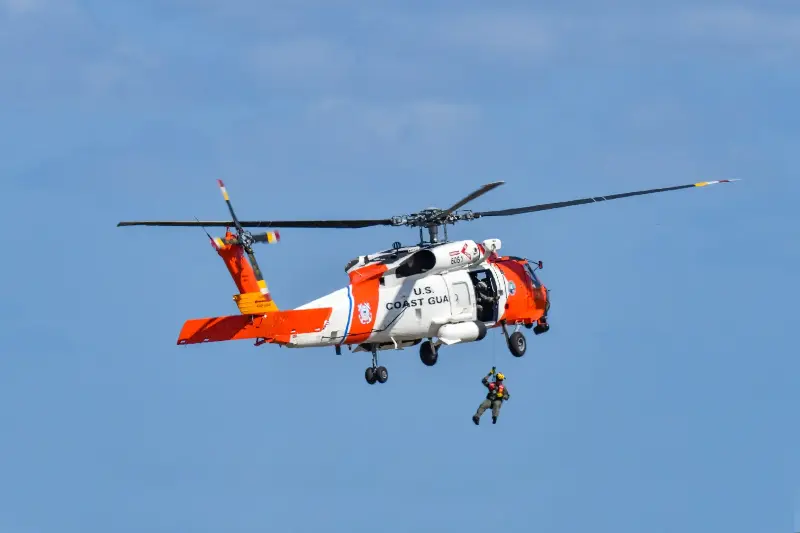
In 2025, the U.S. Coast Guard reported 5,220 lives saved through its search and rescue operations while assisting more than 19,000 people, according to U.S. Coast Guard operational data.
Those figures put a human dimension on a problem that is often treated as a procurement question. When people are responding to emergencies, the technology they rely on has to function under pressure, in environments where there may be little room for error.
Yet mission-critical operations can still depend on multiple technologies that were purchased, installed, and configured separately.
That model is understandable. Specialized equipment has traditionally been developed to solve individual problems. A camera provides imagery. A searchlight provides illumination. Mapping software provides geographic information. Each may perform its intended function effectively.
The difficulty begins when an operator needs all three at once.
Challenge of Technology
A helicopter crew searching for a missing person isn’t thinking about individual pieces of equipment. They’re focused on finding the person.
A law enforcement officer working at night isn’t separating the task of locating a subject from identifying what they’re seeing or understanding where other units are positioned.
A maritime crew responding to a search and rescue incident must interpret information, make decisions, and communicate with people in other locations, often while operating in extremely challenging environments.
The operational problem is therefore not simply whether each technology works. It is how well the technologies work together in a seamless workflow.
That is a distinction that matters increasingly as agencies adopt more sophisticated equipment. The Department of Justice‘s Technology and Equipment Program, for example, supports eligible law enforcement entities in acquiring technology and equipment, including capabilities intended to support interoperable operations.
Interoperability has become an important consideration because adding more technology does not necessarily make an operation more capable. If systems require separate controls, displays, or workflows, they can also introduce additional demands on the person using them.
I have seen this issue repeatedly across the critical vision technology sector. My work in this field has given me a close view of how agencies approach imaging, mapping, and illumination across airborne, land, and maritime operations.
Whether the mission involves ground-based counter-UAS (C UAS), border protection, airborne search and rescue (SAR), Intelligence, Surveillance, Target Acquisition, and Reconnaissance (ISTAR), or environmental monitoring, the challenge is often not simply whether individual technologies can perform their intended functions, but how effectively they work together.
What stands out is that the technical specification is only part of the problem.
Integration and Operation
An operator may have access to excellent individual technologies and still face unnecessary complexity if those technologies do not communicate effectively. In a high-pressure environment, every additional interface or manual step competes for the operator’s attention.
Consider an aircraft searching for a specific location on the ground. A tactical flight officer (TFO) may need to identify a point on a map, direct a camera toward it, illuminate the area, and communicate what they are seeing to people elsewhere.
When those functions are integrated, the operator can coordinate them through a more unified workflow. Mapping, imaging, and illumination become parts of the same operational task rather than separate tasks that happen to be taking place at the same time. An integrated approach can allow TFOs and other operators to coordinate multiple vision technologies through a common interface, reducing the need to manage each capability separately.
The broader point is that integration and interoperability can be as important as the capabilities of the individual technologies themselves.
That distinction can be easy to overlook when technology is evaluated primarily through specifications.
A camera’s resolution matters. A searchlight’s range matters. Mapping capabilities matter. But so does the amount of attention an operator has to devote to moving between those functions.
In one such configuration, an operator can select a location on a map and direct connected imaging and illumination equipment toward it. Stabilized multispectral cameras can then provide visual and infrared information from a distance. The significance is not any individual specification. It is how those capabilities interact when an operator needs to use them together.
The broader lesson is not that one particular configuration will suit every agency or mission. Whether you’re on the ground protecting critical infrastructure, at sea, or in the air performing search and rescue missions, the relationship between technologies can be as important as the capabilities of the technologies themselves.
The question is not simply whether a piece of equipment is capable. It is whether the overall system can be implemented, operated, and maintained without creating unnecessary complexity.
Rethinking Cost of Mission
That also changes how we should think about cost.
The purchase price of an individual component is only one part of the total cost of mission technology. Agencies must also account for installation, integration, training, maintenance, upgrades, and the time operators spend learning and managing different interfaces.
An integrated approach can help reduce this complexity by addressing the needs of the entire mission, from OEMs and integrators through to the end operator.
A lower cost component can therefore become more complicated to operate when it requires additional systems or integration work. Conversely, a more integrated approach may reduce some of those operational layers even when the individual components are not the least expensive options available.
The procurement conversation should reflect that reality.
Instead of asking only what a particular device can do, agencies can also ask how it fits into the wider workflow. Can information move between systems? Does the operator have to repeat the same task in multiple interfaces? How much training is required? What happens when the technology needs to be upgraded or maintained?
These are not secondary questions. They are part of determining whether technology will actually work as intended once it reaches the field.
The Coast Guard’s 2025 search and rescue figures illustrate the scale of the environments in which these decisions matter. More than 5,000 lives saved in a single year represents thousands of situations in which equipment, communications, training, and human judgment had to come together under pressure. The U.S. Coast Guard’s search and rescue information shows the breadth of that operational responsibility.
Technology cannot remove uncertainty from those situations. It can, however, either add to the operator’s workload or reduce it.
That should be part of the standard by which mission critical technology is evaluated.
The question is not simply how many cameras, searchlights, or software systems an agency owns. It is whether those technologies help the person responsible for the mission understand what is happening, communicate that information, and act without unnecessary friction.
When people are operating in darkness, smoke, bad weather, or unfamiliar terrain, complexity has a cost. When the mission involves saving a life, protecting a community, or keeping an operator safe, that cost deserves to be considered alongside the price of the equipment itself.
Agencies evaluating mission technology should therefore look beyond individual specifications and consider the system as a whole. They should ask how technologies interact, how much attention they demand from operators, and whether they support the actual workflow of the people who will use them.
If technology is supposed to help people make better decisions under pressure, the technology itself should not become another problem they have to solve.
Corey Stafford is Marketing Director at Trakka Systems, which manufactures the integrated searchlights, EO/IR imaging and mapping technologies discussed in this article.
The views expressed in this article are the writer’s own.