



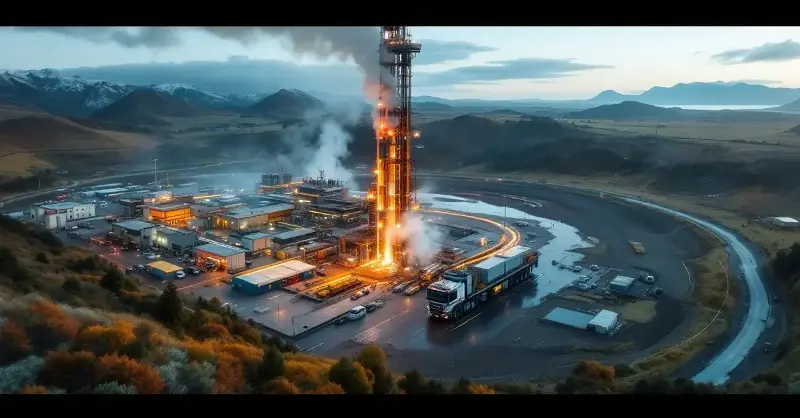
New Zealand has moved a step closer to drilling its first superhot geothermal well as the GeoShot NZ project progresses to its next phase. The initiative, led by the Ministry of Business, Innovation and Employment in partnership with Mercury NZ and Tauhara North No.2 Trust, will test whether extremely deep geothermal resources can be harnessed to support long‑term national energy security. The project is located at the Rotokawa Geothermal Field and has now secured government approval for the release of further public funding to begin pre‑drilling activity.
According to a government announcement, Cabinet has approved the release of the remaining NZ$55 million from the NZ$60 million initially allocated through the Regional Infrastructure Fund. The funding will support preparations for drilling a deep exploratory well, including securing specialist equipment, engaging contractors and completing technical work required to safely drill and test the site.
Government and industry collaboration on GeoShot NZ
Regional Development and Resources Minister Shane Jones said the project has reached an important milestone with the selection of New Zealand firm Todd Energy as the preferred drilling contractor. The partnership combines public funding with industry expertise from energy generator Mercury NZ and landowner Tauhara North No.2 Trust.
Mr Jones noted that the programme now has a defined drilling location, technical partners and oversight arrangements in place. The government views the initiative as a high‑risk but potentially high‑reward step in developing next‑generation geothermal energy technology.
Exploring superhot geothermal resources
The GeoShot NZ project aims to reach geothermal fluids located approximately 4–5 kilometres below the surface—roughly twice the depth of conventional geothermal wells. At these depths, the geothermal fluids are expected to carry significantly more energy, potentially delivering around three times the output of standard geothermal resources.
Accessing these resources presents major engineering challenges. Drilling equipment and well materials must withstand extreme temperatures and pressures, while systems must be developed to capture and convert the energy safely once it reaches the surface.
The first stage of the project focused on detailed engineering design for the first of three planned wells and on assessing specialised materials capable of operating under superhot conditions. That work was funded with NZ$5 million from the Regional Infrastructure Fund and has now been completed, allowing the programme to move into the drilling preparation stage.
Strengthening long‑term energy resilience
Officials see supercritical geothermal technology as part of a broader strategy to improve New Zealand’s energy resilience. The government has increasingly focused on diversifying domestic energy sources, particularly as declining gas reserves have prompted new policy responses, as reported in recent government energy security measures.
Mr Jones said government leadership is essential when developing emerging energy technologies that carry significant upfront risk but may deliver long‑term national benefits. If successful, the project could strengthen domestic expertise in geothermal engineering while supporting regional economic development.
New Zealand has been a global pioneer in geothermal energy since the 1950s. The GeoShot NZ initiative also includes collaboration with international partners, including Iceland, where similar superhot geothermal drilling projects are underway. Knowledge sharing between countries is intended to help address the technical challenges associated with drilling at extreme depths and temperatures.
The government views the project as part of a wider effort to expand clean energy options alongside other initiatives such as renewable energy investments and climate resilience programmes, including efforts to strengthen community infrastructure through the Māori Climate Platform funding for marae resilience.
If the exploratory drilling confirms viable superhot resources, the project could lay the foundation for future geothermal developments capable of generating significantly larger amounts of renewable energy.
This article is created with the assistance of OpenGov AI.