



Our oceans have effectively become trash dumps where massive quantities of plastic end up. So much so, in fact, that the largest offshore plastic accumulation zone has been labeled the Great Pacific Garbage Patch.
In new research published in the journal Communications Earth & Environment, scientists investigated whether decades of plastic pollution are changing the color of the ocean near this patch. And what they found could give us a new way to monitor plastic pollution at sea.
Microplastics are formed when larger plastic items break down over time or are intentionally manufactured at that microscopic size. Either way, tracking them is remarkably difficult. While it is relatively easy to spot large floating debris from far away, microplastics can be as small as a fraction of a micrometer. They are nearly impossible to scoop out at scale or detect using standard satellite infrared tools. So a completely different strategy is needed.
A different way to detect plastic pollution
Instead of trying to spot floating litter directly, scientists realized they could look at the color of oceans. That's because it is influenced by what is dissolved or suspended in the water, including plankton, organic matter and potentially plastic particles.
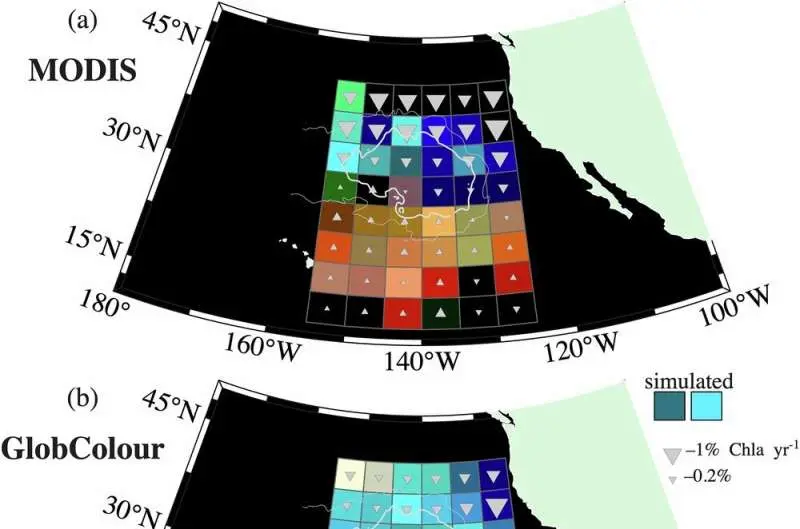
Building on this idea, Shea Cheatham, Daniel Koestner and Børge Hamre at the University of Bergen in Norway set out to determine how microplastics might affect the ocean's color. They examined three separate 20-year sets of satellite data (from 2002 to 2022) covering the region around the Great Pacific Garbage Patch, located in the eastern North Pacific Ocean.
The research team found that areas in and around this zone had become progressively brighter in blue and green light over time. This was noticeably different from waters farther away, which did not show the same shift.
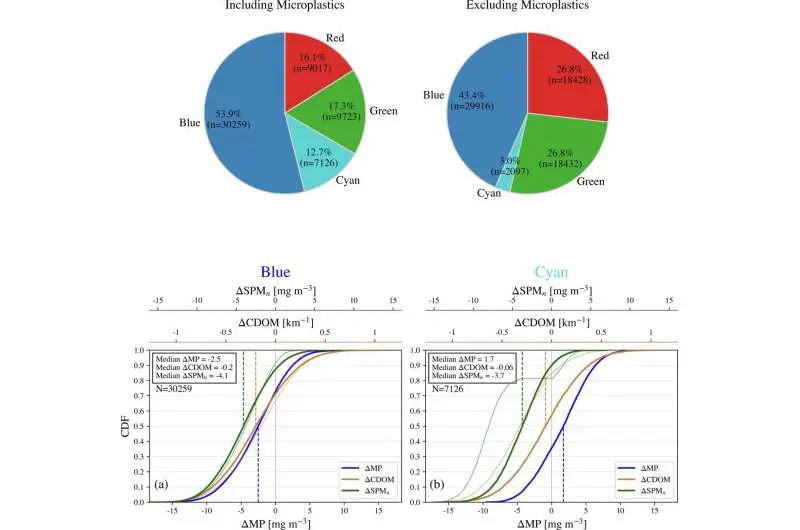
That being said, they could not link the color change directly to microplastics from the satellite images alone. "The observation of spectral brightening consistent with a modeled increase in suspended microplastic concentration does not, in itself, indicate that microplastics are the root cause of the perceived brightening," wrote the study authors.
Why is the ocean changing color?
However, computer simulations strengthened the suggestion of cause and effect. Their models showed that when suspended microplastics were present in the water, they scattered light in ways that produced a brightening pattern consistent with what satellites observed. This occurred in just 3% of simulations involving only natural changes, compared with 13% when microplastics were also included.
The researchers note that while natural changes in plankton populations or dissolved organic matter could theoretically cause a similar color shift, doing so would require unusually drastic ecological changes.
If the microplastics are contributing to the color change, the researchers believe satellite ocean-color measurements could be a valuable diagnostic tool to assess and monitor their accumulation from space. "Clear evidence of the scale of microscopic pollution is essential to address the growing use and mismanagement of plastics."
Written for you by our author Paul Arnold, edited by Gaby Clark, and fact-checked and reviewed by Robert Egan—this article is the result of careful human work. We rely on readers like you to keep independent science journalism alive. If this reporting matters to you, please consider a donation (especially monthly). You'll get an ad-free account as a thank-you.
Publication details
Shea Cheatham et al., The ocean's color is changing near the Great Pacific Garbage Patch, Communications Earth & Environment (2026). DOI: 10.1038/s43247-026-04071-0
Who's behind this story?
Paul Arnold
BSc Biology from University of London. BBC documentary producer with world travel experience. Freelances from southern Spain. Full profile →
Gaby Clark
MA in English, copy editor since 2021 with experience in higher education and health content. Dedicated to trustworthy science news. Full profile →
Robert Egan
Bachelor's in mathematical biology, Master's in creative writing. Well-traveled with unique perspectives on science and language. Full profile →
© 2026 Science X Network
Citation: Microplastic pollution could be changing the color of the Pacific Ocean (2026, November 6) retrieved 6 November 2026 from https://phys.org/news/2026-11-microplastic-pollution-pacific-ocean.html
This document is subject to copyright. Apart from any fair dealing for the purpose of private study or research, no part may be reproduced without the written permission. The content is provided for information purposes only.