




Killer whales, or orcas, are among the ocean's most formidable predators, hunting everything from fish and seals to other whales. But how and when these members of the dolphin family evolved into such effective hunters has long been something of a mystery.
Now, new research published in the journal PeerJ is helping to fill in some of the details. It suggests that orcas developed the physical characteristics needed to tackle large prey more than 2 million years ago. That's much earlier than previously thought.
Before they became the formidable predators we know today, early orcas were probably much smaller animals that fed mainly on fish. Over evolutionary time, they developed features such as larger bodies, powerful jaws and large teeth capable of gripping and tearing apart large prey.
Seabed discoveries
Clues to how this happened have come from the analysis of two skull fragments, part of a lower jaw and two sets of fused neck vertebrae from ancient orcas. The fossils were recovered from the seabed of the southern North Sea by commercial fishing trawlers and stored at the Natural History Museum Rotterdam in the Netherlands.
Scientists, led by Hidde Bakker from the museum, took detailed measurements of the fossil bones and compared their shapes and sizes with those of modern and extinct killer whales and other members of the dolphin family.
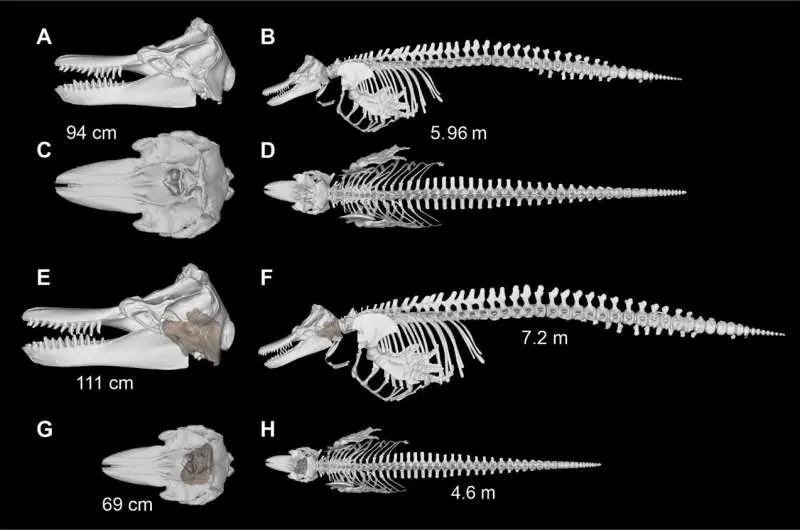
They also created 3D models of the skull fragments and compared them with a complete skeleton of a modern killer whale. This helped them determine the size of the ancient creatures.
To establish their age, the researchers analyzed microscopic fossils of marine algae preserved in sediment attached to one of the skull fragments.
Bigger and older than expected
And they were old, with the sediment dating back 2.6 to 2.1 million years, to a period known as the Gelasian. They weren't small either, with the researchers estimating that the larger individuals measured between 7.2 and 7.7 meters (23.6 to 25.3 feet) long. "The estimated body length of this killer whale was comparable to that of the largest extant male Orcinus orca," the study authors wrote.
Even back then, these orcas appear to have been equipped to tackle large prey. The fossil jaw had large, deep, widely spaced sockets, suggesting they possessed large teeth with long, strong roots. Previously, genetic studies had placed the emergence of modern killer whale populations with different hunting specializations in the Middle Pleistocene, around 770,000 to 120,000 years ago.
However, one question remains. Were these ancient predators early members of the same species that swims in our oceans today, or did they belong to a different species altogether? "It is still unclear whether the Gelasian Orcinus represents an early presence of O. orca or a distinct, large, currently undescribed species within the genus."
Written for you by our author Paul Arnold, edited by Lisa Lock, and fact-checked and reviewed by Robert Egan—this article is the result of careful human work. We rely on readers like you to keep independent science journalism alive. If this reporting matters to you, please consider a donation (especially monthly). You'll get an ad-free account as a thank-you.
Publication details
Hidde Bakker et al., A large orca from the Lower Pleistocene of the Southern North Sea Basin pushes back the origin of macropredatory behavior in the oceanic dolphins (Odontoceti, Delphinidae), PeerJ (2026). DOI: 10.7717/peerj.21890
Journal information: PeerJ
Who's behind this story?

Paul Arnold
BSc Biology from University of London. BBC documentary producer with world travel experience. Freelances from southern Spain. Full profile →

Lisa Lock
BA art history, MA material culture. Former museum editor, paramedic, and transplant coordinator. Editing for Science X since 2021. Full profile →

Robert Egan
Bachelor's in mathematical biology, Master's in creative writing. Well-traveled with unique perspectives on science and language. Full profile →
© 2026 Science X Network
Citation: Killer whales became fearsome predators long before scientists thought (2026, November 20) retrieved 20 November 2026 from https://phys.org/news/2026-11-killer-whales-fearsome-predators-scientists.html
This document is subject to copyright. Apart from any fair dealing for the purpose of private study or research, no part may be reproduced without the written permission. The content is provided for information purposes only.