



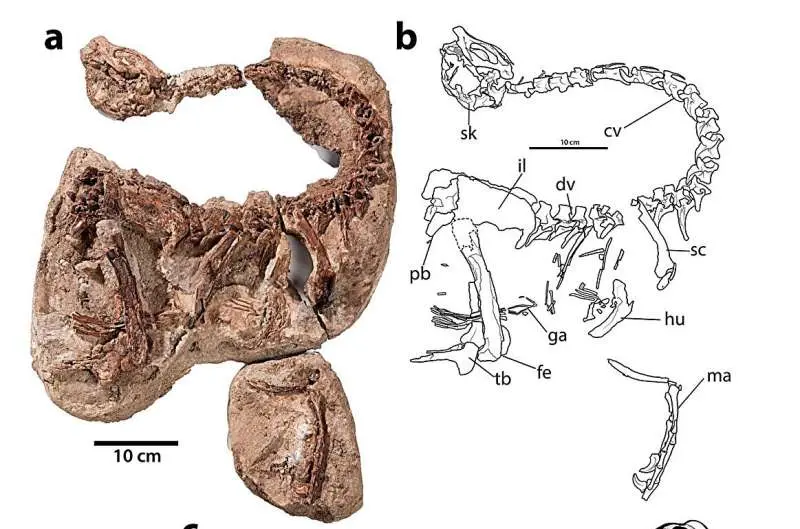
While many dinosaurs were fearsome predators with razor-sharp teeth, others were peaceful herbivores munching on plants. We can now add a new species to the list of plant-eaters, Infernogallus jamesi. Its name means hell chicken, and its fossilized remains were found in the Hell Creek Formation, a fossil-rich rock formation extending across parts of Montana, South Dakota and North Dakota. And it is providing fresh insights into how some dinosaur diets evolved.
Infernogallus jamesi was a 26-pound (12-kilogram) turkey-sized birdlike dinosaur that roamed North America around 66 million years ago. This small creature is a member of the caenagnathid family, a group of birdlike dinosaurs known for their toothless beaks and slender bodies.
This find includes the first nearly complete skull ever found for this group. Such skulls are exceptionally rare because their delicate bones and lightly built skeletons rarely survive fossilization. This has made it extremely difficult for scientists to figure out what these animals ate or how their jaws worked.
Unlocking the secrets of its jaw
But Gregory F. Funston at Stony Brook University in New York and colleagues didn't have this problem. However, that's not to say there weren't challenges, as parts of the skull and lower jaw had been crushed.
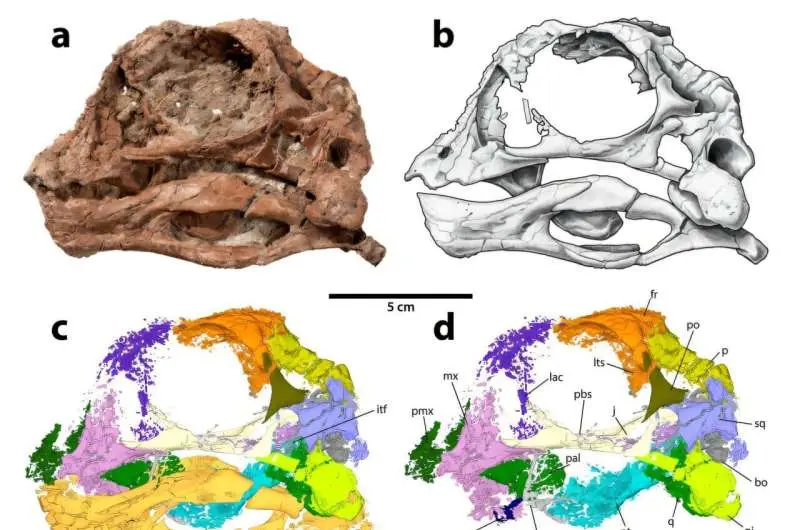
To solve this, the team used CT scans to digitally separate and reconstruct individual bones. They also mapped out where the jaw muscles attached and compared them with living birds and other dinosaurs to determine how the jaws worked.
The scientists found that instead of a strong up-and-down biting force, the jaw muscles were built to slide the lower jaw backward and forward, as they detail in their paper published in Nature Communications. The ridges and grooves inside the mouth may have acted like a mortar and pestle to mash soft food. Another reason for reaching this conclusion is that no stomach stones, which many plant-eating dinosaurs used to grind food, were found in its body cavity.
Fruit may have shaped dinosaur evolution
A similar feeding mechanism is found in some fruit-eating parrots, which use a similar front-to-back jaw motion to process soft fruit pulp. "We hypothesize that Infernogallus jamesi could have been specialized for processing soft, fleshy fruit," the study authors wrote.
This adaptation may help explain how dinosaur diets evolved along with changing Cretaceous ecosystems. As flowering plants spread and began producing larger, fleshier fruits, oviraptorosaurs, the wider group that includes caenagnathids, also diversified.
However, whether these dinosaurs actively helped spread plant seeds and drive fruit evolution is still an open question, as the researchers acknowledge. "Their role in the Late Cretaceous proliferation of fruit—which shaped early Cenozoic flora—remains unclear."
Written for you by our author Paul Arnold, edited by Gaby Clark, and fact-checked and reviewed by Robert Egan—this article is the result of careful human work. We rely on readers like you to keep independent science journalism alive. If this reporting matters to you, please consider a donation (especially monthly). You'll get an ad-free account as a thank-you.
Publication details
Gregory F. Funston et al., Fruit-eating adaptations in a Late Cretaceous oviraptorosaur (Theropoda), Nature Communications (2026). DOI: 10.1038/s41467-026-78343-w
Who's behind this story?
Paul Arnold
BSc Biology from University of London. BBC documentary producer with world travel experience. Freelances from southern Spain. Full profile →
Gaby Clark
MA in English, copy editor since 2021 with experience in higher education and health content. Dedicated to trustworthy science news. Full profile →
Robert Egan
Bachelor's in mathematical biology, Master's in creative writing. Well-traveled with unique perspectives on science and language. Full profile →
© 2026 Science X Network
Citation: Toothless 'hell chicken' dinosaur may have had a taste for fruit (2026, October 14) retrieved 14 October 2026 from https://phys.org/news/2026-10-toothless-hell-chicken-dinosaur-fruit.html
This document is subject to copyright. Apart from any fair dealing for the purpose of private study or research, no part may be reproduced without the written permission. The content is provided for information purposes only.