



Neutrinos are tiny elementary particles with little mass and no electric charge. While most neutrinos pass through matter without interacting, a neutrino can occasionally scatter off an atomic nucleus, transferring a little energy to it and causing it to move.
This motion, known as nuclear recoil, is tiny and very difficult to detect. Some physicists, including members of the COHERENT Collaboration, have been conducting advanced particle physics experiments aimed at measuring these nuclear recoils.
The COHERENT Collaboration is a research group involving scientists based at different institutes worldwide who conduct experiments at Oak Ridge National Laboratory (ORNL) and analyze the resulting data. One of its most recent papers, published in Physical Review Letters, reports the most precise measurement to date of coherent elastic scattering, in which a neutrino scatters off an atomic nucleus as a whole. This measurement sets tighter limits on how strongly neutrinos could interact with quarks through forces not described by the Standard Model.
"Neutrinos are among the few loose ends left in the Standard Model of particle physics, and one way to test our understanding of them is to measure the ways they interact with matter that theory predicts precisely," Ryan Bouabid, a corresponding author of the paper, told Phys.org.
"Coherent elastic neutrino-nucleus scattering (CEvNS) is one of those cleanly predicted interactions: a low-energy neutrino scatters off a nucleus as a whole, which makes the process far more likely than scattering off individual protons and neutrons. The trade-off is that the only sign it happened is the tiny recoil of the nucleus, which is much heavier than the neutrino."
Measuring the tiny recoil of atomic nuclei
The nuclear recoil linked with neutrino scattering leaves very small traces in particle detectors. The resulting signal is so small that it is hard to distinguish it from background noise.
COHERENT first observed this tiny signal in 2017, more than four decades after the process was first predicted. In their new paper, the researchers reported a more precise measurement obtained with germanium-based detectors.
"COHERENT's detectors sit at the Spallation Neutron Source (SNS) at ORNL, the world's most intense pulsed, accelerator-based neutron source," explained Bouabid.
"Protons striking a mercury target there produce pions, which decay into an intense burst of low-energy neutrinos as a byproduct. Our detectors sit in a basement corridor nicknamed 'Neutrino Alley,' about 20 meters (66 feet) from the mercury target behind thick concrete and gravel that block beam neutrons."
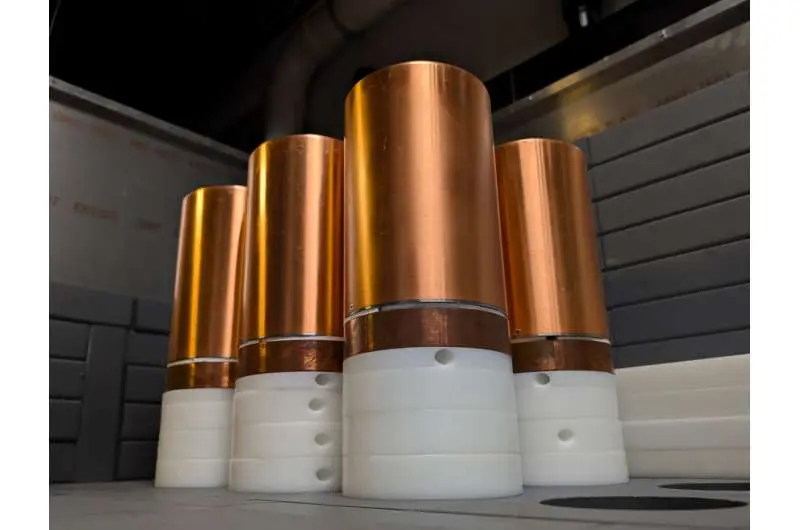
To detect the tiny nuclear recoils, the COHERENT Collaboration used detectors containing high-purity germanium. When a neutrino nudges a nucleus in a germanium crystal, the recoil frees a tiny amount of electric charge that is collected by the detector and measured.
Germanium itself produces very little background radiation, and shielding reduces radiation from the detector's surroundings. This makes the tiny recoil signals easier to detect.
"The key, though, is the beam's timing," said Bouabid. "The SNS fires 60 short pulses per second, so we know exactly when the neutrinos arrive. Looking only in a brief window after each pulse rejects the vast majority of backgrounds constant in time, while the long gaps between pulses allow us to measure and subtract what's left."
Setting new constraints on neutrino interactions
The researchers' new CEvNS measurement allowed them to set tighter limits on how strongly neutrinos could interact with quarks through some hypothetical forces. The team found that neutrinos scattered off germanium nuclei about as often as predicted by the Standard Model.
"A fun side result (though not the goal) is that each of our four 2.2 kg germanium detectors saw a significant signal on its own: three cleared the 5-sigma threshold physicists use to claim a discovery, and the fourth came just short," said Bouabid. "That puts each of them in the running for the world's smallest neutrino detector."
The ultimate goal for the COHERENT Collaboration is to measure neutrino scattering with very small uncertainty levels. This would pave the way for the detection of subtler effects, such as the so-called "charge radius," which can slightly affect how neutrinos scatter from charged particles, even if neutrinos have no net electric charge.
To move toward this goal, the researchers first need to collect more data and attain more accurate estimates of how many neutrinos from the SNS reach their germanium detectors.
"With this result we've reached the point where our precision is limited more by the knowledge of this neutrino flux than by the number of events we've counted in our detectors," said Bouabid.
"So, as we keep collecting data, we're also running a heavy-water detector to measure the flux independently, using a neutrino interaction on deuterium that can be calculated precisely. Theorists are already using our data to test for new interactions and neutrino properties."
Bouabid and the rest of the COHERENT team are now collecting more data with their germanium-based detectors and using a separate detector that measures the flux of neutrinos independently. This additional detector works by detecting the number of times that neutrinos interact with deuterium, a heavier form of hydrogen.
As part of their ongoing research, the researchers also plan to measure how often neutrinos scatter off other kinds of atomic nuclei. They will then compare their measurements with those obtained so far.
"We're deploying a ton-scale liquid argon detector to follow up on our earlier argon measurement, and we're exploring a cryogenic cesium iodide detector to reach lower energy thresholds," added Bouabid. "We're also making a range of inelastic measurements, where neutrinos excite or break up the nucleus instead of just nudging it.
"These investigations matter for understanding supernovae and for calibrating future large neutrino detectors. Measuring CEvNS on several different nuclei lets us test how the process scales with nuclear size, which is one of the cleanest checks of the Standard Model prediction."
Written for you by our author Ingrid Fadelli, edited by Sadie Harley, and fact-checked and reviewed by Robert Egan—this article is the result of careful human work. We rely on readers like you to keep independent science journalism alive. If this reporting matters to you, please consider a donation (especially monthly). You'll get an ad-free account as a thank-you.
Publication details
M. Adhikari et al., Measurement of Coherent Elastic Neutrino-Nucleus Scattering on Germanium by COHERENT, Physical Review Letters (2026). DOI: 10.1103/999m-b763
Who's behind this story?

Ingrid Fadelli
Freelance journalist with BSc Psychology and MA International Journalism. Covers AI, robotics, neuroscience, and astrophysics since 2018. Full profile →

Sadie Harley
BSc Life Sciences & Ecology. Microbiology lab background with pharmaceutical news experience in oil, gas, and renewable industries. Full profile →

Robert Egan
Bachelor's in mathematical biology, Master's in creative writing. Well-traveled with unique perspectives on science and language. Full profile →
© 2026 Science X Network
Citation: Most precise measurement of coherent elastic neutrino–nucleus scattering to date tightens limits on new forces (2026, November 25) retrieved 25 November 2026 from https://phys.org/news/2026-11-precise-coherent-elastic-neutrinonucleus-date.html
This document is subject to copyright. Apart from any fair dealing for the purpose of private study or research, no part may be reproduced without the written permission. The content is provided for information purposes only.