



Today, tropical waters typically host a wider range of marine animals than polar waters. This decline in marine biodiversity from the equator toward the North and South poles is known as the latitudinal diversity gradient.
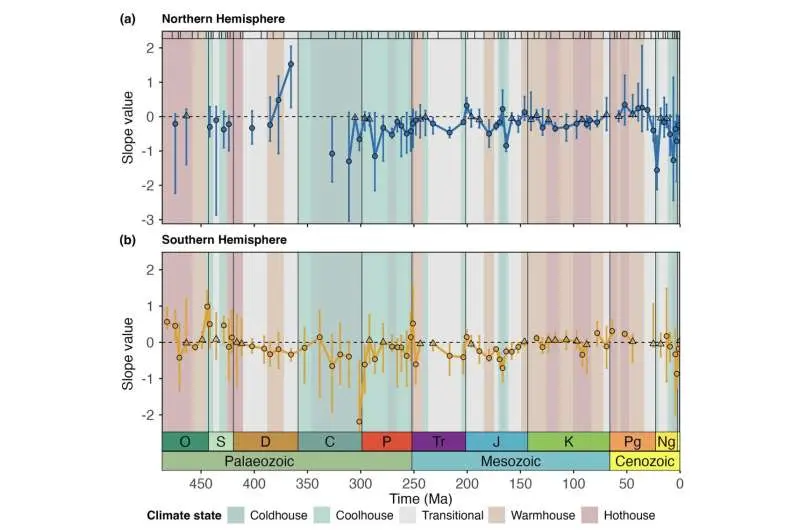
Researchers at Nanjing University and University College London (UCL) recently studied marine fossils spanning roughly 500 million years to understand how the diversity of marine environments changed over time. Their findings, published in Proceedings of the Royal Society B: Biological Sciences, suggest that today's latitudinal diversity gradient has not always been constant, as its strength and shape shifted in accordance with long-term climatic changes on Earth.
"My interest in this topic began early in my Ph.D. when I read a research article that proposed that the latitudinal distribution of biodiversity across Earth differed between warm and cold climates throughout Earth's geological history," Die Wen, first author of the paper, told Phys.org. "This led me to question whether today's tropical diversity peak is a permanent feature or a consequence of our current climate state, i.e., a warm interval within a coldhouse world."
Reconstructing marine patterns from ancient fossils
Wen and colleagues wanted to better understand how the climate on Earth influenced latitudinal diversity gradients in marine environments over the past 500 million years. To do this, they analyzed marine invertebrate fossil records stored in the Paleobiology Database, an online resource documenting the published record of past life on Earth.
"We reconstructed these fossils' ancient geographic locations and divided the globe into equal-area grid cells approximately 250 km (155 miles) apart," explained Wen. "Because some regions have been sampled more extensively than others, we used a statistical method called coverage-based rarefaction to make diversity estimates more comparable. We then measured how biodiversity changed with latitude separately in each hemisphere and compared these patterns across five global climate states, ranging from cold to extremely warm."
The team's analyses revealed that during colder periods on Earth, marine invertebrates were typically more diverse near the equator, while diversity declined steeply at higher latitudes. During warmer periods, on the other hand, marine invertebrate diversity was often more evenly spread across latitudes or peaked in temperate regions.
"Our key finding is that the familiar pattern of biodiversity being highest in the tropics and declining toward the poles has not been constant throughout Earth's history," said Wen. "Instead, its strength is closely associated with global climate state. One possible explanation is that warming shifts suitable thermal habitats toward higher latitudes, potentially reducing tropical biodiversity."
What ancient fossils suggest about global warming today
The findings of this study suggest that ongoing global warming could eventually change where marine life is most diverse. The team's fossil analysis, however, does not establish how quickly today's marine diversity patterns might change or which regions will gain or lose more species.
"Understanding how biodiversity might respond to global climate change is crucial to the conservation of life on Earth, with the fossil record providing our only window into the long-term effects of major environmental change," explained Philip Mannion, co-senior author of the paper. "With increasing warming expected over the next century, our results suggest that we might see declining tropical diversity and the poleward redistribution of species, at least for those organisms able to disperse."
The recent work by Wen, Mannion and their colleagues Lewis A. Jones and Junxuan Fan could contribute to the understanding of marine ecosystems on Earth and how they respond to climatic changes. Future analyses could compare the ancient fossil data analyzed by the researchers with more recent records of marine life on Earth.
"We now plan to investigate the mechanisms underlying these patterns, particularly the roles of continental drift, shallow-marine habitat availability and species' thermal preferences," added Wen. "By combining fossil records with paleoclimate simulations and Earth system models, we hope to gain a better understanding of how environmental changes shape biodiversity distributions and contribute to major evolutionary events, including mass extinctions."
Written for you by our author Ingrid Fadelli, edited by Gaby Clark, and fact-checked and reviewed by Robert Egan—this article is the result of careful human work. We rely on readers like you to keep independent science journalism alive. If this reporting matters to you, please consider a donation (especially monthly). You'll get an ad-free account as a thank-you.
Publication details
Die Wen et al., Climate state controls the strength of the latitudinal diversity gradient, Proceedings of the Royal Society B: Biological Sciences (2026). DOI: 10.1098/rspb.2026.1490.
Who's behind this story?

Ingrid Fadelli
Freelance journalist with BSc Psychology and MA International Journalism. Covers AI, robotics, neuroscience, and astrophysics since 2018. Full profile →

Gaby Clark
MA in English, copy editor since 2021 with experience in higher education and health content. Dedicated to trustworthy science news. Full profile →

Robert Egan
Bachelor's in mathematical biology, Master's in creative writing. Well-traveled with unique perspectives on science and language. Full profile →
© 2026 Science X Network
Citation: The tropics weren't always the most diverse marine environments, study finds (2026, November 12) retrieved 12 November 2026 from https://phys.org/news/2026-11-tropics-werent-diverse-marine-environments.html
This document is subject to copyright. Apart from any fair dealing for the purpose of private study or research, no part may be reproduced without the written permission. The content is provided for information purposes only.