



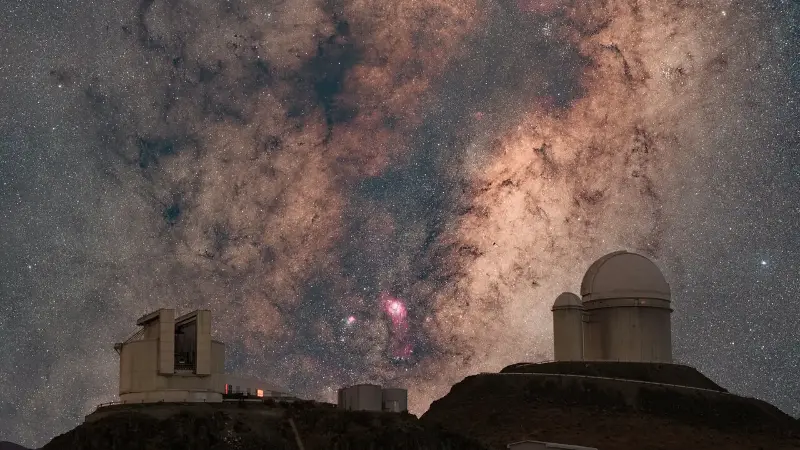
Dark clouds swirl across a sky speckled with stars as the Milky Way stretches above the European Space Observatory's La Silla Observatory in Chile's Atacama Desert.
What is it?
In this photograph snapped by astronomer José Rodrigues, the Milky Way splashes across the night sky above two telescopes at ESO's La Silla Observatory.
Between the two telescopes, the blue and red Trifid Nebula glows to the left of the larger and redder Lagoon Nebula, all within the Sagittarius constellation.
While the colorful glow of these two nebulae pull the eye toward the center of this photograph, they are surrounded by a majestic night sky landscape. The Milky Way paints the sky with dark, looming clouds lit by the galaxy's many stars.
While some of the dust in these clouds reflects starlight, causing some of the color that we see in the nebulae, most of this dust appears as dark , branching wisps.
Why is it incredible?
This image is obviously beautiful. It is a work of art; in framing the telescopes and the nebulae together, Rodrigues has created a striking visual.
But for Rodrigues, these telescopes are more than a pretty picture. The telescope seen on the left in this photo is ESO's New Technology Telescope (NTT), and the one on the right is ESO's 3.6-meter telescope. The latter scope which includes the instruments HARPS (High Accuracy Radial velocity Planet Searcher) and NIRPS (Near Infra Red Planet Searcher), which astronomers use to find and study exoplanets — worlds outside of our solar system.
And Rodrigues now studies exoplanets, making these instruments an important part of his life and his work.
"It is very special, as I grew up with a poster of the 3.6 m in my room, dreaming of using it to find exoplanets," Rodrigues said in a statement.