



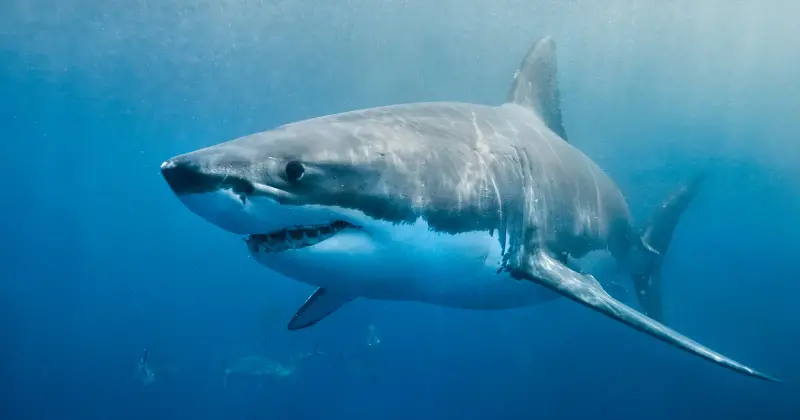
The Greenland shark has become a fixture of popular science writing in the way of a small number of charismatic creatures: the immortal jellyfish, the deep-sea tube worm, the bristlecone pine. The story arrives in roughly the same shape each time it is told. The shark lives for centuries. Some of the largest individuals alive in the North Atlantic today may have been born before or during Isaac Newton’s lifetime. Across those centuries, a parasitic copepod attaches to the cornea and stays there. The popular conclusion is that the sharks live extraordinarily long lives, and that they spend almost all of those lives blind.
The first part of that story is well-supported. The second part has just been revised, and the way it has been revised is more interesting than the version it replaces.
We want to look at what happened to the blindness claim, and then at what tends to happen when popular science meets a creature that lives much longer than we do.
The 2016 paper and what it actually said
The longevity claim rests on a single primary source: a 2016 paper in Science by Julius Nielsen and colleagues, based at the University of Copenhagen with a small group of collaborating institutions. The team applied radiocarbon dating to the eye lens nuclei of 28 female Greenland sharks ranging from 81 to 502 centimetres in length. The lens nucleus is useful for this work because it forms during embryonic development and does not turn over the way most tissues do. The carbon-14 captured at the centre of the lens reflects atmospheric carbon-14 at the time of birth.
The result was an estimated lifespan of at least 272 years, with the two largest sharks in the sample dated at approximately 335 and 392 years. The 392-year figure carries a confidence interval of plus or minus 120 years, which the popular version of the story tends to flatten. The reasonable reading is that the species can live for several centuries, that some individuals currently in the population were born in the 1600s or 1700s, and that the precise upper limit remains genuinely uncertain.
The blindness claim has a separate origin. It comes from a series of papers across the 1990s and 2000s describing infection by Ommatokoita elongata, a copepod parasite that attaches to the corneal surface, anchors itself with an adhesive structure called a bulla, and feeds on the tissue. The 1998 paper by Borucinska and colleagues, looking at six infected shark eyes in Victor Bay in the Canadian Arctic, concluded that parasitism “could lead to severe vision impairment, possibly including blindness”. That qualifier “possibly” did most of the work, and it was the part that gradually fell away in summary after summary, until “the sharks are functionally blind” became the standard line.
What the new paper actually shows
In January 2026, Lily Fogg, Dorota Skowronska-Krawczyk and colleagues at the University of Basel and UC Irvine published in Nature Communications what is, in our reading, one of the first comprehensive tests of the question. They present genomic, transcriptomic, histological and functional evidence that the Greenland shark retains an intact visual system well-adapted to dim conditions. The retinal tissue in the specimens they examined showed no signs of degeneration across the age range. The molecular machinery for processing low light was present and active. The authors identified DNA repair pathways in the retina that they argue help preserve photoreceptor function across centuries.
The starting point for the work was, on Skowronska-Krawczyk’s account, a video clip. She watched footage of a Greenland shark moving its eyeball to track a light source. Her observation was a biologist’s one: evolution does not tend to maintain a complex sensory organ that confers no benefit. If the eye works enough to track light, something is being seen.
The shark is not blind. The parasite is real, often present, and clearly does some local damage to the cornea. The animal sees through it, or around it, or in spite of it, well enough that the visual system has been actively preserved for centuries rather than allowed to decay.
This is a more interesting finding than the one it replaces.
What we tend to do with very long lives
In our reading of the popular coverage of this species over the past decade, there is a pattern worth naming.