



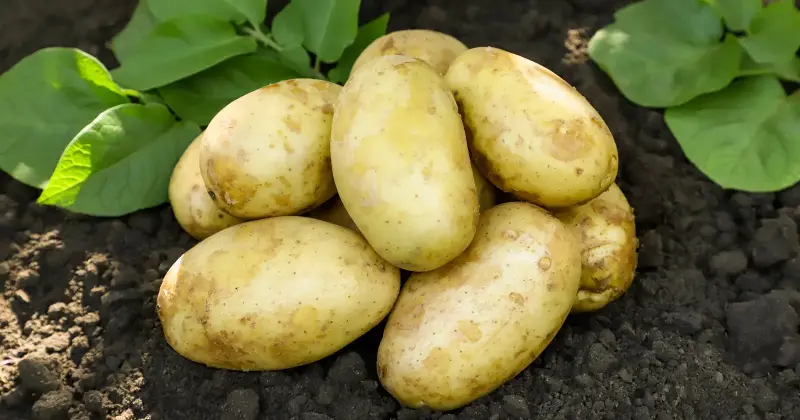
The potato is the third most important staple crop on Earth. Together with wheat, rice, and maize, it provides approximately 80 per cent of all the calories consumed by the human species. Approximately 7,000 years ago, on the shores of Lake Titicaca in what is now Bolivia and Peru, humans began cultivating the plant that has since spread to every arable continent and, in many countries, become the single largest source of dietary carbohydrate.
The plant humans domesticated 7,000 years ago was already the product of a substantially older biological event. Where the potato came from, evolutionarily, had been one of the more persistent unresolved questions in agricultural botany for most of the past century. The tuber itself, as a structure, has a specific and unusual profile. Very few plant lineages produce tubers, and those that do have generally evolved them independently. The potato tuber, on the available comparative evidence, is a genuinely novel biological invention.
What has been unclear, until recently, is who invented it.
The problem
The cultivated potato belongs to a lineage of plants called Petota, which contains the cultivated species Solanum tuberosum along with 107 wild relatives. The Petota lineage is closely related to two other lineages within the genus Solanum. The first is the Tomato lineage, which contains 17 cultivated and wild species including the familiar Solanum lycopersicum. The second is a much smaller lineage called Etuberosum, which contains just three living species, all native to the southern part of South America and largely unknown outside specialist botanical circles.
The three lineages had, for most of the twentieth century, resisted definitive classification. Some morphological features of the potato appeared to align it with the Etuberosum lineage. Some genetic features aligned it with the Tomato lineage. Attempts to place the potato within a single evolutionary tree consistently produced contradictions. The most detailed twentieth-century analyses concluded that potato was closer to Etuberosum than to Tomato, but subsequent molecular studies produced results that supported the opposite conclusion.
The problem, as botanists working on the group increasingly suspected but could not confirm, was that the potato might not fit on a single evolutionary tree at all.
The 2025 finding
In July 2025, a research team led by Sanwen Huang at the Chinese Academy of Agricultural Sciences, with co-authors including Sandra Knapp at the Natural History Museum in London, published a paper in the journal Cell that resolved the long-standing puzzle. The team had assembled and analysed high-quality genome sequences from every major Petota, Tomato, and Etuberosum lineage in the Solanum genus, using computational methods sensitive enough to detect the specific signature of ancient hybridisation between two previously distinct evolutionary lineages.
The signature was there. The Huang team’s analysis established that the entire potato lineage, including every wild potato species and every cultivated variety, descends from a single ancient hybridisation event between an ancestor of the modern Tomato lineage and an ancestor of the modern Etuberosum lineage, occurring approximately 8 to 9 million years ago in what is now the southern half of South America.
The two parent lineages had, at that point, been diverging for approximately 14 million years. They were sufficiently distinct that their offspring should not, on the standard rules of biological speciation, have been able to reproduce. The chance encounter that produced the potato was, in ordinary evolutionary terms, an event that should not have worked. Its offspring should have been sterile or unviable. Instead, the hybrid produced a stable lineage that has diversified over the following 8 million years into the more than 100 species that now make up the Petota clade.
What each parent contributed
The most striking result of the Huang team’s analysis was the identification of the specific genes that each parent contributed to the potato’s most distinctive feature.
The tuber is not a single trait. It is a coordinated developmental system involving the timing of tuber initiation, the identification of which underground stems will become tubers, the accumulation of starch in the appropriate tissue, and the eventual dormancy that allows the tuber to survive winter. Two genes, the Huang team’s analysis showed, are essential to the process, and each of them came from a different ancestor.
The first gene, called SP6A, functions as the master switch that tells the plant when to begin making tubers. It responds to daylight length and other environmental cues and triggers the developmental cascade that produces the tuber. SP6A came from the Tomato ancestor. The Tomato lineage does not itself produce tubers, but the gene that would later become the master switch for tuber formation was present in the tomato ancestor’s genome, doing a different job related to flowering.
The second gene, called IT1, controls the identification of which underground stems will become tubers and the coordination of tuber formation itself. IT1 came from the Etuberosum ancestor. The Etuberosum lineage produces rhizomes rather than tubers, and the IT1 gene in that lineage does related developmental work that had not, on its own, produced true tubers.
Neither parent lineage could produce a potato tuber. The Tomato ancestor had the master switch but not the developmental coordination gene. The Etuberosum ancestor had the coordination gene but not the master switch. Only the hybrid, carrying both genes from both parents, could produce the developmental sequence that results in a tuber. The Natural History Museum described the finding as the resolution of a long-standing puzzle in agricultural botany. The potato was, in a specific and literal sense, an accident.
What it means
The Huang team’s finding has implications that extend well beyond the resolution of an academic taxonomic dispute.
The first is that one of the most important crops in human history is a genuine evolutionary novelty. The potato is not simply a variant of an existing plant lineage that humans selected for particular traits over the past 7,000 years. It is the product of an interspecific hybrid event that produced a new developmental system that had not previously existed on Earth. The potato exists because two ancient South American plant lineages, having diverged for 14 million years, happened to grow close enough together to reproduce, and their offspring, against the standard biological odds, was viable.
The second is that the specific mechanism identified by the Huang team, in which two genes from two different ancestors combine to produce a developmental capability that neither parent had, is likely to be more common in the evolutionary history of other agricultural crops than has previously been appreciated. Several other food plants, including wheat and cotton, are known to have polyploid genomes derived from ancient hybrid events. The specific type of homoploid hybrid speciation that produced the potato, in which no whole-genome duplication was involved, has been substantially harder to detect and may account for more of agricultural biology than the current genomic evidence has yet resolved.
The third is that the practical implications for modern potato breeding are potentially substantial. The Zhang team’s commentary on the Huang paper in the same issue of Cell noted that identifying the specific parental contributions to modern potato varieties would enable more targeted breeding approaches. The wild relatives of both parent lineages, including the three surviving Etuberosum species, may contain useful genetic variation that could improve the disease resistance, climate tolerance, or nutritional quality of cultivated potato varieties. The potato’s evolutionary history is not just of academic interest. It is potentially a resource for the future breeding of a crop that feeds a substantial fraction of the human species.
The tuber itself is not a random accumulation of starch in an underground stem. It is a coordinated developmental system that required two specific genes from two specific ancestors, brought together by a chance encounter approximately 9 million years ago, in a place none of the participants in that encounter had any way of understanding.
The wild tomato that contributed the master switch is still alive today, in various forms, on the mountainsides and coastal regions of western South America.
The small tuberless plant that contributed the coordination gene is still alive too, in three surviving species, all restricted to a small area of Chile.
Neither knows what they made together.
The post The modern potato traces back to an ancient chance encounter between a wild tomato and a small tuberless plant approximately nine million years ago in South America, in a hybrid event that produced the first underground storage organ neither parent could have made on its own appeared first on Space Daily.