



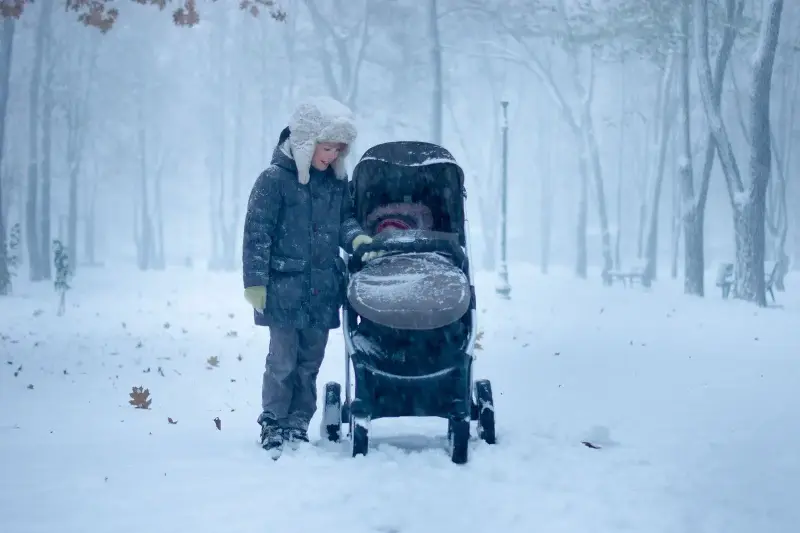
Across Finland, Sweden, Norway and Denmark, parents push prams onto balconies, into garden snowdrifts, and along café pavements when the thermometer reads minus 5°C, then walk away. The babies inside, swaddled in wool and down, sleep. Often longer than they ever do indoors. The practice is so ordinary in Helsinki that no one looks twice, and Nordic parents will tell you their infants nap up to ninety minutes longer in the cold air than in a warm bedroom — an observation that has circulated in Scandinavian parenting culture for nearly a century, even if the controlled clinical trial to nail it down has never quite been done.
The claim sits somewhere between folk wisdom and physiology. It is repeated by midwives in Stockholm, paediatric nurses in Oslo, and the staff of Helsinki nurseries where toddlers spend seven hours a day outdoors in winter. The mechanism — why a baby in a sub-zero pram should sleep more deeply than the same baby in a centrally heated nursery — is where the story gets interesting.
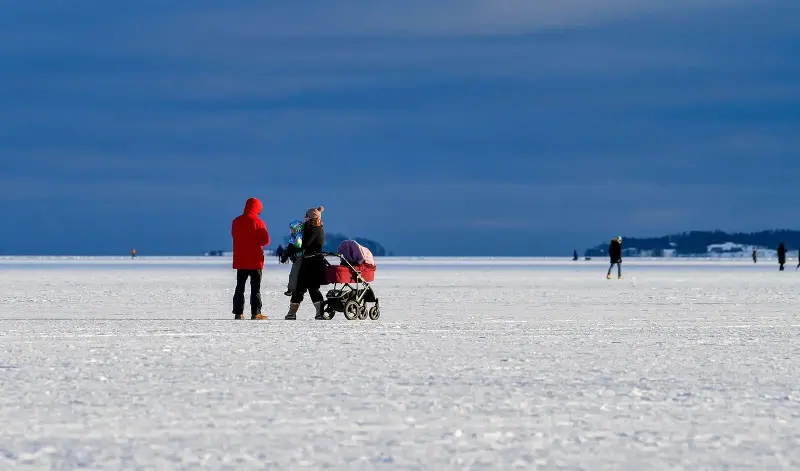
The pram on the balcony
The custom traces back to the early twentieth century, when Nordic public-health campaigns urged mothers to expose infants to fresh, cold air to ward off rickets and respiratory infection. By the 1950s it had hardened into routine. Walk through central Stockholm in February and you will see rows of prams parked outside cafes, their occupants invisible under sheepskin liners, while parents drink coffee inside. In Finland, the practice is bound up with friluftsliv — literally “open-air living” — the cultural conviction that time outdoors is not a treat but a daily nutritional requirement, like food or sleep itself.
The temperature threshold most Nordic parents cite is around minus 10°C. Below that, prams come inside. Above it, a well-dressed baby is considered better off in the cold than the warm. The often-repeated figure — that outdoor naps run roughly 90 minutes longer than indoor ones — comes from surveys of Scandinavian parents rather than a randomised trial, but the consistency of the reports across four countries and several generations is striking enough that paediatric researchers have begun looking at the physiology that would explain it.
Why cold air and sleep get along
Human sleep is regulated, in part, by a drop in core body temperature. As the body cools at night, the brain shifts into deeper, slower-wave sleep. Overheating does the opposite — it fragments sleep, prolongs the time spent in lighter stages, and triggers more frequent arousals. Indoor nurseries in winter often run at 21 to 23°C with low humidity and stale, recirculated air. A well-bundled baby in those conditions is essentially in a thermal environment closer to a sauna than a sleep chamber.
Outdoor air at minus 5°C, by contrast, gives the baby’s exposed face a steady cooling signal while the insulated body remains warm. The temperature differential appears to deepen sleep without triggering the metabolic stress of actual cold exposure. Research from communities living through the Arctic polar night has shown that sleep architecture in cold climates differs meaningfully from sleep in temperate ones, with longer slow-wave phases and fewer micro-arousals in adults acclimatised to the cold.
There is also the question of air quality. Indoor nurseries are reservoirs for the viruses and bacteria of every child who passed through that morning. Microbiologists studying indoor air systems have repeatedly shown that recirculated, warm, humid air encourages microbial growth and the suspension of respiratory droplets. Cold outdoor air is, by comparison, almost sterile.
The croup clue
One of the strongest pieces of clinical evidence that cold air does something specific to small airways comes from a 2023 trial on childhood croup. Children with moderate-to-severe croup were randomised to receive standard treatment or standard treatment plus thirty minutes of outdoor cold-air exposure. The cold-air group showed significantly greater improvement in symptom scores within thirty minutes — faster than the medication alone could account for.
The mechanism, as the researchers described it, is that cold air constricts inflamed mucosal blood vessels in the upper airway, reducing swelling and opening up the breathing passage. For a baby who is not sick, the same principle still applies in a milder form — cooler inhaled air means clearer breathing, and clearer breathing means fewer of the small obstructive arousals that fragment infant sleep.
How a baby actually stays warm in a pram at minus 5°C
The physics here is more delicate than it looks. Infants have a higher ratio of skin surface to body mass than adults, less subcutaneous fat, and less muscle to shiver with. Children are less effective than adults at producing body heat through shivering. A sleeping baby cannot keep moving to stay warm, which is what older children in forest nurseries do.
What keeps the baby warm is the pram itself, configured as a small thermal envelope. A wool base layer against the skin. A fleece or wool middle layer. A down or wool suit. A sheepskin or lambskin liner inside the pram bassinet, which is the part Nordic parents will tell you is non-negotiable. A windproof cover over the foot of the pram. The baby’s face stays exposed to the air; everything else is in a microclimate that hovers around 20 to 25°C even when the outside reads well below freezing.
Paediatric guidance on winter dressing for infants stresses the same principle — layers that trap warm air, no bulky snowsuits inside car seats, and constant checking of the back of the neck and the chest, which are the truest indicators of a baby’s core temperature. Cheeks will be cold to the touch even in a perfectly warm baby. The neck tells the real story.
The ninety-minute figure
The specific claim that outdoor naps run up to ninety minutes longer than indoor ones appears most often in Finnish and Swedish parenting surveys, where mothers were asked to compare nap durations across settings. A frequently cited unpublished comparison from a Finnish daycare cohort placed outdoor naps in the 90-to-180-minute range and indoor naps in the 30-to-90-minute range — a gap that lines up neatly with the ninety-minute headline figure.
The caveats matter. These are observational reports, not blinded trials. Babies who nap outdoors may also nap after a long pram walk, which is itself sleep-inducing. Parents who commit to outdoor napping may have calmer routines overall. The cold air may be one variable among several. What the data does show, consistently, is that the practice does not appear to harm sleep duration in healthy, well-dressed infants and may extend it — a finding that survives across decades of Nordic paediatric observation even if the controlled experiment is still missing.
What forest nurseries figured out
The same logic scales up. In Nordic forest nurseries, children spend extended hours outdoors year-round, including naps in tents or nearby shelters after cold-weather play. Teachers at these programs report that the children rarely catch colds, an observation backed by a Finnish study led by Aki Sinkkonen at the Natural Resources Institute Finland, which found that microbial diversity on the skin and in the guts of children playing in forest undergrowth increased measurably within 28 days, along with anti-inflammatory markers in their blood plasma.
The same biology applies to babies, scaled down. Cold, clean air. Exposure to environmental microbes through the face and respiratory tract. A thermal challenge mild enough not to stress the metabolism but real enough to deepen sleep. Nordic parenting culture stumbled onto a package that modern paediatric science is only now beginning to itemise.
What it doesn’t mean
None of this is a licence to leave a baby in any cold environment unsupervised. The Nordic practice depends on a tight set of conditions: temperatures generally not below minus 10°C, no wind chill driving the effective temperature lower, dry weather, and constant adult monitoring from a window or nearby seat. Pram cameras and baby monitors are standard. The baby is checked roughly every twenty minutes. Any sign of cold cheeks paired with a cool neck, and the pram comes inside immediately.
Other variables that affect infant sleep duration also need accounting for. A study found that breastfeeding was linked to longer sleep duration in one-year-olds, which suggests feeding patterns are at least as important a contributor as the thermal environment. The outdoor-nap effect, if it is real, is one input in a larger system.
The broader Nordic bet
The babies in the prams grow into the toddlers in the forest nurseries, who grow into the children Finland has spent nine consecutive years ranking at or near the top of the World Happiness Report. The thread connecting them is a simple cultural assumption: that humans, including very small ones, are built to be outside more than they are. Sleep, immunity, mood, and what developmental psychologists call sensory regulation all seem to respond to that input in ways indoor environments cannot replicate.
It is the same logic, scaled to infancy, that we’ve explored elsewhere on Space Daily in the context of how early language exposure shapes infant development — the recurring finding that babies are far more receptive to environmental signals than the design of most modern indoor spaces assumes.
A sleeping baby in a pram in Helsinki at minus 5°C is, in that sense, not doing anything strange. The strange thing is the heated, sealed, recirculated bedroom that the rest of the world has decided is the proper place for an infant to sleep. The Nordic countries quietly opted out of that consensus a hundred years ago, and the babies, judging by the duration and depth of their naps, seem to agree.
On any given Tuesday in February, somewhere in central Helsinki, a pram sits outside a cafe with a baby inside it, breathing slow, cold breaths, asleep for the second hour.
The post Finnish researchers tracked babies napping outdoors at minus 5°C and found they slept up to 90 minutes longer than indoors appeared first on Space Daily.