



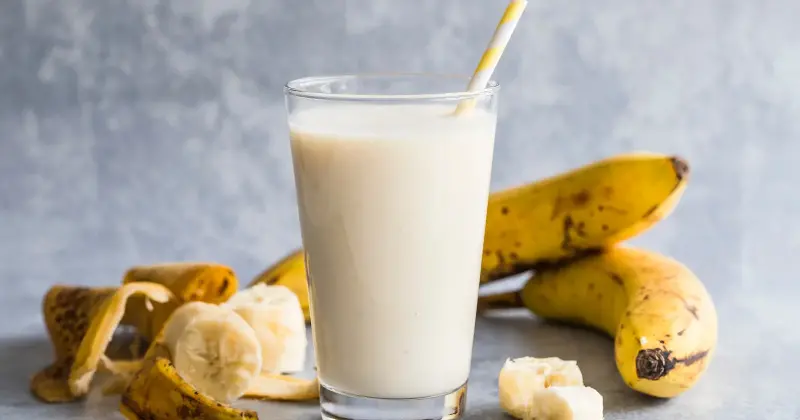
The standard cultural framing of how to make a healthy smoothie has, for most of the last two decades, been calibrated to a particular combination of ingredients. The combination involves blending a base of one or two bananas with a generous portion of mixed berries, alongside whatever combination of yogurt, almond milk, and various other additions the particular smoothie configuration calls for. The combination is, by every available measure of how the wider population actually consumes smoothies, the dominant formulation in most contemporary kitchens. The combination is also, on close examination, almost exactly calibrated to neutralize the various health benefits that the wider register has been telling smoothie drinkers the smoothies were going to provide.
A research study, originally published in 2023 in the Royal Society of Chemistry journal Food & Function and subsequently the subject of considerable ongoing coverage across the wider register, has demonstrated that adding a banana to a berry smoothie reduces the body’s absorption of certain key antioxidants by approximately 84 percent. The reduction is structurally specific. The reduction is also, on close examination, the result of a particular enzymatic mechanism that the wider register has not, until quite recently, been aware of.
The mechanism is the same enzyme that turns bananas brown after they are peeled. The mechanism is, in some real way, doing the same kind of degradation in the smoothie as it does on the kitchen counter, except that the smoothie configuration provides the enzyme with direct access to the various antioxidant compounds in the berries, and the access is what produces the 84 percent reduction.
What the study actually found
It is worth being precise about what the study actually found, because the wider register has tended to absorb the finding in slightly more dramatic terms than the underlying evidence warrants.
The study was led by Javier Ottaviani, an adjunct researcher at the University of California, Davis, and the director of the Core Laboratory at Mars Edge, working with Professor Gunter Kuhnle of the University of Reading. According to the UC Davis documentation of the work, the study was a controlled crossover trial involving eight healthy men. Each participant consumed three different test conditions across the trial: a banana-almond milk smoothie, a mixed-berry smoothie, and a flavanol capsule used as the control. The researchers then analyzed blood and urine samples to measure how much of the relevant antioxidants had actually been absorbed by the participants’ bodies.
The relevant antioxidants are called flavanols, sometimes also called flavan-3-ols, and they are part of a wider class of plant compounds called polyphenols. Flavanols are found in considerable concentrations in berries, apples, pears, grapes, cocoa, and tea. The wider scientific literature has documented, across decades, that flavanols are associated with various structural health benefits, including improvements in blood flow, blood pressure, memory, and the various other cardiovascular and cognitive functions that the Academy of Nutrition and Dietetics has been calibrating its dietary recommendations to.
The results of the trial were structurally clear. According to the ScienceDaily coverage, the participants who drank the banana smoothie showed an 84 percent reduction in flavanol levels in their blood and urine compared with the participants who took the flavanol capsule. The participants who drank the mixed-berry smoothie, by contrast, showed flavanol levels comparable to the capsule control. The combination of the banana and the berries, accordingly, was producing the structural difference between the two smoothie conditions.
What polyphenol oxidase actually is
The structural mechanism that produces the 84 percent reduction is, on close examination, an enzyme called polyphenol oxidase, often abbreviated as PPO. The enzyme is widely distributed across various fruits and vegetables. The enzyme is also, by every available measure of how it actually operates, considerably more concentrated in bananas than in most of the other foods the wider register has been treating as standard smoothie ingredients.
The enzyme is what produces the brown color that bananas develop after they are peeled and left exposed to air. The browning occurs because the enzyme, when exposed to oxygen, catalyzes the oxidation of various phenolic compounds in the banana, producing dark-colored quinones as the reaction products. The reaction is structurally identical to what is happening when a sliced apple turns brown, when a cut avocado darkens, or when various other phenolic-rich fruits and vegetables undergo the same enzymatic oxidation.
The structural feature worth attending to is what happens when the PPO enzyme is brought into direct contact with the flavanols in berries, as it is when the two are blended together in a smoothie. According to the published research, the PPO rapidly degrades the flavanols into quinones, which the body does not absorb in the same way as the original flavanols. The degradation is, by every available measure of how it occurs, structurally fast. The enzyme does its work in the smoothie itself, before the smoothie is even consumed. The flavanols are, in some real way, being destroyed during the blending process.
Professor Kuhnle’s published comments on the magnitude of the effect are worth quoting directly. “The extent of the effect from adding a single banana was still very surprising,” he said. “It had enough polyphenol oxidase to destroy the vast majority of flavanols found in the berries.” A single banana, in the typical smoothie configuration, is sufficient to produce the 84 percent reduction. The effect is not, on close examination, calibrated to large quantities of banana. The effect is calibrated to the structural concentration of PPO in even a single banana, which turns out to be enough.
What happens when banana is consumed alongside the berries, but not blended
The structural question worth attending to is whether the degradation only occurs during blending, or whether it continues to occur after the smoothie has been consumed. The wider register has tended to absorb the finding as if it were primarily about the blending process. The accurate framing is more specific.
A secondary part of the study, on the available reporting, tested what happens when participants consumed flavanols and a banana drink at the same time but without blending them together. According to the Advisory Board coverage, this configuration also showed a reduction in flavanol absorption, although the magnitude was smaller than the 84 percent figure produced by the blended smoothie. The reduction in this configuration suggests that the PPO enzyme remains enzymatically active in the stomach after ingestion, and not only during the mechanical mixing of the blending process.
The implication is that the structural problem extends beyond the smoothie configuration to any situation in which bananas and flavanol-rich foods are consumed together. The blending makes the problem worse, by providing the PPO with direct mechanical access to the cellular contents of the berries. The consumption together, even without blending, also produces some degree of the same enzymatic degradation in the digestive tract.
What the actual practical recommendation is
The practical recommendation, on the available evidence of the published research, is structurally specific. The recommendation is not, on close examination, that bananas should be avoided. Bananas are, by every available measure of their wider nutritional profile, a healthy fruit that provides fiber, potassium, vitamin B6, and various other nutrients that the wider population would benefit from consuming.
The recommendation is, more specifically, that bananas should not be combined with flavanol-rich foods in a single smoothie if the goal of the smoothie is to maximize flavanol absorption. According to Ottaviani’s published recommendations, people aiming to consume the Academy of Nutrition and Dietetics’ recommended daily flavanol intake of 400 to 600 milligrams should pair flavanol-rich fruits such as berries with ingredients that have low PPO activity. The low-PPO alternatives include pineapple, oranges, mango, and yogurt. These ingredients provide the structural body and creaminess that bananas have been providing in the standard smoothie configuration, without producing the enzymatic degradation that bananas produce.