



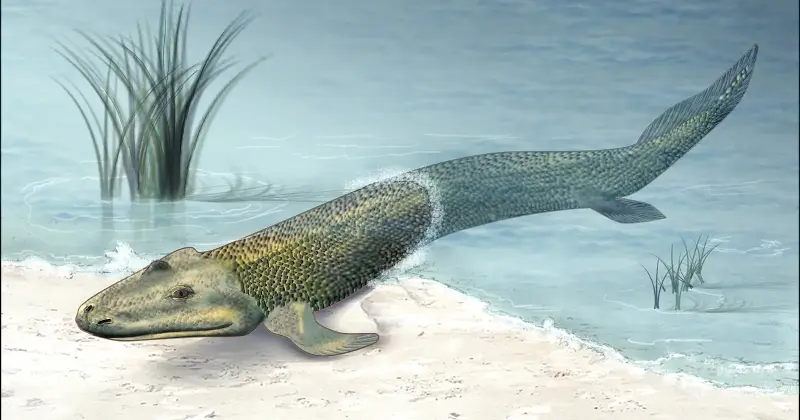
In 1999, three paleontologists made a decision that would, five years later, lead them to one of the most important fossil discoveries of the twenty-first century.
They had a hypothesis. Somewhere in the world, in rocks of roughly the right age — between 380 and 365 million years old, the moment in Earth’s history when fish were thought to have begun the transition to land animals — there should be fossils of creatures that were neither fully fish nor fully tetrapod. Half-and-half animals. Bridges in stone.
The trouble was finding them. Rocks of the right age that hadn’t been destroyed by geological forces, weren’t buried under modern cities, and were accessible to fieldwork were rare. The team — Edward Daeschler of the Academy of Natural Sciences in Philadelphia, Neil Shubin of the University of Chicago, and the late Farish Jenkins Jr. of Harvard — settled on Ellesmere Island, in the Canadian Arctic.
Their first four summers there produced nothing of significance. The fifth, in 2004, produced Tiktaalik.
What they found
The fossil that came out of the rock that summer was extraordinary. It belonged to a creature that has since been nicknamed the “fishapod” — because that is, almost literally, what it was.
Tiktaalik had scales. It had gills. It had fins. By every external measure, it looked like a fish. A large fish — adults reached up to 2.7 metres, with a flat crocodile-like head and sharp predator’s teeth.
But inside the fins, the bones told a different story. Tiktaalik’s pectoral fins — the ones that would become front legs in its eventual descendants — contained the same basic skeletal architecture as the limbs of land animals. A shoulder. An elbow. A wrist. Bones articulated with joint surfaces that could rotate and flex. Crucially, the bones were robust enough to support the animal’s weight, suggesting Tiktaalik could prop itself up in shallow water and possibly drag itself onto mud banks.
It also had something no fish had. A neck. Most fish skulls are fused directly to their shoulder girdles, which is why fish can’t turn their heads. Tiktaalik’s skull was free to swivel — a feature found in land animals, not in fish. Combined with primitive lungs (it had both gills and lungs) and a sturdy ribcage capable of supporting its body out of water, Tiktaalik was a creature genuinely caught between two worlds.
The species was named Tiktaalik roseae — Tiktaalik from the Inuktitut word for “large freshwater fish,” chosen with input from the Inuit community that lived near the dig site, and roseae in honour of an anonymous donor who funded the work.
What it actually proves
The popular version of this story often calls Tiktaalik “the missing link” — the single bridge between fish and land animals. The reality is more interesting.
Tiktaalik is not, by itself, the bridge. It is one of a series of transitional fossils that paleontologists have uncovered since the 1960s — including Panderichthys, Acanthostega, and Ichthyostega — each of which captures a slightly different point in the long, slow transition from aquatic to terrestrial vertebrates.
What makes Tiktaalik special isn’t that it’s the only such fossil. What makes it special is how complete it is, how clearly it shows the intermediate anatomy, and the fact that the team found it by deliberate hypothesis-driven prediction. Daeschler, Shubin and Jenkins didn’t stumble into it. They predicted where a fossil like this should exist based on the geology, went there, and found it. The discovery is one of the cleanest examples of evolutionary biology making a falsifiable prediction and having it confirmed in the field.
There’s also one careful distinction to make. Tiktaalik may not be the direct ancestor of modern tetrapods — it could be a close cousin of the lineage that actually gave rise to land vertebrates. Britannica describes it as “a very close relative of the direct ancestors of tetrapods,” which is the most accurate framing. The line of descent from water to land is now well-documented, but Tiktaalik itself sits adjacent to that line, not necessarily on it.
Two surprises that came later
Two follow-up discoveries have complicated the simple story in fascinating ways.
In 2014, the team published an analysis of Tiktaalik’s pelvis, which they had initially overlooked. The pelvis turned out to be far more substantial than expected — robust, with a ball-and-socket hip joint resembling those of early land animals. This was unexpected because previous theories had assumed hind legs developed after vertebrates moved onto land, as an adaptation to terrestrial locomotion. Tiktaalik’s pelvis suggested that powerful rear-limb development began in water, before any of these animals walked on dry ground. Hind legs evolved as swimming aids before they ever became walking aids.