



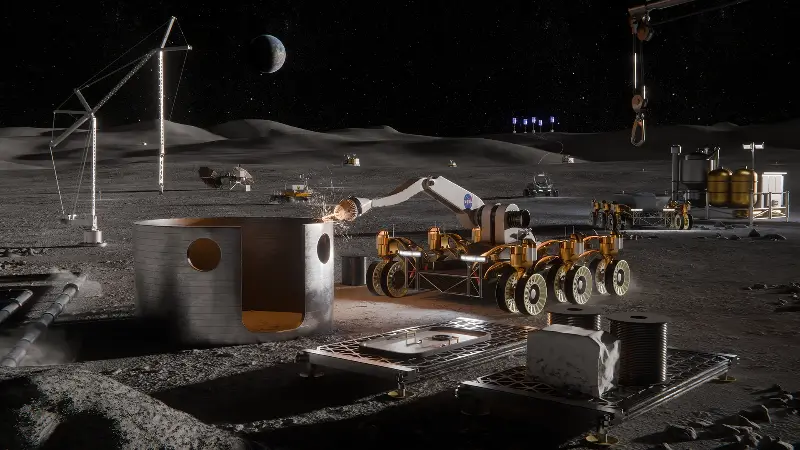
The first hard problem for a Moon base is not building something that works in sunlight. It is building something that still works when sunlight disappears.
Most early lunar surface systems are expected to lean heavily on solar power. That makes sense: sunlight is available, solar arrays are mature, and carrying fuel from Earth is expensive. But the Moon’s day-night rhythm is brutal for machines. Away from special polar lighting conditions, a lunar night can last about two Earth weeks, and the surface can fall into a cold, power-starved interval that is hostile to batteries, electronics, mobility systems, and thermal control.
NASA’s current Moon Base planning has started to put that problem in plain language. In a June 29, 2026, technology notice, the agency said sustained lunar operations need surface power that can function throughout the lunar day and night. A companion NextSTEP-3 lunar enabling technology page says NASA is seeking to mature vertical solar arrays, in-situ resource utilization oxygen systems, advanced manufacturing, nanomaterials, and Stirling radioisotope generators.
That last phrase is the quiet clue. NASA is not only asking how to collect more sunlight. It is asking how to operate when sunlight is the wrong answer.
The south pole helps, but it does not solve the problem
The lunar south pole is attractive because the Sun stays low on the horizon, and some high ridges and crater rims can receive long periods of illumination. Nearby permanently shadowed regions may also preserve water ice, which is why the region has become central to Artemis and Moon Base planning.
But polar lighting is uneven. A solar array may have a good view of the Sun from one ridge and a poor one a short distance away. Long shadows, crater walls, dust, rough slopes, and seasonal changes all matter. A rover that drives into a scientifically valuable shadowed area may quickly leave its comfortable power assumptions behind.
For a short demonstration, this is annoying. For a base, it becomes architecture. Machines have to survive before humans arrive, keep sites warm, move payloads, collect data, relay communications, and prepare infrastructure. A robot that dies when the Sun sets is a useful scout. A robot that survives the night becomes part of the base.
Why Mars rover power suddenly matters on the Moon
NASA has already flown a different answer on Mars. Perseverance carries a radioisotope power system that uses the heat from plutonium-238 decay to make electricity. NASA says the rover’s Multi-Mission Radioisotope Thermoelectric Generator has a 14-year operational lifetime, produces about 110 watts at launch, charges batteries, and helps keep the rover’s systems at proper operating temperatures.
That is not a huge amount of power. It is less than many household appliances use. But it is steady, and steady power is a different class of asset on a cold planetary surface.
This is where PROMISE enters the discussion. The concept, described as a JPL engineering twin in the lineage of NASA’s nuclear-powered Mars rovers, would be an unusual lunar test: instead of solving the lunar night with larger solar arrays and heavier batteries alone, NASA could send a rover whose basic power philosophy was inherited from Curiosity and Perseverance.
NASA has not presented PROMISE in the public pages reviewed here as an approved flight mission with a launch date. The publicly documented move is broader: the agency is seeking industry input and technology development for lunar surface power, including Stirling radioisotope generators. PROMISE is best understood at this stage as a candidate workaround in that wider push, not as a booked payload.
A rover as a power experiment
If flown, PROMISE would not make solar power irrelevant. A Moon base will still need large, scalable power systems, and solar arrays are likely to be central to early surface infrastructure. The question is whether every critical robot should depend on the same weak point.
A radioisotope-powered rover could test several things at once. It could show how a Mars-derived mobility platform handles lunar regolith, low gravity, abrasive dust, thermal cycling, and polar terrain. It could operate through darkness when solar machines are asleep or conserving energy. It could also act as a mobile demonstration of heat management, which may be just as important as electricity.
On Mars, an MMRTG gives Perseverance heat as well as power. On the Moon, that thermal side may matter even more. Electronics and actuators do not simply need energy to move. They need to stay within survival temperatures while the environment swings hard between sunlight and darkness.
The oddness is the point
Sending a Mars-rover twin to the Moon sounds backward because the two worlds are so different. Mars has an atmosphere, weather, dust storms, longer communication delays, and a day just over 24 hours. The Moon has vacuum, harsher thermal transitions, jagged regolith, and a day-night cycle measured in weeks.
Yet that mismatch is also why the idea is interesting. NASA’s Mars rovers are among the agency’s most proven long-duration surface robots. If part of that heritage can be adapted to the Moon, NASA gets a way to test night survival and autonomous operations without starting from a blank sheet.
There are tradeoffs. Radioisotope systems are scarce, expensive, and regulated carefully. Plutonium-238 is not something NASA can use casually. Any nuclear-powered lunar surface system must pass safety review, fit within launch and landing constraints, and justify why solar plus storage cannot do the job. Stirling systems, which convert heat to electricity using moving machinery, also need high confidence before they are trusted on a remote surface mission.
But the lunar night is not a small inconvenience. It is one of the design filters that separates a visiting robot from infrastructure. Surviving it requires either storing enough energy, transmitting power from elsewhere, operating only in select illuminated zones, or bringing a power source that does not care whether the Sun is above the horizon.
The base before the base
A Moon base will not begin as a habitat with astronauts looking out a window. It will begin as machines proving that the site can be powered, mapped, warmed, serviced, and revisited.
That is why PROMISE, if it advances, would be more than another rover. It would be a question on wheels: can NASA take the nuclear survival logic that kept Mars rovers alive for years and use it to bridge the Moon’s longest, coldest operational gap?
If the answer is yes, the first real Moon-base robot may not be the biggest machine or the fastest one. It may be the one that is still awake when the solar fleet has gone dark.
The post Most of NASA’s first Moon-base robots will depend on solar power, which makes the two-week lunar night one of the whole project’s nastiest problems — but NASA is now considering an odd workaround: sending PROMISE, a JPL engineering twin of its nuclear-powered Mars rovers, to the lunar south pole. appeared first on Space Daily.