



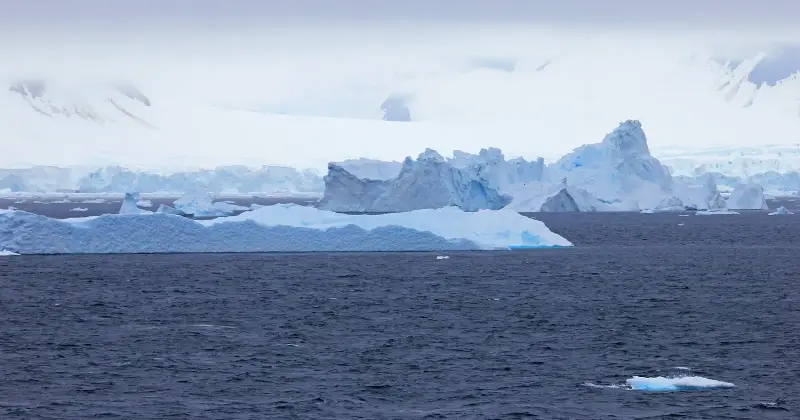
A team led by researchers at the Helmholtz-Zentrum Dresden-Rossendorf (HZDR) has found traces of iron-60 in Antarctic ice cores dating back between 40,000 and 80,000 years, providing the most direct evidence yet that the material filling the Local Interstellar Cloud, the diffuse gas and dust cloud through which our Solar System is currently moving, was seeded by a supernova explosion. The results were published in Physical Review Letters on 13 May 2026, with Dominik Koll of HZDR’s Institute of Ion Beam Physics and Materials Research as lead author.
Iron-60 is a radioactive isotope that does not occur naturally on Earth in any appreciable quantity. It is produced inside massive stars and dispersed when those stars end in supernova explosions. Its presence in geological archives has been used for decades as a tracer of nearby stellar events, and previous measurements had already identified iron-60 concentrations in deep-sea sediments and Antarctic snow samples from recent centuries. What those earlier findings could not resolve was the source: they could have reflected an old, fading supernova signal that had slowly diffused across millions of years, rather than material actively present in the interstellar cloud surrounding us now.
What the ice cores add
The older samples reported in the Physical Review Letters paper change that picture. By analysing ice from the EPICA drilling project, supplied by the Alfred Wegener Institute Helmholtz Centre for Polar and Marine Research (AWI), the team was able to look at the iron-60 signal at a time when the Solar System is believed to have been entering the Local Interstellar Cloud, or still outside it entirely. What they found was that iron-60 levels were lower in the older ice than in more recent samples, suggesting a genuine increase over time, consistent with the Solar System progressively moving deeper into material enriched by a supernova.
The temporal variation matters. The iron-60 signal changes significantly over periods of tens of thousands of years. That rate of change is difficult to explain with an old supernova blast that has been dispersing smoothly for millions of years; such a source would produce a slowly and steadily declining signal, not the pattern observed. According to the paper, this helps rule out competing explanations and supports the hypothesis that the Local Interstellar Cloud itself was shaped by a stellar explosion and still carries that material within it.
“This means that the clouds surrounding the Solar System are linked to a stellar explosion. And for the first time, this gives us the opportunity to investigate the origin of these clouds,” Koll said in the HZDR announcement accompanying publication.
The measurement problem
Detecting iron-60 in ice is not straightforward. The quantities involved are at the outer edge of what current instruments can resolve. The team transported approximately 300 kilograms of Antarctic ice from AWI‘s facility in Bremerhaven to Dresden for chemical processing. After that processing, the usable sample amounted to a few hundred milligrams of dust. The iron-60 content within that dust was measured at the Heavy Ion Accelerator Facility (HIAF) at the Australian National University, which the paper’s authors describe as currently the only facility in the world capable of detecting such small quantities of the isotope.
The post Radioactive iron from an ancient stellar explosion has been found in 80,000-year-old Antarctic ice, confirming that the Solar System is passing through the remnant debris of a supernova appeared first on Space Daily.