



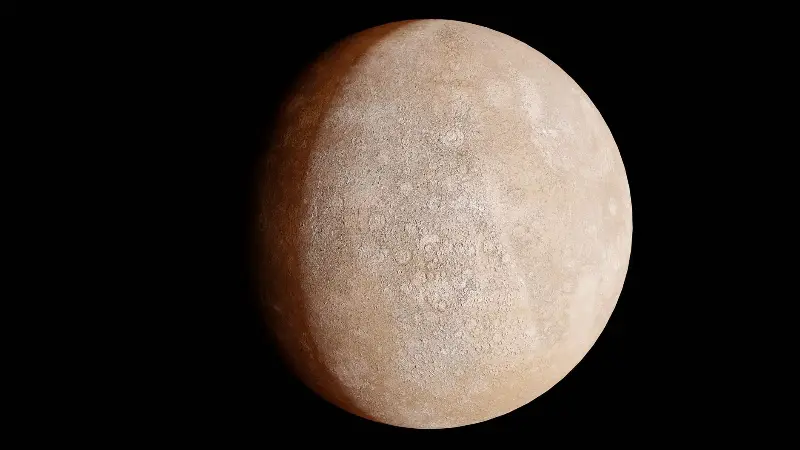
In November, a spacecraft called BepiColombo, after nearly eight years looping through the inner solar system, will finally let Mercury capture it into orbit. It is a quiet milestone for one of the least-visited planets we have. Only two missions have ever gone to Mercury, and only one of them ever orbited it, which makes this the third visit and the second time any spacecraft has settled in to stay.
BepiColombo is a joint mission of the European and Japanese space agencies, and it launched on 20 October 2018. The long delay between launch and arrival is not a fault. It is the price of going to Mercury at all.
Why Mercury is so hard to reach
Mercury sits at the bottom of a very deep hole. Anything that falls in toward the Sun speeds up as it goes, so a spacecraft aimed at Mercury arrives moving far too fast to be caught, and would simply sail past unless it can shed an enormous amount of speed.
Getting rid of that speed is the whole problem. BepiColombo has spent its cruise doing exactly that, using a long, patient trajectory and nine planetary flybys as brakes: one past Earth, two past Venus and six past Mercury itself. Each close pass, combined with gentle thrust from its ion engines, bled off a little more velocity. In a real sense the mission has spent eight years slowing down rather than speeding up.
A stack of three that becomes two
What launched in 2018 is really three craft joined together. There is a transfer module that carries the others and runs the ion propulsion, and stacked on top of it are two orbiters: the European Mercury Planetary Orbiter, which will study the surface and interior, and Japan’s orbiter Mio, which will study the planet’s magnetic field and its surroundings.
After arrival the transfer module is discarded, and the two orbiters separate to take up their own paths around the planet. That arrangement is part of what makes the mission valuable. For the first time, two spacecraft will study Mercury at the same time, one looking down at the rock and one watching the magnetic environment around it.
The thruster problem that cost a year
The November date is later than originally planned. In April 2024, engineers found that BepiColombo’s thrusters were no longer delivering full power, traced to unexpected electric currents in the transfer module between its solar array and the unit that distributes power.
With less thrust available, the original arrival could not be met. The agency’s flight dynamics team worked out a new trajectory, including flying the spacecraft closer to Mercury during its remaining flybys to gain more braking from the planet’s gravity. The fix preserved the full science mission, but it pushed orbit insertion from December 2025 back by about eleven months, to November 2026.
Where it is right now
The spacecraft made its final Mercury flyby in January 2025. Then, in June 2026, it finished the main cruise phase of its ion propulsion and entered what the mission calls its arrival phase.
The capture in November will not be a single dramatic engine burn of the kind that puts a probe around Mars. Because BepiColombo relies on low, steady thrust rather than a big chemical rocket, arrival is a gradual affair. A final sequence of manoeuvres will trim its speed just enough that Mercury’s gravity can take hold and, in the mission’s own word, “weakly” capture it into a polar orbit. From there the careful work of separating the orbiters and settling them into their science orbits will follow.
Why bother with Mercury at all
Mercury is small and close and easy to overlook, but it is genuinely strange, and that is the point. It has an outsized iron core that fills most of the planet, far larger in proportion than the core of any other rocky world. It is the only inner planet besides Earth with a global magnetic field. And despite being the closest planet to the Sun, it appears to hold water ice in the permanent shadows of craters near its poles, where sunlight never reaches.
Our close-up record of all this is thin. NASA’s Mariner 10 flew past three times in 1974 and 1975 and returned the first detailed images, but never stopped. NASA’s MESSENGER orbited from 2011 to 2015 and transformed what we knew. That is the entire history of Mercury seen up close, which is why a third mission, and only the second orbiter, matters as much as it does.
What to watch
The immediate thing to watch is the capture itself in November, a slow, low-thrust arrival that has to be flown precisely for a spacecraft that no longer has all the power it was built with. After that comes the separation of the two orbiters and the start of the main science mission, expected in 2027.
Then the questions that have waited a long time for an answer come back into play. Why is Mercury’s core so large. How does so small a planet sustain a magnetic field. What is really sitting in those shadowed polar craters. For now, a much-travelled spacecraft is closing the last of an eight-year fall toward the Sun, and one of the solar system’s least-seen planets is about to get a good, long look.
The post In November, a spacecraft that has spent eight years falling toward the Sun will finally settle into orbit around Mercury, a planet we have seen up close fewer times than almost any other in the solar system. appeared first on Space Daily.