



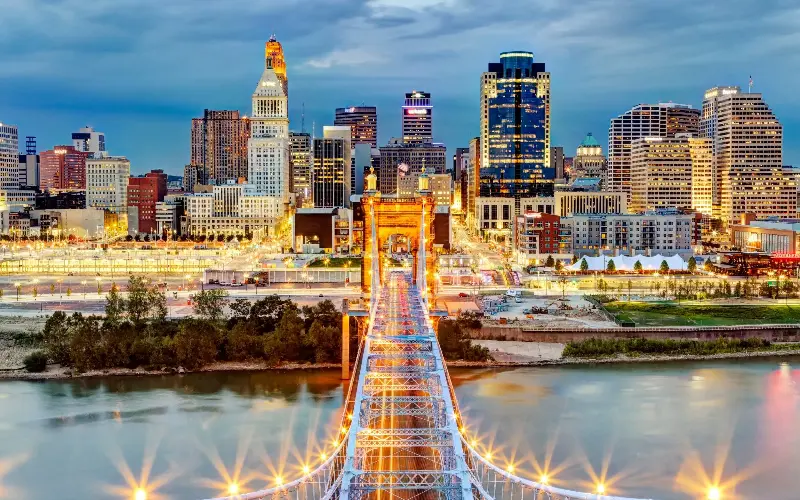
Even in the context of an America which likes to build along the waterline, Cincinnati’s riverfront is pretty spectacular. Once I have made it across the multiple lanes of Interstate-71, which separate the core of downtown from the last three blocks that slope down towards the currents, I find myself in a location where landmarks rise at every turn.
There, to the west, is the colossal 66,000-seater stadium where the city’s American football titans, the Cincinnati Bengals, ply their rough-and-tumble trade. Directly to the east, I can see the Great American Ball Park, where baseball stalwarts the Cincinnati Reds – five-time winners of the World Series, albeit not recently – dash around the diamond in front of 43,500 supporters. And to add a soundtrack to the scene, the Andrew J Brady Music Center sits between the two – a strikingly angular confection of metal and glass which makes plenty of noise as one of the city’s main venues for touring rock acts.
The river Ohio flows past it all with a silvery smile, sharing its name with the state on its north bank. On a hot day, with the sun on its surface, it does not look much like a border. But then, the state line runs down its middle – Newport and Covington, on its south edge, both belong to Kentucky. Had I been standing here 150 years ago, I would have been staring at a frontier that was not unlike the Iron Curtain and Berlin Wall of a century later.
True, there was no barbed wire. There were no watchtowers, no murals or graffiti. But in the early 19th century, this river was a crucial boundary all the same – part of the fault line that would ultimately crack open into civil war. Effectively, it was a continuation of the Mason-Dixon line between the North and the South; a high fence between different political beliefs, between opposed ways of life. On one bank of the river was freedom, on the other, subjugation. And in some cases, on one side was survival – on the other, death.
When Ohio was formally founded as a state in 1803, it already had a ban on slavery. Kentucky, categorically, did not. And in the six decades before Abraham Lincoln and the Emancipation Proclamation abolished that most evil of practices across the nation (in 1863) – and on plenty of the lingering dark days which followed – Cincinnati became a light in the distance, a terminus on the Underground Railroad, drawing desperate people north, away from the lashings and torture, and out of reach of the lynching posse’s noose.
So it is appropriate that the most important building on the river’s north bank – sitting quietly between the two giant stadiums – has found its place there. Opened in 2004, the National Underground Railroad Freedom Center was constructed pretty much on the spot where escaped enslaved people once came ashore – wild-eyed and terrified, hunkered down in rowing boats, gasping for breath, still expecting the gun to ring in the night behind them.
As museums go, it is an unsurprisingly sobering affair, and an experience that stays with me long after I have left its galleries. This is the intention. The museum hails those who fought so loudly for the cause – abolitionist Frederick Douglass, author Harriet Beecher Stowe – but its main focus is to direct the visitor’s gaze towards hard proof of the abuses that were perpetuated.
The “star” exhibit is a “slave pen” salvaged from Mason County, Kentucky – a squat, wooden “house”, barely ventilated, into which men and women intended for sale were crammed. There are chains and shackles, as used on slave ships. And while a more lyrical approach is taken with the strings of green glass beads hanging from the ceiling of a windowless room, the message is the same. They are designed to commemorate the lost souls who died during those unfailingly hellish Atlantic crossings.
Ohio’s third-biggest city (behind state capital Columbus, and north-easterly Cleveland), tucked into its south-west corner (Indiana is also only 25 miles to the west), Cincinnati has long been a magnet for those seeking to improve their circumstances. Numerically, its biggest new demographic in the early 19th century was not refugees fleeing north, but European migrants coming west. Irish and (especially) German settlers swelled the city’s ranks once steamboat services started docking in 1811.
Signs of this population surge are still clearly visible in the centre. Look closely at the walls on Republic Street, which runs north-to-south with arrow straightness, and you may spot faded signs for “Bremen Street” – the road’s former name, changed on a tide of anti-German sentiment during the First World War.
But there is no erasure a few blocks further north, at food hub Findlay Market, where Eckerlin Meats – a going concern since 1852 – specialises in goetta. This mix of slow-cooked ground beef and pork, fattened with oats and onions, is specific to Cincinnati, and originated with German immigrants.
So did the city’s heady brewing culture, which finds particular focus in “the OTR” – or the historic (and now gentrified) “Over-The-Rhine” district. It was a moniker bestowed by Rhineland settlers via their habit of referring to the Cincinnati stretch of the Miami and Erie Canal as if it were the great river of their former homeland.
Cincinnati’s taste for beer – or, at least, its capacity to produce it – also suffered during the early 20th century, as Prohibition (1920-1933) took hold. But that thirst has long since returned. The Rhinegeist Brewery, at the top end of the OTR, distils the Germanic drinking experience into one building – a cavernous bottling plant where long tables are arranged in parallel. Cincinnati Lager House extends the concept to the riverside and the shadow of the baseball stadium, and pours a few shots of bourbon into the conversation.
Mention of this potent nectar is a reminder that Kentucky – bourbon’s spiritual heartland – lies within staggering-home distance. Relations with the state over the river are far better now than they were during the Civil War. Considerably better, certainly, than they were during the “Defense of Cincinnati” in September 1862.
This was the month when a party of 8,000 Confederate troops was dispatched north through Kentucky with orders to launch an attack on what was then the USA’s sixth-largest city – only to spot the 85,000 union soldiers manning its various fortifications, and think better of starting any trouble.
In fact, nowadays, Newport and Covington are both considered parts of the Cincinnati conurbation. Wander from north to south on a warm afternoon – perhaps via the John A. Roebling Suspension Bridge, a magnificent landmark completed in 1867 by the titular German-American civil engineer who also constructed the Brooklyn Bridge – and the idea of the river Ohio as a border seems even further consigned to the past.
The Old Kentucky Bourbon Bar on Covington’s Main Street does exactly as its name suggests – and delivers me into the evening in a fuzzy amber glow. In such a context, Cincinnati is still a bright light on the opposite shore – but in 2026, getting there only requires a taxi.
Essentials
British Airways serves Cincinnati directly from Heathrow. A seven-night getaway to the four-star Westin Cincinnati, departing on on Sept 5, starts at £1,286 per person. For further information, see visitcincy.com.