



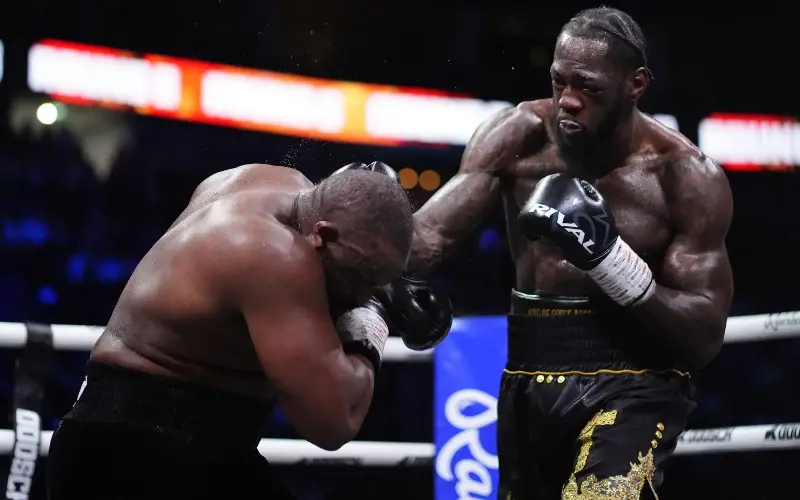
The narrative of “woulda, shoulda, coulda” changed as we witnessed a heavyweight psychodrama at the O2 on Saturday that only this beautiful, brutal, maddening pantomime could conjure. It was billed as a farewell for Derek “War” Chisora, the man who has spent two decades battling a who’s who of heavyweights as he reached the half-century milestone in ringwalks. But by the time the final bell tolled on an error-strewn, 12-round battle between two aged warriors leading to a split-decision victory for Deontay Wilder, the narrative had pivoted. It wasn’t about the end; it was about a resurrection. Or perhaps, more accurately, a re-haunting.
As Wilder stood victorious, after the judges scored it 115-111, 115-113, 112-115, a figure emerged from the shadows of ringside that sent a collective shiver through the 20,000 in attendance – Anthony Joshua. The two titans of a lost era, men who have circled each other like colossi for nearly a decade without ever colliding, finally passed each other.
“Let’s do it, baby,” growled Wilder, battered and bruised, yet victorious, to Joshua standing ringside in a white suit, having been deeply and warmly feted and received by fans and celebrities in the Docklands venue. Joshua eyed Wilder with a steely gaze, saying nothing. Having passed him, Wilder told his team: “Look, did you see? He fears me. He’s scared as f---!” Wilder’s eyes were shimmering with the manic intensity that has defined his own 50-fight odyssey. Joshua, back in the public eye after a harrowing few months following the death of two close friends in the December car accident that so nearly also took his life, did not blink. The air between them crackled with the static of $100m missed opportunities and eight years of what ifs.
Make no mistake, what we saw between Wilder and Chisora was not a technical masterclass. It was a street fight in silk shorts. It was two ageing lions tearing at each other’s manes until neither could stand straight. Wilder, at 40, looked every bit the fighter who has been through the Tyson Fury wringer. The jab was pawing, the movement leg-heavy.
Yet, the power, that terrifying equaliser of a right hand, remains one of the most dangerous single weapons in combat sports. Chisora, the ultimate gatekeeper, did what “War” does: he ducked, he mauled, he targeted the ribs, and he forced Wilder into the trenches.
“I don’t play boxing, I come to end it,” Wilder told me afterward, draped in the Alabama flag. “Many people doubted me, they threw dirt on my name. But you can’t bury the chosen.”
Chisora leaves the sport a hero, a gladiator who can now be free, a man of the people who rode the Underground to his own swansong and somehow survived the fistic firing squad, or perhaps the “Bomb Squad”. But for Wilder, this was a stay of execution.
We are now looking at the ghost of a 2018 blockbuster. We have been here before. Eight years ago, when Wilder and Joshua held all the gold, the fight was one of the biggest events in world sport, the “Super Bowl of Boxing”. Greed, ego and the labyrinthine politics of the four-belt era saw any hope of such a fight evaporate.
Now, in 2026, the belts are gone. The “invincible” auras have been punctured. Joshua is rebuilding after his own setbacks and the trauma of personal loss. Wilder is a man trying to prove his soul has not been left in a Las Vegas ring.
Is it too late? To the purists, perhaps. But to the fans? Absolutely not. There is a morbid, Shakespearean fascination in seeing these two meet now. They are no longer the polished specimens of their mid-20s. They are flawed, vulnerable and desperate. In heavyweight boxing, vulnerability is the secret sauce that creates drama. When two men with underlying power and histories of knockout defeats meet, someone is going to fall, and someone is going to the Hall of Fame.
The last dances for Wilder, Joshua and Fury are now clearer. On the Joshua side, Eddie Hearn and the powerbrokers in Riyadh will already be crunching the numbers. The O2 drama proved that Wilder is still a massive draw on British soil. Joshua remains one of the faces of the sport in the UK. This isn’t about undisputed titles anymore, it’s about closure. It’s about answering the question that has nagged at every boxing fan for over a decade: who wins when the Bronze Bomber collides with the British Adonis.
Wilder looked Joshua in the eye and told him it is time. For the sake of the sport’s integrity, and for the legacies of two men who defined a generation, we must see it. The 50th fight for Wilder and Chisora was a celebration of survival. The 51st for Wilder should be the collision we were promised a lifetime ago. London is ready. The world is waiting. Give us the knockout we’ve been dreaming of for eight years. From there, Joshua’s next move would be Fury. And next weekend, Fury must show the world against Russian Arslanbek Makhmudov at Tottenham Hotspur Stadium that his side of the bargain is very much alive, and that in 2026 and 2027 we witness all the fights this era promised.