



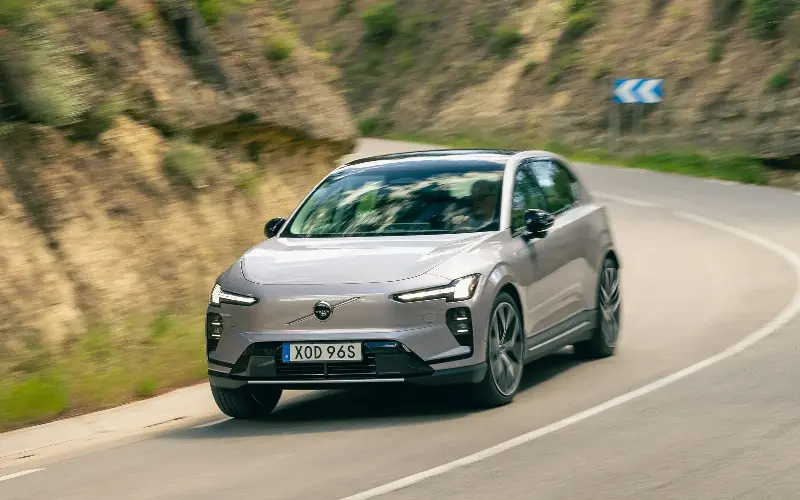
I wasn’t the greatest fan of this car’s big sister, the EX90. “Too large, too heavy and too expensive,” I concluded of this seven-seat, six-figure-priced electric SUV, while praising its sleek ride quality, performance and comfort.
One answer from the Chinese-owned Swedish carmaker has been the introduction of a rear-wheel-drive version of the EX90, with a smaller battery and lower price (from £73,160). The other is this, the EX60, an eagerly awaited electric vehicle (EV) five-seater.
Not another SUV, I hear you cry. But a lot of folk like these SUV/crossovers, which now form Europe’s largest market sector. EV rivals include the Porsche Macan, BMW iX3, Tesla Model Y, Lexus RZ and Mercedes GLC.
What is it?
The EX60 is the third car to use Volvo’s SPA3 scalable electric architecture, which was designed and developed in Sweden. The car is made at Volvo’s historic Torslanda plant in Gothenburg.
Suspension is all independent, with double wishbones at the front and multi-link at the rear, with active damping on the 4x4 models and passive frequency-selective units on the rear-wheel-drive version.
Weight-saving tech includes using the latest large single-piece castings for the bodyshell, flush glazing and frameless doors. As a result, it weighs between 2.1 and 2.3 tonnes.
The doors open and close electrically, although there is a vestigial handle to pull them fully open. There are also electronic shutters for the battery coolers at the front, which close to reduce drag when cooling isn’t required, as well as a powered boot lid, without which no car can be called luxury these days. There’s an electronic key fob or you can use your phone as a key.
Less striking and more amorphous than its larger sister, the EX60 also benefits from not having the 1990s taxi sign-esque radar sensor on the roof.
Three drivetrains are offered, the £56,860 P6 tested here in £62,360 Ultra trim, which is a single-motor, rear-drive chassis with an 83kWh (gross) lithium-ion nickel manganese cobalt (NMC) battery, an output of 369bhp and 354lb ft of torque, a range of 295 miles on the 22in wheels of the launch cars, and up to 320kW DC fast charging.
The P10 all-wheel drive (AWD) starts at £59,860 with a 95kWh battery, 503bhp and 524lb ft, 0-62mph in 4.6sec, a range of 312 miles and 400kW DC charging from 10 to 80 per cent in 28 minutes.
The top model P12 starts at £64,860 and has equivalent figures of 117kWh, 671bhp/583lb ft, 3.8sec and 400 miles on the smallest-diameter tyres. For the record, against a quoted efficiency of 3.44miles per kWh for the P6 I achieved 3.5m/kWh at speed with the air-con working hard, which gives a credible range of 280 miles.
To follow is a Core trim level, which undercuts the middling Plus by about £5,000, but perhaps the most desirable will be the Cross Country. It arrives later this year, featuring a greater ride height, taller tyres and 4x4 with more crawling options.
For about £5,500 on top of the Pure, the top-spec Ultra is pretty cool, with large squashy seats upholstered in an off-white perforated recycled plastic material. It is much nicer than it sounds, but not great for those with muddy dogs, which must be about 95 per cent of UK Volvo owners. Other interior hues are available.
Inside job
The fascia is all new if loosely based on that of the EX90 and it’s a mixed blessing. It is well made although there are still some howlers such as the weird mini-fridge-like centre console with a cave-like slot at the top for wireless phone charging.
Open front footwells give a delightful impression of space. There is space aplenty in the rear, too, the seats folding 40/20/40 per cent leaving a large and largely flat load bed. Including the 63- and 91-litre under-boot floor spaces, there’s a minimum of 523 litres; if you fold the rear seats and pile it to the roof, it’s 1,647 litres.
For those used to Volvo’s more recent portrait-style (upright) touchscreen, this is a move forward (or back). The heating functions are buried in the screen menus along with the steering and door-mirror adjustment, which is a pain – and beyond distracting if you attempt adjusting these on the move.
Google Gemini is incorporated within the software and while some colleagues raved about its voice-recognition abilities, it didn’t understand a single thing I said. This is all being sold to us as a software-defined vehicle, which brings a few benefits to you, but mostly to the manufacturer as it centralises computing into one big electronic control unit, usurping the individual units from outside suppliers before. Yes, it saves space and makes things simpler, but it’s also a hostage to fortune if it goes wrong.
On the road
I first tried the P10 model and there was something wrong with it. Fast it certainly was, the suspension was over-soft and the adjustable damping appeared to have gone AWOL meaning every tiny twitch of the steering or touch of the brakes had the body flopping around. It drove like a blancmange.
By contrast the rear-wheel-drive P6 was a significant improvement. It is gently sprung so the dampers have a lot to do with controlling the body movement, but they manage well enough, even if on occasion the back wheels feel out of sync with the fronts. Overall it’s brisk, comfortable and cossetting, which is what a lot of Volvo owners want. The drivetrain is refined, the interior is quiet and there’s a serenity about the way it addresses bumps and undulations, which is just the ticket for long journeys.
And the brakes are simply fantastic, strong with the most progressive and confidence-inspiring pedal feel. The steering isn’t bad, although there isn’t quite the swift response of, say, a Jaguar F-Pace or the recent BMW iX3.
A replacement P10 was a vast improvement, if still not quite as impressive as the P6. Its greater weight at the front slows the steering and the damping still struggles over some surfaces, but it rides reasonably and the 4x4 system provides extra confidence if your journey includes unmade roads.
The Telegraph verdict
After the slightly disappointing EX90, this car turned out far better than I had expected. Most of the credit for this should go to the rear-drive P6 model, thanks to its excellent ride quality and decent efficiency.
The EX60 is a refreshing change from the unrelenting and unforgiving “sportiness” of most of the opposition, although I would still prefer a traditional estate to an SUV/crossover.
The facts
On test: Volvo EX60 P6 Electric RWD
Body style: five-door premium SUV
On sale: now, first deliveries end of June
How much? Range from £56,860 to £70,360. As tested in Ultra trim £62,360
How fast? 112mph, 0-62mph in 2.5sec
How efficient? from 3.44m/kWh, 3.5m/kWh on test
Powertrain: 83kWh gross (80kWh net) lithium-ion NMC battery, rear-mounted electric motor with step-down gearing, rear wheel drive
Range: 295 miles (WLTP Combined), 280 miles on test
Charging: 150kW DC, 10-80 per cent in 26min; 7.4kW household wallbox, 1-100% in 10.5hrs
Maximum power/torque: 369bhp/354lb ft
CO2 emissions: 0g/km (tailpipe), 30g/km (CO2 equivalent well-to-wheel)
VED: £10 first year, £640 next five years, then £200
Warranty: three years/60,000 miles, eight years/100,000 miles on battery
The rivals
BMW iX3 40
From £53,259
Terrific debut for the 4x4 50, but the 40 is rear-wheel drive only, with a 316bhp motor giving a 395-mile range and up to 300kW DC charging. It’s £5,000 cheaper than the 4x4, but can it match that car’s driver appeal?
Mercedes-Benz GLC EQ 4x4
From £60,350
We’re still waiting for confirmation of a cheaper rear-drive version of this handsome SUV. In the meantime, this gently sprung 4x4 has an output of 482bhp and a range of 406 miles. Good to drive, but the all-glass dashboard is divisive.