



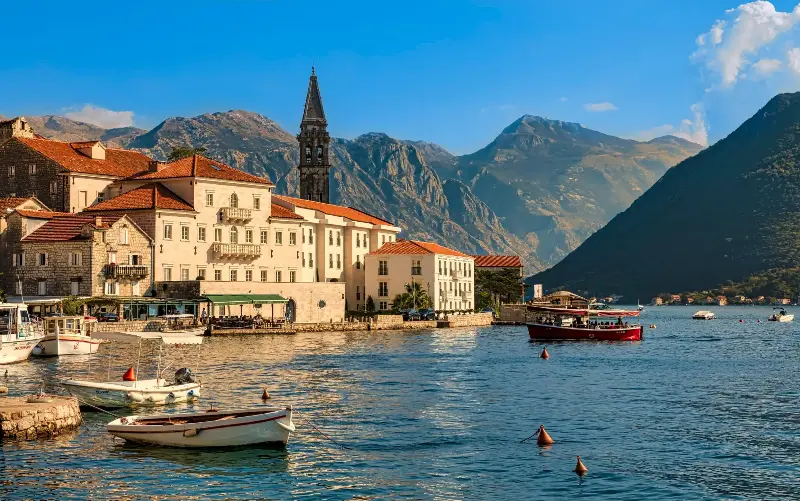
Throughout the summer in the tiny town of Perast in Montenegro’s Bay of Kotor, everyone is in or on the water. Children leap off the quayside. Yachts sail serenely around the bay. Sunbathers plunge in to cool off – albeit only a little, the water here being around 25C in August. On one day, though – July 22, to be precise – all of this changes. Instead, the locals throw rocks.
There is, of course, a story. There are two islands just off the coast of Perast. One, Sveti Dorde (St George), is a natural island that houses an ancient graveyard for the once great local families. The other is Gospa od Skrphela – Our Lady of the Rocks – and is entirely manmade, built over the course of 200 years after two brothers found an icon of the Madonna on a reef on July 22, 1452. They brought it back to the town where it proved to be miraculous (it healed one of the two sailors from a long illness) and then vanished back to where they’d found it.
This happened three times, and so it was decided that the Madonna knew exactly what she wanted. Obediently, all the men went out in their boats to drop rocks (and occasionally scuttle ships) to form the island, where her church was finally built in around 1630.
Now, every July 22, they celebrate with the ceremony of Fasinada (meaning “chain”, as the boats are linked together for the short journey). At sunset all the small craft, bedecked with greenery, sail to the island and hurl in the rocks to keep it shored up against the sea and ensure the continuation of the Madonna’s safe haven.
It is the most picturesque of evenings, but then Perast is quite lovely most of the time – it’s even described as Montenegro’s Venice. And there are similarities. There’s the nightly passeggiata, when locals and visitors promenade along the town’s only street. There are water taxis flitting over the clear blue waters of the Adriatic. Numerous Italian words remain in the local dialect.
The idea of Venice is, of course, inextricably linked to canals – and here, in a town that has a winter population of only around 200, there hasn’t been much call for those. Its architecture, though, is Venetian to its very core, its palaces built by the wealthy families who enjoyed a privileged position in La Serenissima’s vast trading empire.
The most beautiful of these, now the Heritage Grand Hotel, has not only its own church but a piazza, while another former palace houses a charmingly quirky museum. Here, you’ll find numerous representations of Venice’s winged lion as well as the Perast Venetian flag, the last to be lowered with a heavy heart when the Republic finally fell.
We can’t be sure that it was specifically Perast that poet Lord Byron had in mind when he wrote of this coastline: “At the moment of the creation of our planet, the most beautiful merging of land and sea occurred at the Montenegrin seaside... When the pearls of nature were sown, an abundance of them were strewn all over this area.” Certainly, there are plenty of pearls to choose from here. It’s a place where majestic limestone cliffs drop dramatically into the sea and age-old settlements shelter beneath them on the shore.
The best known of these is surely Kotor, its entire old town a Unesco site packed with charming squares, palaces and churches. After the 1979 earthquake, considerable restoration was needed, but the 1166 cathedral is somehow still standing, built on the foundations of a church that is thought to have dated back to the fourth century.
You can walk around the Venetian walls that protected the city from invaders from the sea (mostly Ottomans and pirates). There are three gates with ancient bastions and the ramparts climb up into the uninhabitable, densely forested mountains that give this country its name.
These days, you can get up into the mountains by cable car for a panoramic view – and not just of the beautiful Bay of Kotor. You can see, too, the wild mountains of the Lovcen National Park with its bears and wolves and, beyond, the coastlines of Croatia and Italy (you’re just two hours by ferry to Bari).
Herceg Novi is on the other side of Perast, a town lacking in roads but known for its many, many steps. Founded as a fortress in 1382 by the King of Bosnia, in Italian it’s known as Castelnuovo and is therefore part of that idiosyncratic association that links all of the world’s Newcastles.
Less visited than Kotor, its old town, built on a hillside, is dominated by a series of forts. One – Kanli Kule or Bloody Tower, once a notorious prison – is now, more invitingly, an amphitheatre for outdoor concerts. Herceg Novi is, in fact, a place renowned for its culture – there are music and film festivals, a literature festival with book fairs and lectures. There’s a famous music school, too, and you can hear its students’ practice sessions float on the breeze across whole areas of the town.
The town’s unusual microclimate meant returning sailors brought home exotic plants that would thrive here, and today it’s remarkably green, with palms, kiwis and bananas lining the town’s stairways. Its genius for re-imagining former spaces can be seen not only in its fort’s concert stages, but also in the former railway line to Sarajevo, now transformed into a 4-mile promenade. There is even an old military barracks reborn as an upmarket resort, with a Four Seasons superyacht in the marina and a One&Only hotel. One of the villas is said to be owned by Novak Djokovic.
Back in Perast, they exude a more subtle glamour. There are fine-dining restaurants (Conte by the water, Rosemarino up a multitude of stone steps overlooking the bay and, my favourite, Eho, where the waitresses dress like Greek goddesses).
There are excellent hotels, notably the Heritage Grand. However, this is a quiet spot, cars banned except for those of the locals and the music is turned off after 10pm. It would be quieter still out of season, of course, the sun barely rising above the high mountains and rough winds soughing in the rooftops. One local described it to me as melancholic. Poetic enough, perhaps, even for Lord Byron.
Essentials
The Heritage Grand Perast Hotel has rooms from €148/£127 during the low season. High-season rates vary depending on dates and availability. British Airways flies from London Heathrow to Tivat three times a week from May to September, with fares from £139 one way. For more information on visiting Montenegro, visit montenegro.travel/en.