



I’ve seen over and over how patients with arthritis become inactive over fear of damaging their joints. I think orthopaedic doctors are in part to blame. We used to refer to osteoarthritis, the most common form of the disease, as “wear and tear”.
That phrase puts the idea in patients’ heads that their joints have worn away because they’ve used them too much. We know that’s not the case – your genes determine whether your cartilage will break down, or a previous injury may have damaged the surface of the joint – and a recent study from Arthritis UK has in fact found that exercise is the most effective way to reduce pain and improve mobility.
This reinforces what doctors have suspected for quite a while but now know: Physical activity is beneficial for – and protective against – all forms of arthritis, rather than causing more damage to arthritic hips and knees.
There are a number of reasons for this. Movement flushes fluid through cartilage – the smooth, slippery surface that coats the end of our bones so they can glide smoothly against each other – keeping them healthy and mobile.
Then there is the increase in strength and range of movement around the joint, as well as the very nature of being active and getting your blood flowing. All of these benefits compound on one another and make getting back into exercise the best thing you can do for painful, arthritic joints.
It can be difficult to get arthritis patients on board with exercise, but I promise it’s worth persevering. I’ve seen patients go from “I can’t go on, I need a hip replacement” to “my symptoms have improved, I don’t need surgery”.
Your new exercise routine
I’ve shared seven exercises and three stretches meant to ease arthritic hips and knees, delay its progression and even prevent the onset of arthritic symptoms in those who don’t have them yet.
Expect some discomfort if you haven’t exercised in a while, especially when doing the moves that target your range of movement. A joint that hasn’t been moved much will no longer want to move. It’s important to push through the pain, as the knee and hip will eventually become more supple and the day-to-day pain from your arthritis will reduce dramatically.
Ease yourself into this routine, being conservative with the number of repetitions. While these moves may seem simple, your stabilising muscles will be working quite hard and you may experience delayed onset muscle soreness in the following days.
This routine works best if you do it at least three times a week, and you will really feel the benefit after three months. From that point you can progress back to the activity you enjoy doing, whether that’s walking, swimming, cycling or any other sport.
If your joint pain gets progressively worse after a few weeks of following this routine, however, I would recommend seeing your GP or a musculoskeletal practitioner.
For each exercise, aim for three sets of 10 repetitions. For the stretches, hold for at least 20 seconds. Increase the number of repetitions and the duration of stretch in line with what you feel able to do.
Exercises
Seated knee extension
Arthritis benefit: Improves knee range of movement and strengthens the quadriceps (thigh muscles)
Sit on a chair with your feet resting on the floor. Keep one foot planted flat on the ground and, with your back braced against the back of the chair, straighten the other leg out in front of you. Hold that position for about five seconds, contracting the quadriceps. Relax and lower your foot to the ground. Repeat for one side as many repetitions as able, and then swap sides.
Modification: If you can’t get your leg completely straight, aim for as straight as you can. Your muscles will still be working hard, and your range of motion should increase over time.
Sit to stand
Arthritis benefit: Strengthens quadriceps and glutes and improves hip and knee mobility
Sit in a chair and rest your arms on your lap or by your side. Without pushing up with your hands, stand up. When standing, maintain good posture and push your hips forward.
Modification: Try a supported squat. Stand up with your hands on a sturdy surface, with a seat behind you, in case you lose balance. Bend your knees and lower yourself, as if you are going to sit on the chair, without doing so. Go as low as you can safely go, before standing back up.
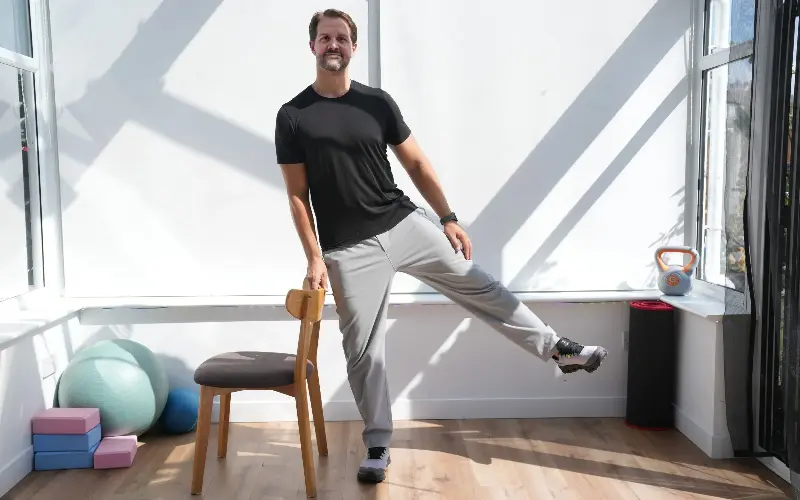
Standing hip abduction
Arthritis benefit: Strengthens the glutes and hip abductors to stabilise the hip joint
Stand with your hands on a chair in front of or beside you. Lift one leg sideways, as high as you can, in a straight line from the side of your body, keeping your toes pointing forward. Hold this position for five seconds before lowering your leg to the floor. Repeat for one side as many repetitions as you are able, and then swap sides.
Modification: If you struggle with this exercise, lower your leg. As you get stronger and improve your range of motion, you will be able to raise your leg higher for longer. You can make it more challenging by using ankle weights to increase the load.
Standing knee raise
Arthritis benefit: Works the hip flexors, increasing the range of movement in the hip joint
Stand next to a chair, resting one hand on it for balance. Raise one leg in front of you, bending at the knee, as if you are going to kick out. Aim to have your thigh horizontal with the floor.
Modification: Lift your knee only as high as you feel comfortable.
Lying leg raise
Arthritis benefit: Engages the quadriceps and hip flexors to reduce pressure on the joint and improve hip and knee control
Lie on the floor with your legs straight and arms by your sides. Lift one leg off the floor, keeping it as straight as you can, while your resting leg remains flat and your back is flat on the floor. Hold your leg in the air for five seconds before lowering it.
Modification (displayed above): If this is too difficult, bend the knee of your resting leg so your foot is flat on the floor. This takes some of the weight off the quadriceps, making it easier to raise your leg.
Heel slides
Arthritis benefit: Improves range of movement in the knee and the hip while working the hamstrings (thigh muscles)
Lie flat on the floor. Bend one knee, keeping that foot flat on the ground. Slide your foot as close to your bum as possible and hold it there for five seconds. Slowly slide your foot back to the starting position.
Modification: If you are struggling to bring the hip and knee bent using just your leg muscles, you can use a towel looped around the ankle and help to pull the leg bent with your arms too.
Step-up
Arthritis benefit: Strengthens the quadriceps and glutes and improves movement control
Stand facing your stairs or an aerobic step. Place your foot on the step and push through it to bring your other foot onto the step. Step back down slowly, one foot at a time.
Modification: The smaller the step you use, the easier this will be. Once your confidence and control grow, you can do bigger steps or two steps at a time.
Stretches
Knee extensions
Arthritis benefit: Improves the knee’s range of movement and activates the quadriceps
Sit on the floor with your back against the wall and your legs straight in front of you. Keep one leg bent and with the foot planted flat on the floor. Roll up a towel and place it under your ankles so your straight leg is slightly elevated. Contract your thigh muscles and push the knee down towards the floor. For an even deeper stretch, use your hands to gently push down on your knee.
Hip flexor stretch
Arthritis benefit: Improves flexibility in the ligaments around the hip
Lie flat on the floor. Bend one knee up to your chest and hold the back of your thigh or the front of your knee, pulling the knee as close to your chest as possible. Repeat on the other side.
Lying hip external rotation
Arthritis benefit: Rotating the hip outwards to improve range of motion
Lie on your back and bend your knees, so your feet are together and flat on the floor. Slowly lower your knees out to the sides. Rest your hands on the inside of your knees and gently push down to deepen the stretch.
Dr Thomas Naylor is an orthopaedic surgeon and sports scientist
As told to Emily Craig