



As Christopher Nolan’s feverishly hyped new blockbuster The Odyssey sails into cinemas this weekend, it arrives to a mixture of universal critical acclaim and, undoubtedly, huge box office receipts. And the hype is justified; it is yet another masterpiece from the most ambitious, and bankable, filmmaker working today. But it is not the only forthcoming treatment of Homer’s epic poem on screen.
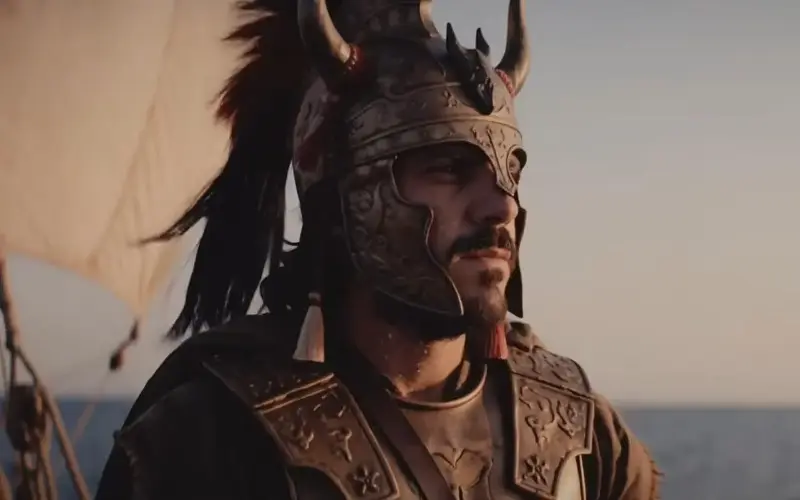
The $250m-budgeted picture will soon be joined by the rather more modest Odysseus: The Fall, directed by the Iranian-British filmmaker Ashkan Kooshanejad (known as Ash Koosha), which is notable for being made entirely using AI. It has been made on a tiny fraction of the budget of Nolan’s film, with Koosha estimating that it costs somewhere in the “mid five figures”. Naturally, it is not expected to make the hundreds of millions of dollars at the box office that The Odyssey will undoubtedly gross.
Koosha’s film has elicited a vast amount of interest by its very existence, even if much of it is negative. Typical comments on X include: “Ash Koosha didn’t direct anything. They ordered fast food and called themselves a Michelin chef” and “this isn’t art, this is rancid slop”. Judging by the two-minute trailer that has been released recently, this criticism seems unfair. While some of the visuals look as if they are on the same level as a cut scene from a computer game, and the AI-generated voice acting is poor, there are some striking images, not least the scenes from the Cyclops’ cave. It may not end up being an Oscar-winning masterpiece, but it’s still proof that AI has come on a vast amount over the past few years.
This development is particularly ironic given Nolan’s disdain for trickery and cost-cutting in his pictures. “It’s just sort of an odd thing,” he recently said in this paper. “Young people in particular, they coined this term ‘AI slop’. There’s a sort of disdain for things AI.”
While Nolan is one of the least-online directors working today – he eschews both smartphone and email – it is almost inevitable that he is at least aware of Odysseus: The Fall, which has to be considered an achievement given that Koosha’s film was made on a budget that would barely have covered Matt Damon’s beard oil. The cost-cutting came from his using a blend of a proprietary AI system and the video generator Kling, which enables him to create startling visuals for next to no money, although, naturally, there is precisely nothing “real” on screen.
Yet the director of the “other” Odyssey film rejects any idea that he has approached his picture as nothing more than a quick and cynical cash-in. “This could have happened a few months earlier, or a few months later, but I don’t think that it should be shocking that there should be two versions of the same story existing,” Koosha tells me. “After all, it isn’t purely Nolan’s story to tell. Christopher Nolan is not Homer.”
It’s undeniably true that, while The Odyssey has never received an all-singing, all-dancing big-budget Hollywood adaptation before, it is one of the foundation myths of countless other narratives – James Joyce’s Ulysses, to name but one obvious example, would not exist without it – and Koosha makes the reasonable point that the existence of one mega-budget picture should not preclude other interpretations being made. “I really like that story, and I have a lot of opinions on translations, including Emily Wilson’s recent one. There have been 3,000 years’ worth of takes on this story, and I don’t see why I can’t offer one too.”
The other filmmaker is no hack, but someone who has lived a multi-faceted and eventful existence. The 40-year-old Koosha was born in Tehran and claimed asylum in Britain after appearing in the award-winning 2009 documentary No One Knows About Persian Cats, which followed his attempts to thrive in Iran’s underground music scene. He has since released several albums, before turning his attention to cutting-edge technology, which has included performing at the ICA (Institute of Contemporary Arts) in a virtual reality headset. His move into AI feature films, then, was a near-inevitability that reflected his restless and enquiring spirit.
Koosha refutes the notion that Odysseus: The Fall has been put together by computer, claiming that he has been involved in scripting and storyboarding the film just as rigorously as Nolan might have done. The difference is that the Hollywood director then works with a team of actors and behind-the-scenes crew, whereas Koosha uses specific technical prompts to achieve the desired impact. He claims that this is time-efficient, saying: “Even before you sit down, you need a finished script and your own vision for the project. AI doesn’t create these things itself; you have to be very precise.”
He likens his use of AI to that of an artist – “there’s a new paintbrush, and I don’t see why I shouldn’t use it” – and he suggests that he has approached the project with the energy and commitment of an old-school filmmaker. “No director in history has done the same amount of work on a picture than I have. I edited it, composed the whole soundtrack, coloured it, wrote it, storyboarded it, managed the files and did the job of seven or eight people, while most directors just order people around. This way, the risk is so low that you can bring your own ideas, and you can become a storyteller yourself.”
I suggest that this was the same approach that Nolan used on his debut film Following – written, directed, edited, filmed and produced by him – and Koosha talks warmly of Nolan. “I don’t think that there’s a single film of his that I haven’t enjoyed,” he says.
Will he be first in line to see The Odyssey then, filmmaker-to-filmmaker? Koosha smiles, perhaps with the air of a man who has been asked this question already. “I haven’t managed to find a ticket yet, but I also don’t want to see it until I’ve completely finished with my film.”
Speaking hypothetically, then, what would the director of Odysseus: The Fall do if he were to be given a $250m budget? “I’d do a conventional film, but I’d certainly want to use AI as part of it. I wouldn’t want to use actors such as Matt Damon, who would cost millions. Instead, I think that the opportunity for directors such as me is to make the craziest shots, and create the craziest worlds and not have to answer to anyone else.
“Again, to use the analogy of directors as painters, most of the time they can’t paint, because they must delegate to others. And AI means that they can concentrate on painting, not dealing with the person who’s running the cables on set.”
He also believes that if Homer had been able to use AI as a tool, he would have jumped at the chance. “I don’t think he would have flinched, because it’s another means of telling the story.”
This is the director’s second film to be wholly made with AI after his first one, a fictionalised docudrama about the massacre of Iranian citizens named Dreams of Violets, premiered earlier this year at the Tribeca Film Festival. While the reviews were not glowing, the more charitable observed that Koosha’s use of AI went far beyond simply augmenting or replicating existing reality.
When I ask whether he’d make use of the wholly controversial AI “actress” Tilly Norwood in his films, he makes a face. “I think that’s a horrible idea,” he says. Instead, he prefers to licence real faces – 13 for his Odyssey film – from a digital archive, for which he pays a fee. “We want viewers to see themselves and relate to this, rather than just see another well-known face,” he explains.
Koosha is engaging company, even if, like Nolan, you believe that AI is detrimental to cinema rather than the future of it. He estimates that if Odysseus makes a six-figure sum, which is far from impossible given the publicity it has engendered (a great deal, admittedly, driven by its far more famous fellow adaptation) then he will go into profit, and presumably there will be more AI films in the future.
He has sensibly steered clear of the culture wars discourse that Nolan has found himself mired in – his picture does not feature Helen of Troy in any form, whatever skin colour she might be – and those who are intrigued by what AI can do to Homer might consider giving his film a whirl, even if out of idle curiosity.
And while Koosha is unlikely to ascend to the heights of the Hollywood A-list that Nolan inhabits, he isn’t above a cheeky dig at the director’s unorthodox casting of the musician Travis Scott as a herald in The Odyssey. “You can do what you like, ultimately. You can make whatever aesthetic choices you see fit. Put a rapper in a mythology tale, if you like. And that choice is as valid as me using AI.” Many might agree.