



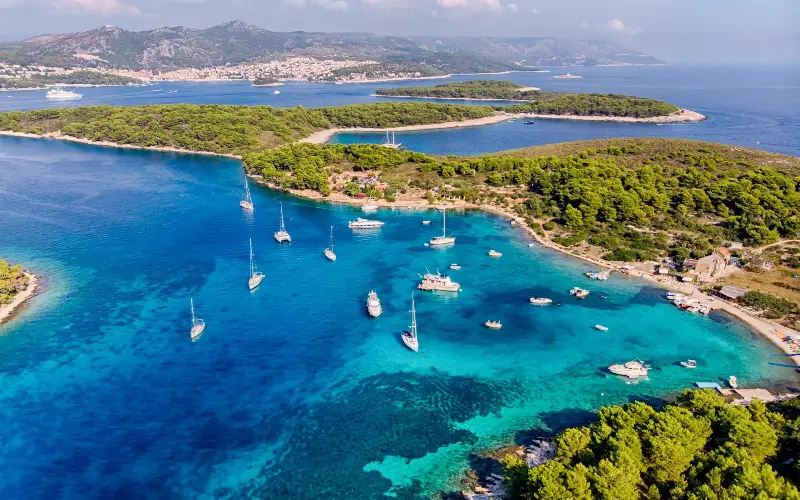
Even travelling at a leisurely pace on board the MV Felicità, the Croatian islands come thick and fast. Between them – on water that veers from deep blue to turquoise – are craft of every kind: sailing boats, fishing boats, superyachts, plentiful ferries and, closer to shore, windsurfers, kayakers and paddleboarders.
What you don’t see much of on this cruise, outside the main ports of Split and Dubrovnik, are huge cruise ships. Instead, this small, 38-passenger ship weaves its modest way down the Dalmatian coast and among its islands, where Armando, the captain, promises (weather permitting) a daily swim in a secluded cove and a mooring in a small harbour.
Passing one uninhabited island after another is solace for the soul for those of us who live in busy cities – a moving meditation in blue, green and cream. There are soaring cliffs, rolling green escarpments, rocky outcrops and the golden gleam of limestone.
Sometimes, an isolated house perches on an impossibly rocky promontory or a tiny vineyard climbs, terrace by terrace, up a steep hillside. Most islands are densely forested, and their shorelines occasionally form natural limestone platforms – an open invitation to sun-worshippers. All are surrounded by water so clear that it reflects the colours of the seabed onto the land, where phytoplankton and sea urchins thrive.
And this is the ultimate beauty of ticking off Croatia’s best-known islands: despite their renown and proximity, each is surprisingly different, filled with tiny, tucked-away coves and enough calm, pretty port towns to give everyone room to breathe.
Take, for example, Korčula’s fortified old town, on which the Venetians left their unmistakable stamp during a rule that lasted 400 years. Laid out in the shape of a fishbone, it has straight streets on the left and curved ones on the right, all offset to create a kind of natural air conditioning in summer and protection from the cold northern winds in winter.
It was the town’s narrow streets and homogeneous stone architecture that saved it from annihilation during the Second World War. Legend has it that Brig Fitzroy Maclean, ordered by Churchill to bomb the island, a German stronghold, flew over and declared Korčula Town a “stone rose”. He spared it.
War hero, adventurer and diplomat, Maclean is thought to have been the inspiration for Ian Fleming’s James Bond – especially given that the two had been friends at Eton. Even 007 is overshadowed here, though, by the greater legend of Marco Polo. While there is some dispute over whether this was actually his birthplace, it was certainly the reason a record of his travels was ever made.
Commander of a Venetian galley, he was captured by the Genoese at the Battle of Korčula in 1298 and, later, in a Genoese prison, dictated his memoirs, Il Milione, to his cellmate, Rustichello da Pisa.
Hvar is one of the biggest islands, its south coast on a monumental scale and its main town guarded by a Venetian fort commanding the coast from the top of a hill. Beneath it, Hvar’s old town is a charming muddle of stepped stone streets that open out into the biggest square in the region. The harbour is packed with boats and dominated by the archway that once formed the entrance to the Arsenale, where the Venetians kept their war galleys safe from the winter storms.
We moored, though, in Stari Grad, the oldest settlement in southern Croatia, where a Greek colony planted olives, grapes and vegetables in the 4th century BC. Their field system resembles modern allotments and continues, as a protected Unesco cultural landscape, to be farmed and irrigated in the same way it has been for the past 24 centuries.
Somehow, in just one week, between all the island hopping, we also managed to spend a day in both Dubrovnik and Split. Dubrovnik has long been the “pearl of the Adriatic” and, despite war, earthquakes and today’s milling crowds, it’s still as lustrous as ever, its pale limestone palaces and churches glowing in the sun and its blue skies filled with the cries of darting swifts.
Split was chosen by the Emperor Diocletian for his retirement – an unusual option for a Roman ruler, many of whom were, of course, assassinated long before reaching middle age. Diocletian was fortunate to spend his last decade here from AD 295, enjoying the sea breezes, gardens and temples, sumptuous living quarters and the protection of a garrison in the rear half of the palace – even a retired emperor had his enemies. The town has grown up around, and even within, the palace, its charming cafés spilling onto oleander-shaded courtyards.
As if the Adriatic didn’t offer enough beautiful water, the island of Mljet has two magnificent lakes within its national park. For a contemplative life, you couldn’t find a better spot and it’s no surprise that, on the lake-locked Isle of St Mary, there’s a 12th-century Romanesque church, once home to a Benedictine order, its soaring roofs now dotted with house martin nests. There are Roman ruins in the park, along with trails for walkers and cyclists through dense forests of holm oak and Aleppo pine. Locally, it is known as the “Green Island”.
It was a glorious whirlwind of a week, and all but impossible to choose a highlight. If pushed, however, I’d put Pučišća on Brač at the top of my list. Once little more than a village attached to a quarry, it is the source of much of the karst – limestone and marble – that built Diocletian’s palace in Split.
Today, the whole place shimmers in the sunlight. Simple cream-coloured houses climb the hills around the tiny harbour, locals enjoy a beer in shady café gardens and gelato stalls sell delicious homemade ice cream.
Along the quayside, locals dangle their feet in the water, chatting as they clean the latest haul of squid. Behind them – and indeed everywhere you look on this island – are sculptures and carvings. Pučišća is now renowned for its School of Stonemasonry, and its students’ work is on display around every corner.
Locals may complain that not much happens here but, for me, that’s the point: an island that is far from secret, yet remains the very picture of serenity.
Essentials
Riviera Travel has the seven-night Dubrovnik, Split & Jewels of the Dalmatian Coast Yacht Cruise from £1,899pp, on board MV Felicità between May and September, and including return flights and transfers, seven tours, daily breakfast, five lunches and three dinners with swim stops every day weather permitting.