



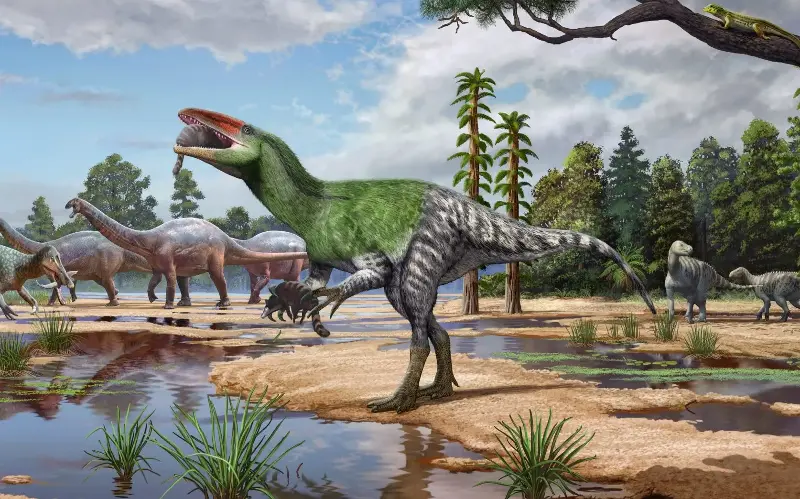
The fossil of a human-sized dinosaur that resembled a Tyrannosaurus Rex has been found in a drawer of the Natural History Museum.
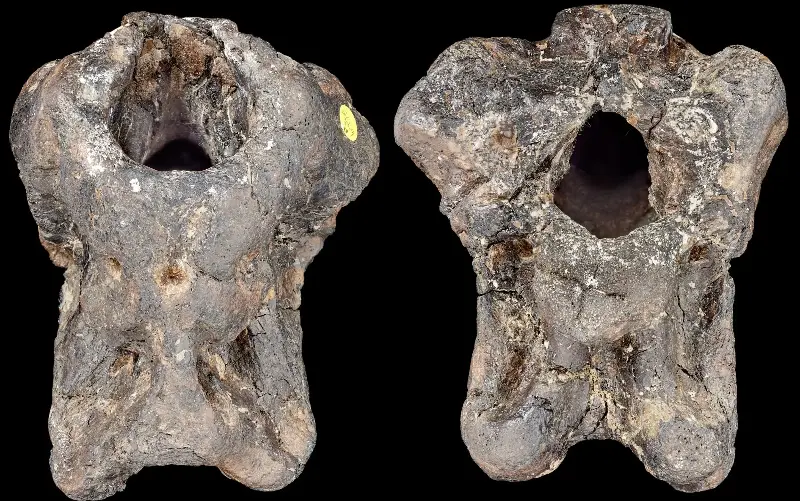
The partial fossil skull of Invictibellatrix amberina was acquired by the museum in 1924, but forgotten about until recently when it was identified as a new species.
It was originally dug up on the Isle of Wight and represents one of the smallest of a group of agile, two-legged carnivores called megaraptorans. They are thought to be related to the T-Rex and dates from the Cretaceous, living about 120 million years ago.
Unlike T-Rex, the dinosaur had a relatively slender head, and attacked its prey with its large arms and giant curved claws, rather than its jaws.
Experts said it would have been a lethal hunter that ate small dinosaurs, lizards and mammals, occupying a similar role in the food chain to the hyena today.
Dr Cassius Morrison, the lead author from University College London (UCL) who identified the dinosaur, said: “It was not the apex predator of its time, but for humans this dinosaur would have been more dangerous than a T-Rex.
“We would have been perfectly sized prey, about a third of their body weight. They definitely would have chased us. A T-Rex would not have bothered, as we would have been too small.
“It is a real mystery that this fossil was overlooked for so long, sitting in a drawer for nearly 100 years. Lots of bones are found on the Isle of Wight – who knows what else is waiting to be discovered.”
The Invictibellatrix fossil was originally found at the foot of a cliff on the south-west coast of the Isle of Wight by amateur palaeontologist Reginald Walter Hooley. It was one of more than 1,000 specimens discovered by Hooley that were acquired by the Natural History Museum after his death.
The new dinosaur is estimated to have been between 10 and 13ft long and 5ft tall. It would probably have had feathers and dangerous curved claws up to 8in long.
Prof Paul Barrett, the study’s senior author from the Natural History Museum, said: “Despite over 200 years of collecting, the Isle of Wight continues to surprise us with new dinosaur species, and finds of carnivorous dinosaurs, such as Invictibellatrix, have been particularly elusive.
“Work like this shows the exceptional value of working with historical museum collections where there are still many discoveries to be made.”
Megaraptors are regarded as the most mysterious of the large, meat-eating dinosaurs, and few fossils have been found.
The subspecies is thought to have originated in Asia, and it was theorised that they must have migrated through Europe to reach the southern land mass of Gondwana, which included present-day Africa, South America, Australia, India and Antarctica.
But until now, this theory was missing the fossil evidence to prove it, as no megaraptorans had been found in Europe. Invictibellatrix amberina is the first megaraptoran to be found on the Continent.
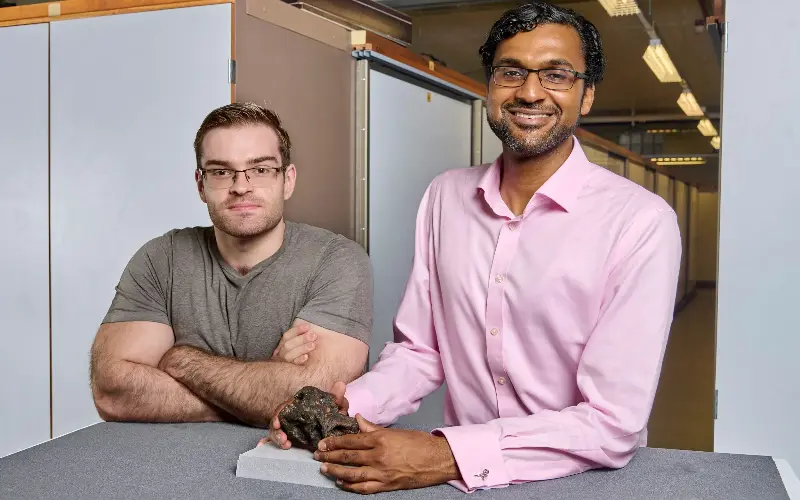
Charlie Scherer, a co-author and doctoral student at UCL Earth Sciences, said: “This new species is the first proof we have that megaraptorans were also present in Europe and that they reached Gondwana this way rather than island-hopping further south.”
Invictibellatrix means “unconquered female warrior” – honouring megaraptorans’ future role as apex predators. Amberina refers to the amber found in the rocks where the fossil was discovered.
For the study, researchers undertook a CT scan of the fossil, creating a 3D model of the skull and brain cavity.
Comparisons with other species showed that the new dinosaur had a unique combination of skull features, including an oval hole where the spinal cord enters the skull and an hourglass-shaped crest, which led researchers to conclude it was a new species.
Computer modelling of the movement of Invictibellatrix suggest it had probably died out in the north before the south, possibly because of the rise of apex predators such as T-Rex.
The dinosaur was described in a paper in the journal Royal Society Open Science.
In June, paleontologists identified a fossil left in a drawer for forty years as the first dinosaur bone found in Antarctica.