



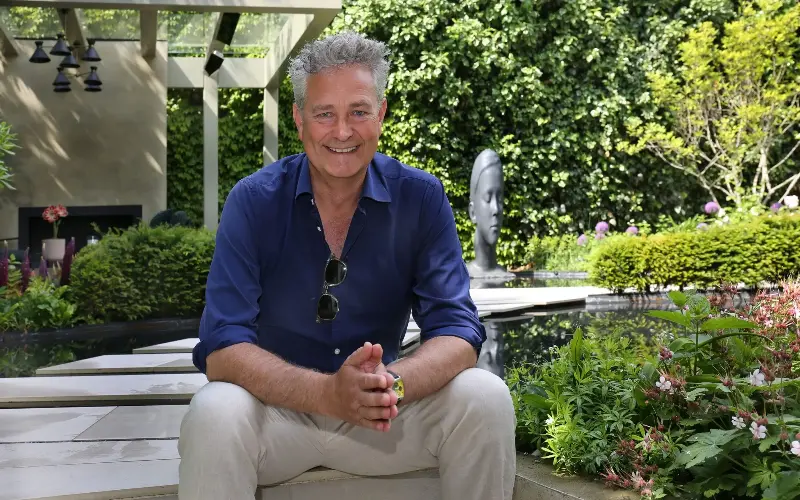
When the landscape designer Richard Miers was asked to redesign this London garden, the owner had said simply: “I don’t know what I want, but I’ll know it when I see it.” Words, says Miers, “that I’ve come to recognise as both wonderful and terrifying”.
The owner had lived in the house for a couple of years, but the garden hadn’t been touched in any meaningful way during that time. It is about 450 sq metres – generous in London terms – and is north-facing, which meant that Miers had to work harder with regard to light, reflection and structure.
The main reason for renovating the garden was a huge robinia (false acacia) that was dominating the space. “It was a magnificent tree, but it was hollow, unstable and, frankly, dangerous; it had to come out,” says Miers. “At the same time, there was an external lift that the previous owners had installed, running from a kitchen window down to the lower ground floor. Built without planning permission, that also had to be removed. Once both of those things were gone, something quite dramatic happened: light flooded into the garden. What had been a dark, slightly awkward space became full of potential.”
The garden had originally been designed by developers, and, says Miers, “You could feel that. It was done to sell the house, not to be lived in. It was almost entirely paved in cut York stone, which can be high-maintenance, and, I feel, rather bleak in a garden that’s meant to be relaxing.”
Despite the client’s enigmatic brief, he did have a modern sculpture by the artist Jaume Plensa that he wanted to be incorporated within the design, and a clear idea of how he wanted to use the space: “I want to do yoga for four people, under cover, with heating. I want to entertain 100 people for drinks. I want to have dinner for 10. I like water. And I like Zen.”
“That was my brief – and actually, it was a good one,” says Miers.
Starting with structure
The client’s children are now in their 20s, so he didn’t need a family-friendly garden, but instead wanted a grown-up space for living, entertaining and relaxing.
Miers started with the hard landscaping: “Before you think about plants, you have to understand how people will move, where the sun will be, how spaces will be used at different times of day,” he explains. The first decision was where to put the pavilion that the client had requested, which needed a fireplace, heating and enough space for four people to do yoga comfortably.
“We placed it on the south-west side of the garden, which gets the best light later in the day,” says Miers. It is also positioned so that from within it, the client can see the whole of the garden. “To balance it, visually and spatially, we put a second main seating and dining area on the opposite side, next to one of the water features,” says Miers. “Then there were all the practical things to consider: enough space to pull chairs out, to walk behind a table, to not fall into a flower bed or off a terrace. You’d be surprised how many beautiful terraces are almost unusable because of small miscalculations.”
One of the biggest changes he made was to the proportions of the terraces. Originally, the upper terrace was huge, whereas the lower one was basically a corridor from the house to the back of the garden. He pushed the steps back into the garden by two or three metres, thereby creating two usable terraces, which made the lower one a destination in its own right – perfect for drinks parties – and improved the flow of the garden.
He also redesigned the steps so they are now bigger and wider, making them more comfortable to use. “In the original design, there were steps everywhere, which felt restless and awkward,” he says. “We made them part of the architecture. I didn’t want to use natural York stone again, so instead we used porcelain tiles that look like stone. They’re impervious to water, so algae doesn’t build up in the same way, and they’re much easier to maintain.”
Incorporating water
The garden now has three shallow reflection pools, about 5cm deep, which are designed to work as mirrors rather than ponds. “They bring the sky down into the garden,” says Miers. “As the light changes, so does the whole atmosphere. The sculpture sits in one of the pools, so you get this extraordinary double image – the piece itself and its reflection. At night, with lighting, the ripples throw patterns onto the walls, and the garden takes on a completely different character.”
Planting for privacy and tranquillity
The planting wraps around the pools, terraces and pavilion, so the walls are entirely concealed and the garden looks as though it continues beyond its boundaries. Miers used a mix of herbaceous planting and shrubs, including large pittosporums and viburnums to provide privacy from the neighbours, lime trees for structure and layers of softer planting that changes with the seasons. Threading through it all are sculptural yew hedges that weave around the pools. “They give the garden its bones – strong, dark, evergreen shapes that hold everything together, even in winter,” says Miers.
Elsewhere, an external staircase was also added from the kitchen down to the garden, which Miers wrapped in wisteria. “In spring it becomes this cascade of flowers, turning a purely functional element into something poetic,” he says.
The combination of planting and thoughtful design has resulted in a calming garden that feels far from its urban location. “One of my favourite things is the stepping-stone path, curving over the water as though it’s floating,” says Miers. “From the bedroom upstairs, you come down and follow this gentle, winding route into the garden – everything is designed to slow you down, to make you notice where you are.”