



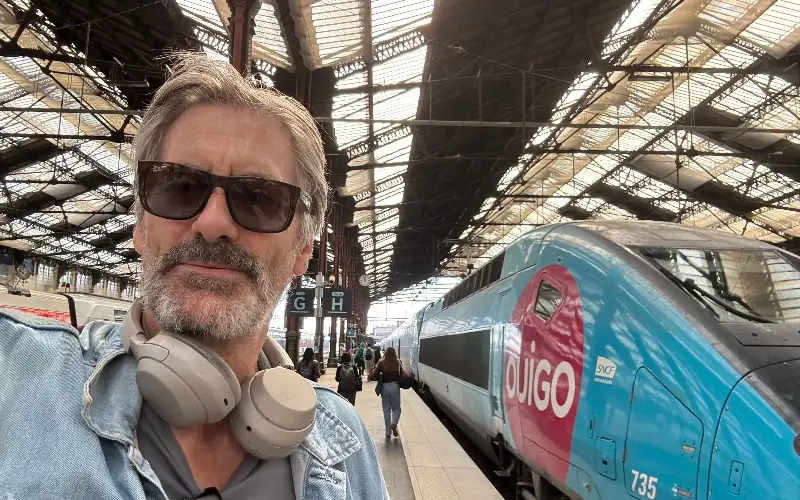
Fans of long railway journeys have been handed an early Christmas present with the resumption of regular passenger trains between Tornio in Finland and Haparanda in Sweden. Though the two towns are just a couple of kilometres apart, they were recently connected by rail for the first time in 38 years, which means the longest continuous railway journey in the EU has become a little longer.
Take a train from Kemijärvi, in Finnish Lapland, to Lagos in south-west Portugal, and you can travel almost 4,000 miles without leaving the EU, and with only the occasional change of platforms. One railway enthusiast, Jon Worth, has completed the journey in a speedy 125 hours and 31 minutes. I decided it would be far more enjoyable to complete it over the course of a month, using a £245 second-class Interrail pass to travel through seven countries on 16 different trains, and pausing at 15 destinations.
Along the way, I discovered that European rail travel is more extensive, less prone to delays and mercifully free of the endless droning announcements and complicated ticketing that can make British rail travel such a chore. Overall, it offers a more civilised, effortless way to travel. Here are some of the highlights from my trip, and what is sure to become one of Europe’s great rail adventures.
Sweden’s uncrowded trains make light work of vast distances
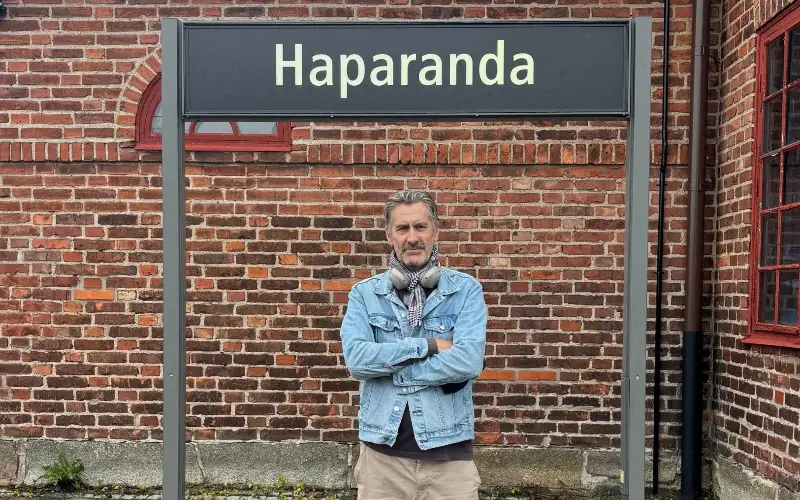
The Finnish town of Tornio and Haparanda in Sweden face each other across the mighty Tornio river, forming a closely connected cross-border neighbourhood. Because Finland is one hour ahead of Sweden, crossing the river by train involves entering a different time zone as well as another country. Distances in Sweden are vast, so it’s worth taking advantage of the country’s extensive rail network to explore a part of northern Europe rarely visited by Britons.
Unlike the Finns, who could be quite standoffish, the Swedes I met on board were friendly and exceptionally helpful whenever they caught me staring blankly at a train timetable. I began the Swedish leg of my adventure in a rustic cabin overlooking the river before boarding one of the smart blue-and-yellow Norrtåg trains from Haparanda, heading south.
The 1,500-mile journey down Sweden’s east coast passes through vast emerald forests punctuated by wide glinting lakes. I upgraded to first class, which included free coffee and snacks, although Wi-Fi was generally patchy on most trains. Along the way, I stopped at historic towns such as Sundsvall, Sigtuna and Luleå, home to the Norrbottens Järnvägsmuseum, with its remarkable collection of antique rolling stock.
Before crossing the 10-mile Øresund Bridge that links Sweden to Denmark, it’s worth spending a couple of days wandering the medieval university town of Lund, with its haunting 11th-century cathedral. Trains were exceptionally comfortable with wide seats, and they were also some of the least crowded.
Where to stay
In Sundsvall, Elite Hotel Knaust offers large, comfortable rooms in a grand setting. Doubles from £68. In Sigtuna, Sigtunastiftelsen Hotel has the feel of an Italian monastery and overlooks Lake Mälaren.
Hamburg is a rail lover’s paradise
Opened in 1906, Hamburg’s stunning Renaissance Revival Central Station is an incredible feat of engineering. Built without interior supports, its gargantuan glass-and-iron platform-hall roof, spanning 240ft, floats high above the bustling concourse.
The city itself is also a must for rail enthusiasts. Several underground stations have been transformed into striking art installations, including HafenCity Universität, where 12 enormous glass cubes hang above the platforms, each containing hundreds of LED lights that change colour every few minutes, flooding the concourse in atmospheric shades of red, green and purple.
At the Speicherstadt warehouse district, I had my nerdy mind blown by the world’s largest model railway, with a track layout measuring more than 51,500ft. More than 1,230 digitally controlled trains haul 12,000 carriages through myriad landscapes, all overseen from a visible glass control room where a team of model railway experts keeps all that miniature rolling stock on track. The display opens daily from 9am (8am on Saturdays). Arrive early to avoid the crowds.
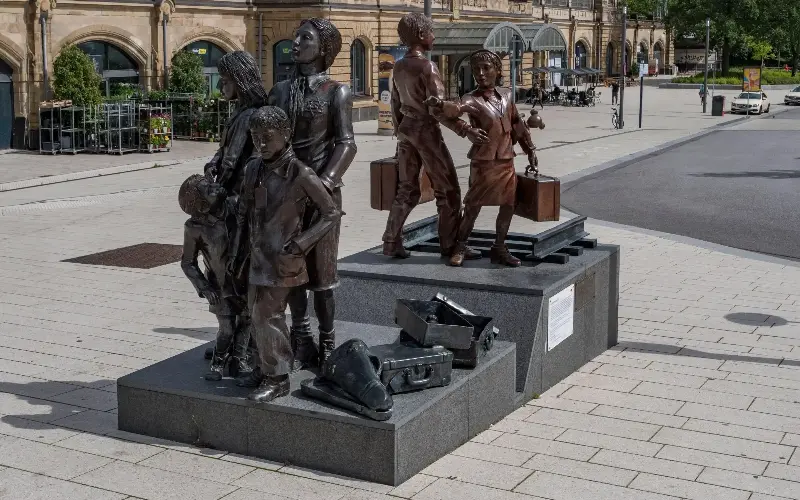
From Speicherstadt, it’s a pleasant metro ride to elegant late-19th-century Dammtor station, from where children were evacuated to safety during the Second World War. The Kindertransport memorial outside the main entrance remains a touching tribute.
I expected German trains to be punctual, so I was surprised when locals complained about late departures. Despite this, Deutsche Bahn’s signature high-speed Intercity Express (Ice) trains can sell out quickly, so it’s worth booking tickets well in advance.
My connection from Hamburg to Strasbourg was cancelled at the last minute, which led to a scrum as passengers piled on to the next available service. Bear in mind, it isn’t always possible to move between carriages, so if, like me, you book a seat but then find yourself in the wrong carriage, you could end up standing for the duration.
Where to stay
In Hamburg, The Fontenay, voted the best hotel in Germany in 2025, is a short walk from Dammtor station and has spectacular views across Alster lake to the city beyond. Doubles from £578.
France’s newly refurbished TGVs and station hubs are a revelation
SNCF, France’s rail operator, began refurbishing its high-speed TGV rolling stock in 2023. The sleek new interiors feature upgraded seating, modern LED lighting (replacing harsh neon strip lights) and stylish new bar areas serving decent food and beverages. On Ouigo, the budget arm of SNCF, Wi-Fi isn’t included, although access can be purchased separately for around €3 (about £2.50).
Before embarking on the 300-mile journey from Strasbourg to Paris, I took some time to admire Strasbourg’s striking modernist station, which has become a symbol of France’s sometimes uneasy relationship between old and new.
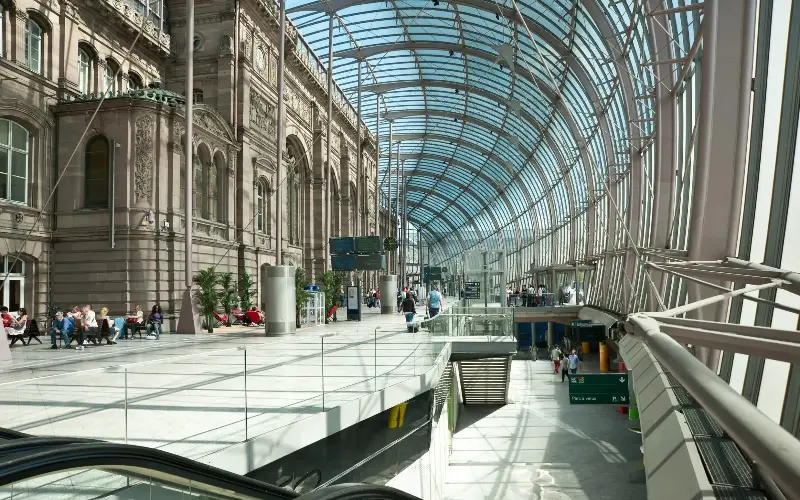
Built to coincide with the arrival of the TGV in 2007, architect Jean-Marie Duthilleul encased the original 19th-century neo-Renaissance façade inside a huge glass canopy. The UFO-style structure caused controversy at the time, with locals complaining that the original building had been obscured. Yet there is plenty to admire, particularly at sunset, when sunlight bounces off the elegantly curvaceous glass structure, bathing Place de la Gare in a warm orange glow.
A more direct route that doesn’t involve a change of stations – heading south from Strasbourg to Geneva, via Basel and Bern, and then to Perpignan via Lyon and Nîmes – is possible here, but as I was keen to stop in Paris, I detoured.
It took less than two hours to reach Gare de l’Est, which also received a major overhaul that includes modernisation works and new passenger facilities. I continued my journey, boarding a comfortable but crowded train to Barcelona, from Gare de Lyon, where the monumental Belle Époque façade and clock tower are undergoing their own £17m facelift.
Where to stay
In Strasbourg, the Hotel Tandem has fine views of the station at sunset. Doubles from £96.
In Paris, the Hotel de Crillon, once one of Marie Antoinette’s playgrounds, occupies a neo-classical palace commissioned by Louis XV. It’s a pleasant stroll to Gare de Lyon along the Seine. Doubles from £1,415.
The scale of Spain’s high-speed network shows up Britain’s shortcomings
The safety of Spain’s high-speed trains has been put under the spotlight following two fatal crashes on the Madrid-Seville line. These are tragic blots on the record of what many consider to be the Continent’s best – and certainly most extensive – high-speed rail network.
It covers more than 2,400 miles, compared with Britain’s paltry 67, with trains reaching speeds of up to 200mph (slightly faster than our HS1).
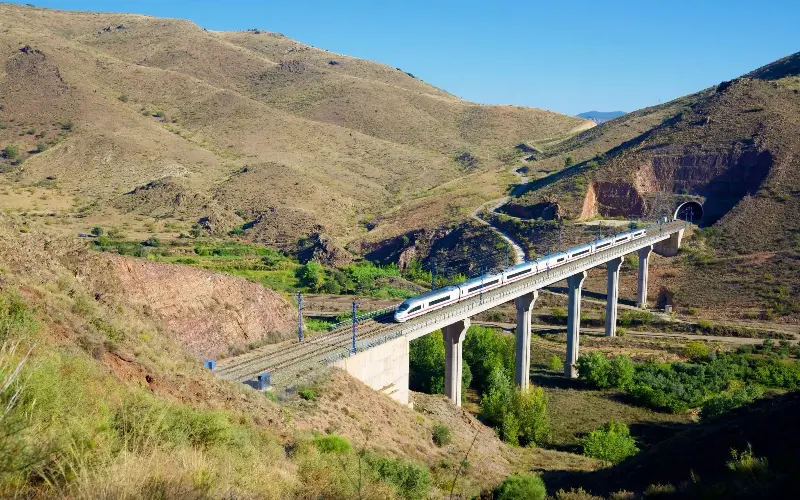
Four different high-speed brands actively compete on the exact same tracks. This fierce rivalry has caused ticket prices to plummet, while driving up service quality and frequency. A one-way trip between Madrid and Barcelona, for example, can be as low as €7 (£6). The 380-mile journey passes through a wonderful variety of landscapes, from the rolling Catalan hills and arid Monegros desert to the sweeping Castilian plains north of Madrid. Expansive views are guaranteed.
Major projects are under way to upgrade some of the country’s principal rail hubs. At Barcelona Sants, a £350m architectural overhaul is turning what was once a grim slab of 1970s utilitarianism into an eco-friendly, light-filled cathedral to transport. Set to open at the end of 2026, the new station will be renamed after opera singer Montserrat Caballé.
In the capital, a £1.3bn project linking Madrid’s Atocha and Chamartín stations will, once completed, eliminate the need to change stations on some journeys through the city. No wonder rail travel in Spain is booming, with passenger numbers at a record high. Bear that in mind when booking tickets.
Where to stay
In Barcelona, the Nobu Hotel, directly opposite Sants station, has a rooftop bar with 360-degree views across the city. Doubles from £210. Or try Casa Bonay, with rooms from £114.
In Madrid, the Four Seasons occupies one of the city’s most ornate buildings and is only a few minutes’ walk from the city’s main stations. Doubles from £593.
Portugal’s eccentric local trains are bags of fun
Direct rail services between Madrid and Lisbon came to an abrupt end in 2020 when the overnight Lusitania was suspended during the Covid-19 pandemic. Plans for a new high-speed link between the capitals have now been shelved until 2034 because of infrastructure hurdles, funding constraints and differing national priorities.
As a result, this is likely to be the most time-consuming leg of your journey – which isn’t necessarily a bad thing if, like me, you enjoy slow travel. It took me more than nine hours to complete the 390-mile trip, but with multiple transfers, slower local trains and the occasional breakdown, it could take even longer.
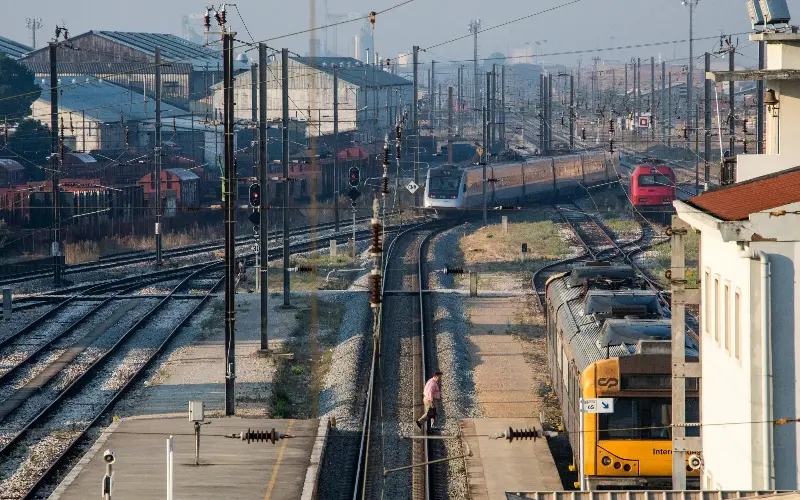
Local rolling stock tends to be quite basic, with no Wi-Fi, air conditioning or buffet car, so bring a packed lunch (Portuguese rissois pastries are delicious and filling), light clothing and plenty of data.
The rickety old train I was travelling on ground to a halt between the remote towns of Badajoz and Entroncamento. After much futile knob-twiddling, the furious driver had to reverse the train all the way back to Badajoz, where another ancient engine hauled us to Lisbon, my penultimate destination.
Despite the inefficiencies, I fell in love with Portugal’s colourful local trains, with their psychedelic upholstery, old-school slam-shut doors and eccentric locals clutching an assortment of pets. Breaking down in the middle of nowhere only added to the sense of adventure.
Where to stay
In Lisbon, Santa Clara 1728 is a stylish boutique hotel in the heart of the Alfama, a 10-minute stroll from the station. Doubles from £408.
The sunny Algarve is a lovely place to end up
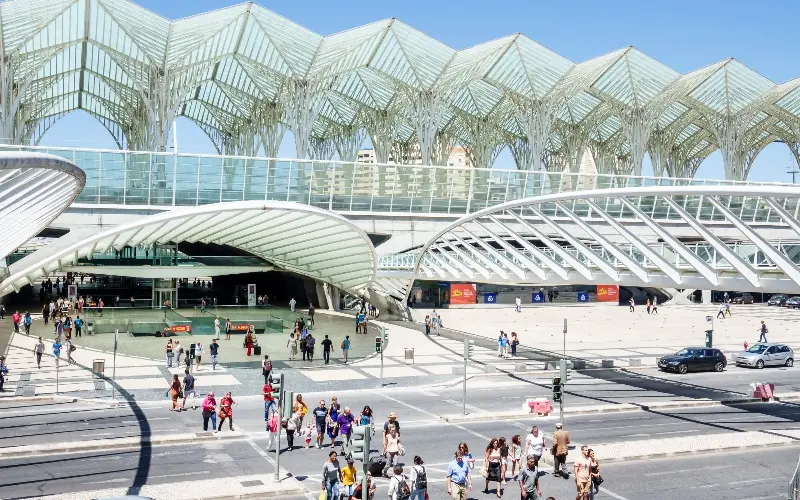
Designed by acclaimed Spanish architect and engineer Santiago Calatrava, Lisbon’s Oriente station is one of Europe’s most striking public buildings. Commissioned for the Expo ‘98 World’s Fair, it is a fine example of Structural Expressionism, fusing cutting-edge engineering with a soaring canopy of interlocking steel-and-glass, tree-like structures that form a continuous transparent roof grid.
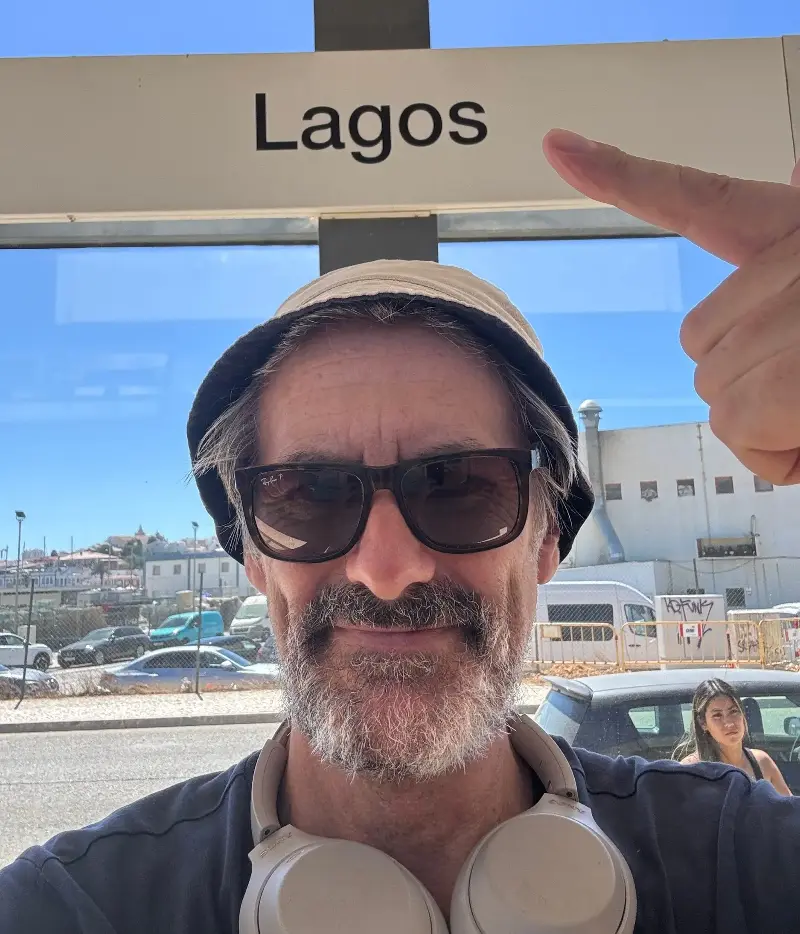
I could have spent all afternoon wandering the station’s sun-dappled concourses, but another local train was waiting to chug me south to my final destination. The charmingly laid-back town of Lagos lies on Portugal’s south-western tip, at the end of a gently undulating coastline dotted with exotic resorts and long, sandy beaches. It all felt a long way from Finland’s icy terrain, from where I began my pan-European rail adventure.
Where to stay
In Albufeira, along the coast from Lagos, the 3HB Falésia Beach Resort is right on the sand. Doubles from £201.
In Faro, a little further east, the Occidental Hotel, in the heart of the old town, has a rooftop restaurant and pool overlooking the marina. It’s a short bus ride to the airport for your return journey to Britain. Doubles from £75.
The enduring pleasure of long-distance rail travel
If you love the romance of rail travel and can make time to tackle all 4,000 miles of this epic odyssey, you won’t be disappointed. The magic for me lay in watching Europe’s extraordinarily varied scenery unfurl, with remote Scandinavian forests giving way to fairytale German villages, French vineyards, vast Spanish plains and, finally, the sun-baked beaches of the Algarve.
After a month on the rails, I was reminded of why long-distance train travel remains such an enduring pleasure. Unlike flying, reaching your destination becomes secondary to the journey itself. Time slows, perspectives shift, thoughts deepen. A constantly changing backdrop encouraged me to relish every moment.