



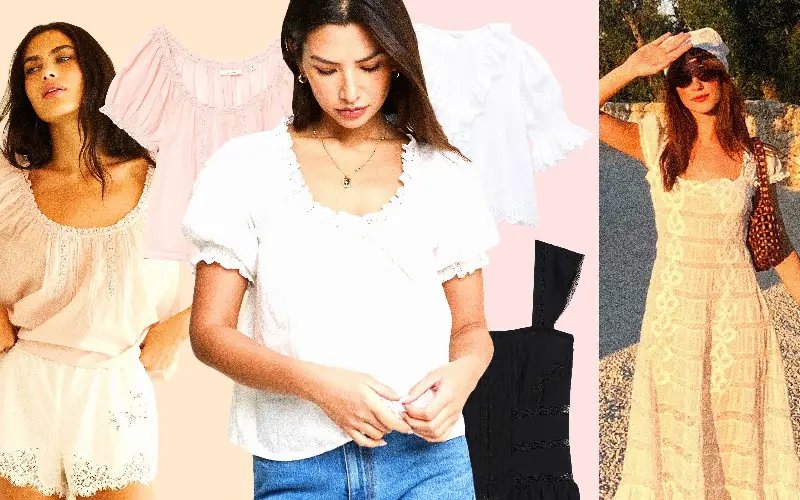
I’m in Edinburgh, some time in the late Nineties, and running late to meet a friend when I hear an insult that’s witty and embarrassing in equal measure. “Oi, Heidi!” a man shouts from across the street. “Where’s yer goat?” It was the last time I dressed in any way that might conceivably resemble a milkmaid...
Until this summer. What changed? Certainly not my ability to pull off one of fashion’s trickiest looks. If I failed 30 years ago, it’s surely utter folly to try again now, in the throes of midlife, when few things have the potential to look more tragic than cosplaying a fictional Alpine goatherd in a beloved children’s story.
To be candid, what changed was that I decided to stop apologising for – and hiding – my cleavage, a lifelong endeavour prompted by a desire to avoid men talking to my chest.
While it shouldn’t be this way, any woman with a generous décolletage will tell you that low necklines can’t be worn without some thought. As myriad takes on milkmaid dressing as there are, the one thing they have in common is their focus on the décolletage, courtesy of the low, square neckline that typifies the look.
To bare this much cleavage can feel like a leap of faith, although the right bra (one that flattens rather than pushes up) can work wonders.
Avoid anything too infantilising
But enough about cleavage: let us move on to the practicalities of being a midlife milkmaid. Liv Purvis, the author and content creator, suggests that a good starting point would be a puff-sleeved white cotton blouse.
“These can be styled in many ways, and always feel romantic, rather than costume-like. A ruched midi-dress would be another good pick. The key is to offset your choice with pieces that feel a little more modern, such as a simple flip-flop or some Bermuda shorts, to stop the look feeling too twee.”
For an affordable take, Purvis suggests Nobody’s Child (“they have the best white broderie blouses this season”) as well as Straw London (“they do amazing co-ords and vintage-inspired dresses”).
Cotton linen blend dress, £145, Straw London
Regardless of age, success will ride on an ability to nod to the look, as opposed to faithfully recreating the milkmaid on a tub of Rodda’s Clotted Cream. In this, it might be wise to avoid any ridiculously puffy sleeves: too infantilising. Likewise, avoid any notion of an apron.
Before you roll your eyes and sigh “as if”, let me tell you about the woman I saw marching purposefully along the Northern Line platform last weekend, dressed in a pale blue milkmaid dress adorned not merely with puff sleeves, but also little pink bows. She’d also layered a corset on top, laced up with pink ribbon. All that was missing was a crook.
The label making milkmaid dressing modern
For a subtler, more modern take, look to Daisy Edgar-Jones. At 28, she’s hardly a midlife woman, yet the pretty white milkmaid dress she wore on holiday earlier this month (shared on Instagram) would look good at any age. Though perhaps lose the matching headscarf, or swap it for a wicker bucket hat.
Her dress is by Dôen, the niche Californian label that seems to be owning summer. Its milkmaid tops (from £168) and dresses have distilled the essence of the trend into something soft and wearable, with just the right amount of whimsy.
If you’re milkmaid-curious, Dôen would be a wise first stop: it has a surfeit of tops in linen, gingham and broderie anglaise, with sleeve styles to suit every arm shape. Another good call is Skye by Brora (currently on sale, with up to 40 per cent off).
The surprisingly political history of milkmaid dressing
Sweet as the milkmaid trend may be, it would be remiss not to mention its sourer tradwife connotations. Tradwife influencers such as Nara Smith and Hannah Neeleman (who posts as Ballerina Farm) are frequently pictured wearing milkmaid garb, playing up the bucolic archetype.
But as Karolina Żebrowska, a fashion historian and author, points out, they omit the dark sides of the source material: the exhaustion that comes with devoting your life to family, and the isolation that a rural life can engender.
“In the 18th century, the aesthetised image of real-life working women inspired a genre of portraits, in which rich and influential women cosplayed as shepherdesses and milkmaids,” she says, noting that Marie Antoinette was one such fan.
“This fascination with the simple lives of peasants was fuelled by the naturalistic philosophies of Jean Jacques Rousseau, but also by a political storm brewing on the horizon. Not long after, the same shepherds and milkmaids that Marie Antoinette was enchanted by came for her head.”
Perhaps it’s no coincidence that milkmaid dressing peaks in specific economic circumstances. “We also saw milkmaid-style dresses having a revival in the Seventies, a decade of economic crisis, recession and rising unemployment rates,” says Żebrowska.
“It’s also likely why cottagecore boomed during the Covid lockdowns, another time of massive uncertainty. When the present starts feeling too uncomfortable, the only place left to go is the past. ‘The good old days’ become not just an aesthetic, but a symbol of slower living and clearly set rules and roles.
“To some, this signifies safety. In a summer dampened by military conflicts, job insecurity and unprecedented heatwaves, it’s possible that women are craving some sort of escapism and lightness.”
Sienna Miller’s secret ingredient
Or maybe there’s a simpler explanation: Sienna Miller. She almost single-handedly pioneered the boho trend in the early 2000s: is it so far-fetched to say she’s doing the same with milkmaid dressing?
She might be a 44-year-old mother of three, but Miller is also Petra Pan, forever destined to look younger than her years. I don’t think I could pull off her red-and-white checked gingham dress, but I love her confidence in wearing it.
Maybe that’s the most important ingredient of all: not gingham, not ruching, but confidence. I’ll raise a glass of milk to that.