



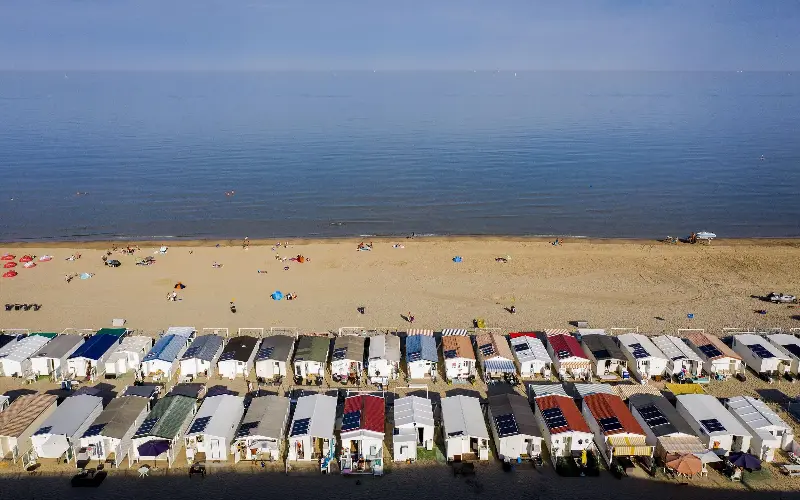
Picture your toes sinking into deep, white sand, powdery soft and stretching further than the eye can see (more than five miles, in fact). You’d have to be in the Caribbean or the South Pacific for this, surely? Well, actually no. There’s a train to this perfect beach and, rather unexpectedly, it takes less than half an hour from the centre of Amsterdam.
And, while the sea temperatures here might not compete with those in Nice, Fiji or Barbados, that appears to be no hindrance to the multitude of sailors, surfers and, yes, even swimmers who take the plunge into the North Sea.
While the very notion that the city of Amsterdam possesses such glorious beaches may come as news to most Brits, Zandvoort (literally “sand ford”) made its name more than a century ago when a poor and isolated fishing village found itself transformed into one of the most prestigious seaside destinations in Europe.
Laid out with the grandest hotels, formal gardens and a wide promenade, it was favoured by the cream of European society. Kaiser Wilhelm visited in 1932 (it made the German newsreels), while the Empress Elisabeth of Austria (Sisi to her friends) returned many times – she particularly enjoyed taking a fishing boat out onto the North Sea and walking in the dunes.
Where previously horses had dragged those fishing boats into the water – Zandvoort has no harbour or quayside – mobile bathing huts took the aristocracy for a spot of sea bathing, wildly popular in the 19th century for its health benefits. Hotels sprang up: the Driehuizen was the first in 1826, followed by the jewel in the crown of the town’s health tourism, the Groot Badhuis (Great Bathhouse) in 1828, a neoclassical monument in the dunes.
Later, Hotel d’Orange and the Kurhaus appeared, equipped with all the latest mod-cons (lifts!), the latest in spa treatments and fine dining, though the Empress still had her food sent from the best hotels in Amsterdam. Basketwork seats known as strandstoel surrounded their occupants with a curved roof and sides that protected them not just from the sun but from the wind, too – it can get quite breezy along this coastline.
And, a few decades later, in 1948 in fact, the Circuit Zandvoort was built. It was home to the Dutch Grand Prix for decades and, in 2021, had a brief renaissance when it hosted that year’s Formula One World Championship.
This bubble of glamour was, however, fated to burst. The war and the German occupation overshadow Zandvoort’s history and were to change its face forever. In the town’s small, delightful museum, the most poignant image is the 1940 photograph of a young Anne Frank on the beach, smiling and carefree, perhaps for the last time in her short life.
The arrival of the Germans saw not just the removal of the local Jewish community but later the majority of the town’s population, along with the destruction of its former magnificence. Those buildings that had withstood fire and storms were demolished and bunkers replaced bathhouses and boulevards. Today, not one of those grand 19th-century hotels remains.
Luckily, there are many towns along this coastline that suffered less and retained their historic charms. Edam is famous not just for its cheese but its huge Grote Kerk (church), with a soaring vaulted ceiling built to resemble an upturned boat and its network of canals along which a local barge can carry you past the prettiest of garden terraces, red-roofed alms houses, families of floating grebes and weeping willows.
Further along the coast is Hoorn, its harbour guarded by a fine fort and Dordrecht, a mini-Amsterdam with tall gabled houses (many of them leaning perilously) and cobbled streets. Just inland from Zandvoort (it’s 15 minutes by train) is Haarlem, New York’s Harlem namesake, and a lovely town with a huge medieval square that houses an excellent Saturday market and the Church of St Bavo where a young Mozart once played the organ.
There are, of course, windmills – including at Cruquius, where you’ll also find the largest beam steam engine housed in a wonderfully Victorian Gothic tower. It’s all that’s keeping your feet dry here, being some four metres below sea level – a third of the Netherlands is, in fact, below sea level. An immensely knowledgeable guide will not only give you a physics lesson but turn on the extraordinary engine and you can watch its monstrous power as the water levels change outside.
Of course, there is a lot of water in the Netherlands, and while drainage has always been the country’s principal concern, the water itself has been repurposed in some surprising ways. At Kunstfort bij Vijfuizen, the fort is one of 42 built in a circle around its outskirts to defend the city of Amsterdam. If an enemy – Spanish, French, German – had invaded, they had the possibility to stop the pumps and use the ensuing flood to bog them down along with their horses and weapons of war in deep mud. The forts that now make up the Unesco World Heritage Site of the Amsterdam Defence line were, however, never needed and a shot was never fired in anger at any of them.
Back in Zandvoort, the town itself may have changed, but its nearby sand dunes have not. Arguably one of the most beautiful parts of the entire country, this vast area has mountains of sand (certainly by Dutch standards) and now comprises 15 square miles of nature reserve, edged by forest and, of course, the sea.
There are pathways and, naturally, cycle tracks (this is Holland) criss-crossing the entire area. There is, too, a surprising amount of wildlife with over 200 species of birds, including sea eagles and crossbills as well as herds of Konik horses and, somewhat unexpectedly, Highland cattle.
Wisents live in the Kraansvlak area of the reserve – European bison up to two metres at the shoulder – and the fallow and roe deer are everywhere (deer sightings are pretty much guaranteed). Windless, scented with pine and wild flowers, it is silent but for the birdsong, a mesmerisingly calm oasis just half an hour away from one of Europe’s busiest capitals.
Essentials
Eurostar operates direct services between London St Pancras and Amsterdam Central, with journey times from 4 hours 19 minutes, starting from £39 one way.
Amsterdam Beach Hotel Zandvoort has doubles from £125 per night.
For interesting ideas and practical travel information about the Amsterdam region, see iamsterdam.com.