



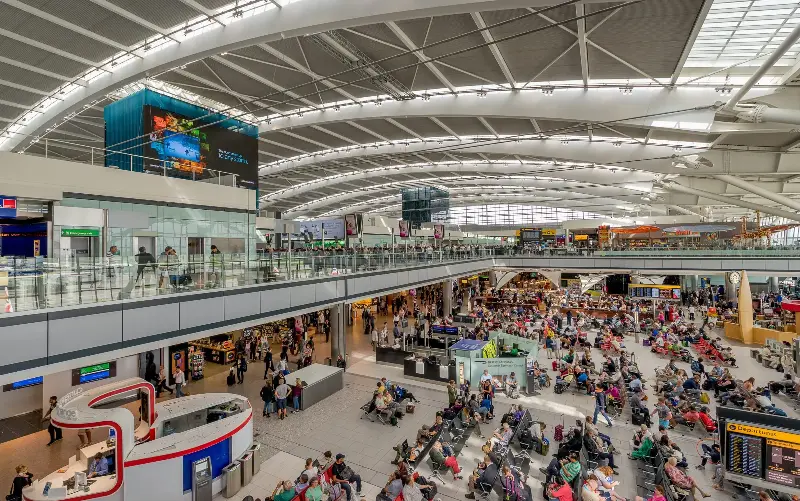
When writing about London Heathrow (LHR), for decades the “second mention” was never a problem. LHR was “the world’s busiest international airport”. That was aviation shorthand for the airport that handled more international passengers than any other (Atlanta, with many domestic travellers, was always ahead in terms of sheer volume of people). By 2014, though, Dubai International (DXB) had eclipsed Heathrow on that measure; even this summer, with traffic traumatised by the Middle East conflict, DXB expects to handle more international passengers this month than LHR.
For the past dozen years, the reflex phrase has been “Europe’s busiest airport”. Initially Heathrow’s only relevant rivalry for that title comprised Paris CDG, Amsterdam and Frankfurt. But in 2019 Istanbul’s new airport opened (IST). The growth of the new Turkish hub was stifled by Covid (as was Heathrow, which briefly, in July 2021, slipped to an unprecedented 17th in the European chart).
But during 2024 and 2025, Istanbul emerged as the chief challenger to Heathrow. Figures for the first half of this year show that the British contender was just 445 passengers – a couple of planeloads – ahead each day from January to June. But Heathrow’s numbers are shrinking, while Istanbul expands relentlessly. From this month on, I calculate that IST is now first.
Heathrow handled 1.8 per cent fewer passengers in June. The reason given: “The continued suppression of Middle Eastern traffic.” Yet Istanbul is also highly susceptible to geopolitical conflict: the route to and from Dubai is one of its busiest five, as it is at the UK hub. In the early weeks of the conflict, Heathrow benefited from the near-total shutdown of the key Gulf airports, with an increase in transfer passengers. But now the suspended links on British Airways and Virgin Atlantic to the United Arab Emirates, Qatar and Saudi Arabia are visibly affecting the statistics. Move over, Heathrow.
What lies behind the decline? Last month, at least, it was because of some meteorological bad luck. Over the last weekend of June, thunderstorms led to the cancellation of around 150 British Airways flights, representing perhaps 25,000 fewer passengers at Heathrow. When disruption afflicts LHR, operations unravel swiftly because there is almost no slack in the system.
UK airports are also at a geopolitical disadvantage on routes to and from Russia. Turkey has no qualms about flights to and from the world’s biggest nation, on carriers from both nations. In the hour from 4.30am this morning at, ahem, Europe’s busiest airport, six flights arrived from Russia. Istanbul’s second-most popular route is to and from Moscow’s Vnukovo Airport.
Noise restrictions also play a part. There were no arrivals or departures at Heathrow at 4.30am, because of a noise curfew designed to ensure a semblance of sleep for residents. Paul Griffiths, the British-born chief executive of Dubai Airports, and former boss of Gatwick, believes that round-the-clock operations at the London hub would transform its fortunes. He does not, however, need to be elected by the people of west London and Berkshire, whose slumbers would be even more disturbed than they are now.
Heathrow’s main handicap, though, is capacity. In terms of flight movements, it is the busiest two-runway airport in the world – even with the overnight closure leaving those precious landing strips empty for hours. In contrast, Istanbul has three main runways that can be used simultaneously around the clock. With more capacity being built, limits to growth are a decade or two away.
Bosses at Heathrow are sure to cite its relative decline as more evidence that its absurdly delayed third runway should finally be built. Yet the incoming Andy Burnham regime – especially if Ed Miliband becomes chancellor – may feel less well-disposed towards the controversial expansion plan than were Sir Keir Starmer and Rachel Reeves. Even if the project gets approval from the new occupants of Downing Street, there is little prospect of any extra flights until the late 2030s.
Where does this leave the confused passenger trying to fly to, from or via London? Bluntly, paying higher fares and having less choice than would prevail if a sensible amount of capacity were available so that market forces could operate freely. Yet despite the toppling of Heathrow, the city remains the global capital of aviation. London’s scattering of airports collectively handles far more passengers than Istanbul, Paris, New York, Shanghai and others.
Gatwick, the second-busiest in the UK, is moving towards becoming a one-and-a half-runway airport by the end of the decade. The standby runway is to be shifted north, allowing take-offs of smaller aircraft only, while all inbound planes and larger jets use the existing main runway. That will add about 40 per cent more capacity for a modest couple of billion. Expansion may even allow the Sussex airport to have another go at becoming a hub airport, for example permitting seamless connections between easyJet flights.
Luton, Stansted and plucky Southend are also expanding. Heathrow is in relative decline even against these no-frills airports.
Yet there is a silver bullet that would allow Heathrow to open up hundreds more take-off and landing slots without trespassing on the night curfew. The secret is “mixed mode” operations. At present, one runway is used for departures and the other for arrivals (apart from 6-7am, when landings are allowed on both). They switch over at 3pm to give some respite to residents. While intuitively this looks sensible, it limits capacity. Gatwick extracts much more from its single runway, allowing up to one landing or take off per minute. Applying the same principle at Heathrow could unlock at least 15 per cent more capacity – around 200 more movements per day.
Heathrow is not pursuing this strategy; it would impact the lives of millions living near the airport. But no other major “dash for growth” would require such little investment but deliver such vast returns. IST would swiftly slip to second. But its leading international air route would remain the same: Istanbul to Heathrow.