



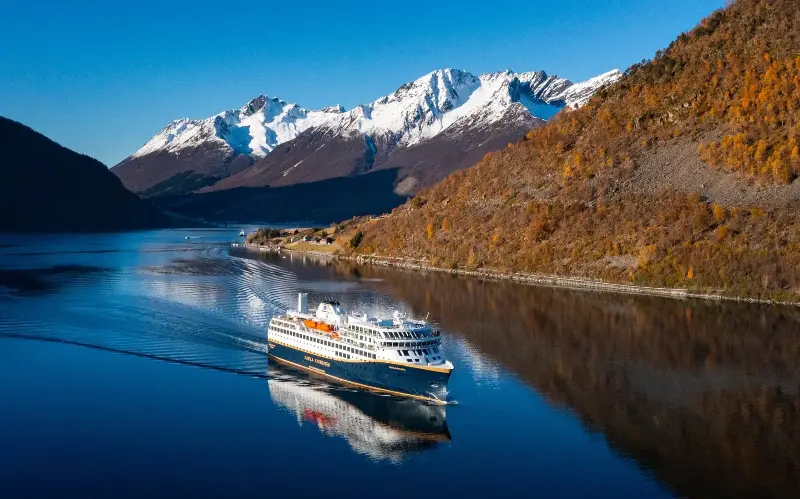
Onboard the Havila Polaris as we sailed towards Bergen, I found an embossed invitation to that evening’s “biogas onboarding.” As ship invites go, this was a first.
The event marked an illustrious day for the cruise line: its first fully biogas-fuelled, round-trip sailing on the line’s popular voyage along Norway’s scenic coast.
Havila has ambitious goals for emissions reduction – like many cruise lines, it is turning its attention towards sustainable fuel solutions. By 2028, it aims to operate solely on biogas that is sourced and produced along the Norwegian coast. So, in November, I went on board to see its latest contribution to the green transition.
The atmosphere on deck was upbeat, as a boat alongside Polaris was feeding the gas to the ship’s engine. The ship’s captain Kurt Harald had joined the celebrations, and I clinked glasses with one of the biogas suppliers, Gunnar Helmen, a director at Molgas Energy, who told me he had been waiting 13 years for this milestone sailing.
Havila’s hybrid fleet is powered by a combination of battery power and liquefied natural gas (LNG). Although it is a cleaner alternative to traditional marine fuel, LNG is still a fossil fuel. Hence the introduction of biogas – Havila’s latest move in the industry-wide march toward carbon-neutral cruising.
How it works
The biogas being used to power the company’s ships is produced from organic waste – such as “food waste, livestock manure and fish sludge,” said Bent Martini, CEO of Havila Voyages.
The technical term is Liquified BioGas (LBG), created through a process that separates CO2 from methane, which can be used as a replacement for conventional natural gas.
“Methane is around 28 times more potent than CO2 as a greenhouse gas if it escapes into the atmosphere,” said Martini. “By capturing that methane from organic waste and converting it into fuel, Havila Voyages prevents harmful emissions while replacing traditional fossil fuels.”
Once the gas is extracted, the remains become a nutrient‑rich bio‑fertiliser that contributes towards a more circular infrastructure. “Biofuel is a win-win because everyone benefits, including farmers,” shared biogas supplier Helmen.
The cruise
After the excitement of embarkation day, it was business as usual on the coastal voyage. On the full itinerary, the ship calls at 34 ports – including Alesund, Bergen and Tromso – and crosses the Arctic Circle, with activities including giant crabs fishing through holes in the ocean ice. Winter or summer, it’s worth heading out on deck to watch remote coastal settlements hove into view and to see the impressive stockfish (Arctic cod) drying racks further north.
On Havila Polaris I found plenty of cosy places to watch mountains, glaciers and weather-beaten islands slide by. Lounges, bars, and restaurants look out to sea, always keeping nature at the heart of the voyage. To reduce food waste, the à la carte menu at all-day dining venue Havrand offers a choice of dishes served as generously portioned small plates. In the evenings, I joined fellow passengers in the observation bar for an elderflower cider and a peer at the night sky through the bar’s glass roof.
In Alesund, a small city known for its art nouveau architecture, I joined a paddle along the Brosundet canal and into open water to enjoy views of light-coiled fishing boats in the harbour and trees and rooftops bristling under a fresh coat of snow.
More nocturnal magic awaited in the harbour, where the tour concluded with a floating sauna and cold plunge – a long-time favourite pastime in the Scandinavian region. I slipped in and managed an eight-minute swim before diving into the sauna for a restorative sizzle.
Our first port stop above the Arctic Circle was in Bodo, a European Capital of Culture in 2024, where I joined an Arctic beach walk. We were soon strapping spikes on to our boots and striding through littoral woodland with our guide, Aleksander.
“Bodo gets more daytime light than anywhere else in the world,” he said. “Although the sun never rises during the polar night, it’s possible to see sunlight just below the horizon even in December.”
We walked towards a Viking grave and craned our necks to see a pair of sea eagles overhead. Before we returned to the ship, Aleksander handed around glasses of meadowsweet mead – what he called “Arctic spirit”.
The future of sustainable cruising
Months after my time on the inaugural biogas sailing, Havila Voyages sent me the results from the switch in fuels. The voyage delivered a 95.5 per cent reduction of CO2 emissions, compared with a sailing run on natural gas – an even better result than the company predicted.
“This was a breakthrough for green shipping. The technology works – and we now have the evidence in black and white. This is big news, both for us and the entire sector,” said Martini.
When I asked Molgas Energy director Gunnar Helmen about the future of sustainability in the cruise industry, he seemed hopeful. “Right now, we are looking for progress, not perfection,” Helmen told me. “What we emit today we can’t take back tomorrow.”
Essentials
Teresa Machan was a guest of Havila Voyages. An 11-night round voyage (Bergen-Kirkenes-Bergen) departing November 17, 2026; costs from £1,771pp for a sea-view superior double cabin.